|
|
|
#1
|
|||
|
|||
|
How often is Venus this high?
No, I'm not talking about Gorden "Venus Flytrap" Sims from the TV show WKRP in Cincinnati... who was likely high all the time.
For the past month or so it seems to me that Venus has been astonishingly high in the sky. When I leave home for work at about 6:20 a.m. Central Time (US) it's nearly 45 degrees up from the horizon (in the eastern sky, obviously). [angle calculated very roughly from measuring three hand-widths high at arms length] Logic tells me that Venus would appear highest in the sky when the angle formed by the three points (Venus, Sun, and Earth when viewed from "above") is 90 degrees. Is this assumption true? And are we at or near this maximum? The Venus year lasts 224 days. With the Earth year of 365 days, can anyone calculate how long it is between maximums?
__________________
"Time flies like an arrow, fruit flies like a banana." (Groucho Marx; but also used to test a language recognition algorithm) "The essential is invisible to the eye." (The Little Prince) |
| Advertisements | |
|
|
|
|
#2
|
|||
|
|||
|
Actually, Venus goes completely 90 degrees to the horizon. But, I assume you mean before the Sun comes up.
To calculate when and where to look for Venus, try downloading Planet Visibility 2.0 from http://www.alcyone.de/ It is freeware and I think it does everything you are looking for. |
|
#3
|
|||
|
|||
|
Oh, and to calculate the orbital configuration that will put Venus highest in the sky try this.
Note: The orbits of Earth and Venus are not completely circles, but are close enough to get the general idea. Also, the Sun and planets are not points, their width would affect things slightly as well... but not significantly. 1) Pick a scale for distances. 1mm per million km is pretty convenient. 2) Draw a point to be the Sun. 3) Draw another point to be the Earth. The Earth 149.6 Million km from the Sun or 149.6mm on my suggested scale. 4) Draw a line between the Sun and Earth. 5) Draw a circle with a compass around the Sun to mark the orbit of Venus. Its average distance is 108.2 Million km from the Sun, or 108.2 mm using my scale. 6) Draw a line from the Earth that is tangent to the orbit of Venus. 7) Draw a line from the where the tangent line touches the Venus orbital circle to the Sun. Time to start measuring. 8) The angle formed between the the Earth/Sun line and the Earth/Venus Orbit (Earth point designates the angle) will be very close to the maximum that Venus can be above the horizon at sunrise (or at other times, sunset). 9) The angle formed between the Sun/Earth line and Sun/Venus Orbit line (Sun point designates the angle) will be your "90 degree" angle. You will find that it is somewhat less than 90 degrees. While there will be years when it comes to slightly more or less than the figures you come up with here as the eliptical nature of the planet's orbits come into play, this should give you a pretty accurate description of things. |
|
#4
|
|||
|
|||
|
If memory serves, Venus is never more than 48 degrees of longitude away from the Sun. scotth's approach would help you determine how far above the horizon this would appear at various latitudes.
The declination of Venus (distance off the ecliptic) at any given time might have some affect on its apparent height in the sky as well. |
|
#5
|
|||
|
|||
|
As for how long between maxima (48-deg separation), I can check it out in my ephemeris when I get home and give you a rough idea.
|
|
#6
|
|||
|
|||
|
scotth, this would be the perfect place to insert a hypothetical smilie indicating that "I bow down to you".
a) You were right in your assumption. My question was how frequently is it this high in the sky and still visible. b) I downloaded that software. It is awesome. It tells me that Venus will first again be visible this high in the morning sky in August of 2004 (viewing from Chicago), 20 months from now. At that time it will reach an altitude of 40 degrees. c) From that software I also see that my rough calculation of altitude was off a bit. It is only 31 degrees high in the sky right now. d) Regarding the relative positions of planets to obtain this maximum... lacking a compass and ruler, I made a rough drawing of the orbits. It appears to me that Venus reaches its maximum when the Earth/Sun and Sun/Venus angle (Sun point determining the angle) is about 40 degrees (?). Makes intuitive sense now that I see it on paper. Thanks for your thoughtful and helpful response. |
|
#7
|
|||
|
|||
|
I didn't preview Jerevan, so I missed your responses.
Is the 48 degree separation you cite, the Venus-Sun-Earth angle, or the Venus- Earth-Sun angle? |
|
#8
|
|||
|
|||
|
Venus is usually visible in the daytime if you know where to look where I live,.
|
|
#9
|
|||
|
|||
|
Algernon, the 48-degree angle puts the Earth at the vertex (Venus-Earth-Sun).
For comparison, Mercury-Earth-Sun angle has a maximum of c. 36 degrees, IIRC. |
|
#10
|
|||
|
|||
|
David, that is interesting. All day? Or just a few hours after sunrise? (or a few hours before sunset when it's visible after sunset)
Is it more a function of where you live? Or that you know where to look? |
|
#11
|
|||
|
|||
|
Thanks for the clarification Jerevan. Where's my trigonometry when I need it. Let's see, we have side-side-angle, right? The Venus-Sun distance. The Sun-Earth distance. And the Venus-Earth-Sun angle of 48 degrees.
So, what is the Venus-Sun-Earth angle? (where my paper drawing showed about 40-45 degrees). |
|
#12
|
|||
|
|||
|
Do you mean, what is the Venus-Sun-Earth angle, when the Venus-Earth-Sun angle is at the maximum of 48 degrees? That would be 90 degrees.
|
|
#13
|
|||
|
|||
|
Jerevan, yes that's what I'm curious about. But I think it's less than 90 degrees. See scotth's point (9) in his post earlier.
|
|
#14
|
|||
|
|||
|
Or, if you're asking how to calculate the Venus-Sun-Earth angle for a given/observed Venus-Earth-Sun angle. . . that's beyond my trig ability.
|
|
#15
|
|||
|
|||
|
I'm not sure I see how it could be less than 90 degrees. I mean, wouldn't the maximum separation of Venus and the Sun as observed from Earth, be a 90-degree Venus-Sun-Earth angle by definition?
|
|
#16
|
|||
|
|||
|
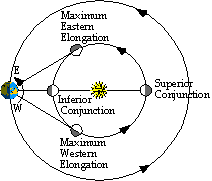
The biggest distance between Venus and the Sun in the sky is called maximum elongation. It occurs when the Earth-Venus-Sun angle is 90 degrees, that is, when a line drawn from Earth to Venus is tangent to Venus' orbit. Handy Illustration.) Since Venus is .723 AU from the Sun and the Earth is 1 AU from the Sun, the Earth-Sun-Venus angle is acos(.723/1)=43.7 degrees.
|
|
#17
|
|||
|
|||
|
Oh, I get it now. I was having trouble visualing/drawing it correctly. Thanks, Podkayne.
By this calculation, then, the maxium elongation of Venus and the Sun (Venus-Earth-Sun angle) is 46.3 degrees. But I suppose the elliptical nature of planetary orbits might mean the maximum observable elongation is somewhat larger (~48 degrees). Yes? |
|
#18
|
|||
|
|||
|
Quote:
If you have a telescope with autopointing and tracking (so it can find Venus for you during the day), it can be quite visible at high noon. |
|
#19
|
|||
|
|||
|
Thanks Podkayne for resolving my somewhat inane question (and supplying the trig that has disappeared irretrievably into the black hole of my memory).
scotth, is Venus typically visible to the naked eye all day? (if you know where to look, and if it's not too angularly close to the sun) |
|
#20
|
|||
|
|||
|
[self-congratulatory hijack]
Heh, heh. My hand-drawn-with-no-tools diagram led me to estimate the angle at 40-45 degrees, and it is really 43.7 degrees. Heh, heh. [/self-congratulatory hijack] |
|
#21
|
|||
|
|||
|
Quote:
NB: What I calculated before was the Earth-Sun-Venus angle. The separation of Venus from the Sun is the Venus-Earth-Sun angle, asin(0.723/1)=46.4 degrees (=90-43.7) Sorry for any confusion. Earth's eccentricity is 0.017 and Venus' is 0.007. To maximize the separation, you'd want Earth to be at perihelion (its closest approach to the Sun) at (1-0.017)*1AU=.983AU and Venus to be at aphelion, at (1+0.007)*.723=0.728 AU, yeilding a separation angle of 47.8 degrees. |
|
#22
|
|||
|
|||
|
Quote:
But, if you have a telescope already pointing at it, you can do it. |
|
#23
|
|||
|
|||
|
Back to the OP, the cycle of Venus-Earth positions cycles about every 584 days. (Yes, that's close to the sum of the length of their years but it's just a coincidence.) That is, conjunctions, etc. occur every 584 days. The maximum elongation in the evening occurs that often as well. So that 584 days from now it will be about where it is now in the sky (from our perspective).
The Mayans were supposedly very keen on this cycle. |
|
#24
|
|||
|
|||
|
Thanks ftg. That coincides with my estimate from the graph of about 20 months.
Did you just know this obscure fact? My amazement of the facts that you Dopers know (or know how to find) is boundless. |
|
#25
|
|||
|
|||
|
Quote:
For my part, I looked up the distance of each planet to the Sun. For the geometric drawing, I just created that in my head. I didn't even draw it for myself. |
|
#26
|
|||
|
|||
|
Quote:
I live on the desert where horizontal visibilities of 100 miles are common. In fact you can visually navigate by air from here clear over past Albuquerque without using a map. From here, when you get airborne a ways, you can see Charlston Peak just west of Las Vegas, NV. Then before you lose sight of that peak behind you, you can see Humphries Peak at Flagstaff, AZ coming up. And before losing sight of that you can see the Sangre de Cristos in New Mexico. It's a good idea to have maps though because you cross the Continental Divide where there can be clouds which restricti visibility even on the desert. |
|
#27
|
|||
|
|||
|
Quote:
365x = 224(x+1) gives the fraction of an Earth orbit for Venus to go around that plus 1 orbit. Multiply by 365, tada. It's a little off from 584 but since the Earth's year is really 365.254 (which I do remember), etc., close enough. I also remember that Venus's orbit is a little over .7 A.U., so I could have roughed out the other calc. in my head too. Not an Astronomer. I just remember stuff. |
|
#28
|
|||
|
|||
|
Quote:
|
|
#29
|
|||
|
|||
|
I happened to know the maximum elongation of Venus -- though I did not know to call it that -- from my astrological work, where the aspects (elongations) between any two planets can have a specific significance, particular those in multiples of 30 or 45 degrees. In my table of interpretations for Sun-Venus aspects, it tells me that the maximum separation is 48 degrees, and therefore most major aspects (60, 90, 120, 135, 180 degress) will never occur between these two.
Incidentally the maximum elongation of Mercury, according to the same table, in 28 degrees, not 36 as I stated earlier from memory. For some reason I always get it wrong that way. At least I'm consistent! |
|
#30
|
|||
|
|||
|
Quote:
|
![]() |
| Bookmarks |
| Thread Tools | |
| Display Modes | |
|
|