The Straight Dope

Go Back   Straight Dope Message Board > Main > General Questions

Reply
 
Thread Tools Display Modes
  #1  
Old 12-06-2007, 08:13 PM
IOMDave IOMDave is offline
Guest
 
Join Date: Nov 2007
Why Are Oranges Segmented?

I was eating an orange tonight and it occoured to me that I have no idea why they should come in handy, easy to eat segments. Is there some sensible reason for this (from an evolutionary standpoint)? I could understand if it wasn't surrounded by a fairly thick, tough, layer holding the whole thing together.

IOMWife thinks it has something to do with each segment providing nutrients for the pips, in much the same way as nut flesh provides fuel for the little bit that actually grows when all is said and done. The oranges we were eating were some kind of funky hybrid that don't have a pip issue, so based on current evidence it seems reasonable, but not definitive.
Reply With Quote
Advertisements  
  #2  
Old 12-06-2007, 08:16 PM
Sapo Sapo is offline
Guest
 
Join Date: Dec 2006
Just like God created the banana, he created the orange. What's so hard to understand? Even Kirk Cameron knows this.

http://www.metacafe.com/watch/114898..._via_a_banana/

ETA: And something about the floral structures and radial symmetry (to give this a semblance of an answer)

Last edited by Sapo; 12-06-2007 at 08:18 PM.
Reply With Quote
  #3  
Old 12-06-2007, 08:31 PM
IOMDave IOMDave is offline
Guest
 
Join Date: Nov 2007
Goodness gracious me...I sincerely hope that that video was intended as a joke on the part of the makers.

Last edited by IOMDave; 12-06-2007 at 08:32 PM.
Reply With Quote
  #4  
Old 12-06-2007, 08:35 PM
jayjay jayjay is offline
Guest
 
Join Date: Nov 2000
Quote:
Originally Posted by IOMDave
Goodness gracious me...I sincerely hope that that video was intended as a joke on the part of the makers.
Nope. Absolutely serious. Kirk Cameron is the Tom Cruise of nutty fundamental creationist Christianity.
Reply With Quote
  #5  
Old 12-06-2007, 09:00 PM
Peter Morris Peter Morris is online now
Charter Member
 
Join Date: Apr 2003
Location: ___\o/___(\___
Posts: 8,460
Quote:
Originally Posted by IOMDave
I was eating an orange tonight and it occoured to me that I have no idea why they should come in handy, easy to eat segments. Is there some sensible reason for this (from an evolutionary standpoint)?

I never thought about this before, but it's an interesting question. Here's a logical guess.

The biological purpose of fruit is to spread the seed. The tree provides a source of nutrition to animals, and they drop the seed away from the parent tree.

Dividing the orange into handy little segments makes it easier for monkeys to eat, and thus better for spreading the seed.

Quote:
....
IOMWife thinks it has something to do with each segment providing nutrients for the pips,
Don't think so. Fruit is for the animals that eat it, not the seed itself.
Reply With Quote
  #6  
Old 12-06-2007, 09:03 PM
IOMDave IOMDave is offline
Guest
 
Join Date: Nov 2007
That seems to make a certain amount of sense, but wouldn't a monkey (for example...I don't know what usually eats oranges) just devour the thing without bothering to split it up, or for that matter peel it?
Reply With Quote
  #7  
Old 12-06-2007, 09:34 PM
Colibri Colibri is online now
SD Curator of Critters
Moderator
 
Join Date: Oct 2000
Location: Panama
Posts: 21,477
I don't think there is any particular adaptive reason for it. The division of a citrus fruit into segments is simply a consequence of the structure of the original ovary. Similar structures are found in many other fruits. And you should remember that a cultivated orange is very different from a wild fruit. The original form did not divide into segments nearly so easily. It is very unlikely that the segmentation is designed to make it easier for fruit-eating animals to eat; most such animals do not peel the fruit and divide it into segments.
Reply With Quote
  #8  
Old 12-06-2007, 09:42 PM
Peter Morris Peter Morris is online now
Charter Member
 
Join Date: Apr 2003
Location: ___\o/___(\___
Posts: 8,460
Quote:
Originally Posted by Colibri
It is very unlikely that the segmentation is designed ...

designed?


... by some sort of intelligence?
Reply With Quote
  #9  
Old 12-06-2007, 09:45 PM
Manduck Manduck is offline
Guest
 
Join Date: May 1999
My guess is that it is actually several fruits (like a bunch of grapes) that have clustered together to share a protective rind.
Reply With Quote
  #10  
Old 12-06-2007, 09:54 PM
Colibri Colibri is online now
SD Curator of Critters
Moderator
 
Join Date: Oct 2000
Location: Panama
Posts: 21,477
Quote:
Originally Posted by Manduck
My guess is that it is actually several fruits (like a bunch of grapes) that have clustered together to share a protective rind.
No, it's a single fruit originating from a single pollinated flower. The segments represent the locules of the original ovary.

Last edited by Colibri; 12-06-2007 at 09:55 PM.
Reply With Quote
  #11  
Old 12-06-2007, 10:07 PM
Sapo Sapo is offline
Guest
 
Join Date: Dec 2006
Ok, since we seem to be drawing a collective blank on this one, here goes my most educated WAG. The structure of the fruit comes from the structure of the flower that gave place to it. Most dycotyledon plants (my guess from spanish, sorry if it is not the exact word) have their structure in fives or multiples of five (monocotyledon plants go in threes or multiples).

All fruits have this same radial symmetry in numbers according to their types. Cut an apple through its equator and see how the seeds are arranged, and see the star shaped figure in the middle. Go crazy with whatever fruits you can find.

That the segments are fully separated in the case of citrus is probably the product of the ovaries of the flower being separated. I do not think citrus is a bunch of separate fruits. Citrus flowers are solitary and I believe the fruit comes from a single ovary.

Many other fruits show separated segments (carpels?). Tomatoes for example, and peppers. Just to give you an idea of different fruit arrangements.

As for this being an advantage, it doesn't have to be. Plant evolution improvises a lot.

[/WAG]
Reply With Quote
  #12  
Old 12-06-2007, 10:22 PM
Rhubarb Rhubarb is offline
Guest
 
Join Date: Nov 2001
It is not necessary for every feature of an organism to confer some evolutionary advantage for that feature to exist. It is only necessary that it not confer an evolutionary disadvantage.

I would WAG that the segmentation of citrus fruts falls into this category. It exists as a result of the structure of the flower. It persists because it doesn't impede the plant's reproductive processes.
Reply With Quote
  #13  
Old 12-06-2007, 10:57 PM
Colibri Colibri is online now
SD Curator of Critters
Moderator
 
Join Date: Oct 2000
Location: Panama
Posts: 21,477
Quote:
Originally Posted by Peter Morris
designed?


... by some sort of intelligence?
Why on Earth would you think that's what I meant?
Reply With Quote
  #14  
Old 12-06-2007, 11:24 PM
Stranger On A Train Stranger On A Train is offline
Guest
 
Join Date: May 2003
Quote:
Originally Posted by Colibri
Why on Earth would you think that's what I meant?
Because you unconsciously used a metaphor which included the appearance of intentionality, even though it means no more than that anyone actually designed an orange to be conveniently segmented than that a photon 'decides' to go through one slot or another. (Or that it is someone's conscious awareness of the cat that causes it to be alive or dead.) British moral "philosopher" (and I use that term loosely, even within the normal ambiguities one makes for philosophy) Mary Midgley gets much mileage out of the unfortunately use of the term "selfish" in regard to the game theory of genetic competition and Richard Dawkins' hypothesis of extended phenotypes even though he and others make it aptly clear that no intentionality or volition exists on the part of a gene. In the case of speaking of the design of naturally evolved organisms, it should be understood that the design is the result of optimization for survival and reproduction between competing groups of organisms, not teleological organization.

As for why oranges are segmented, Colibri and Sapo have it right. The orange, and indeed all citrus fruits, are evolved from flowering forms, and the segmentation is an extension of the locules of the ovary. The same is true, I think, in fact for any fruit which contains multiple seeds. Although it is not obvious from the structure of the modern varieties of apples (which are highly artificially evolved for human consumption), the fruit of all members of genus Malus is at least rudimentarially segmented into five sections, as careful dissection of the fruit will show. One might as well argue a bee's understanding of analytical geometry and mechanical design from the hexagonal structure of the hive as to reason from the supposed perfection of fruits.

And in regard to Kirk Cameron, a friend of mine recently passed around the link to the video to her coworkers to add some levity to the day. Apparently one coworker watched the video with the sound off while doing other work, and then wondered how Cameron had gotten into fruit fetish porn. "...the Tom Cruise of nutty fundamental creationist Christianity," indeed.

Stranger
Reply With Quote
  #15  
Old 12-07-2007, 12:44 AM
yabob yabob is online now
Charter Member
 
Join Date: Mar 2000
Posts: 6,992
Quote:
Originally Posted by IOMDave
Goodness gracious me...I sincerely hope that that video was intended as a joke on the part of the makers.
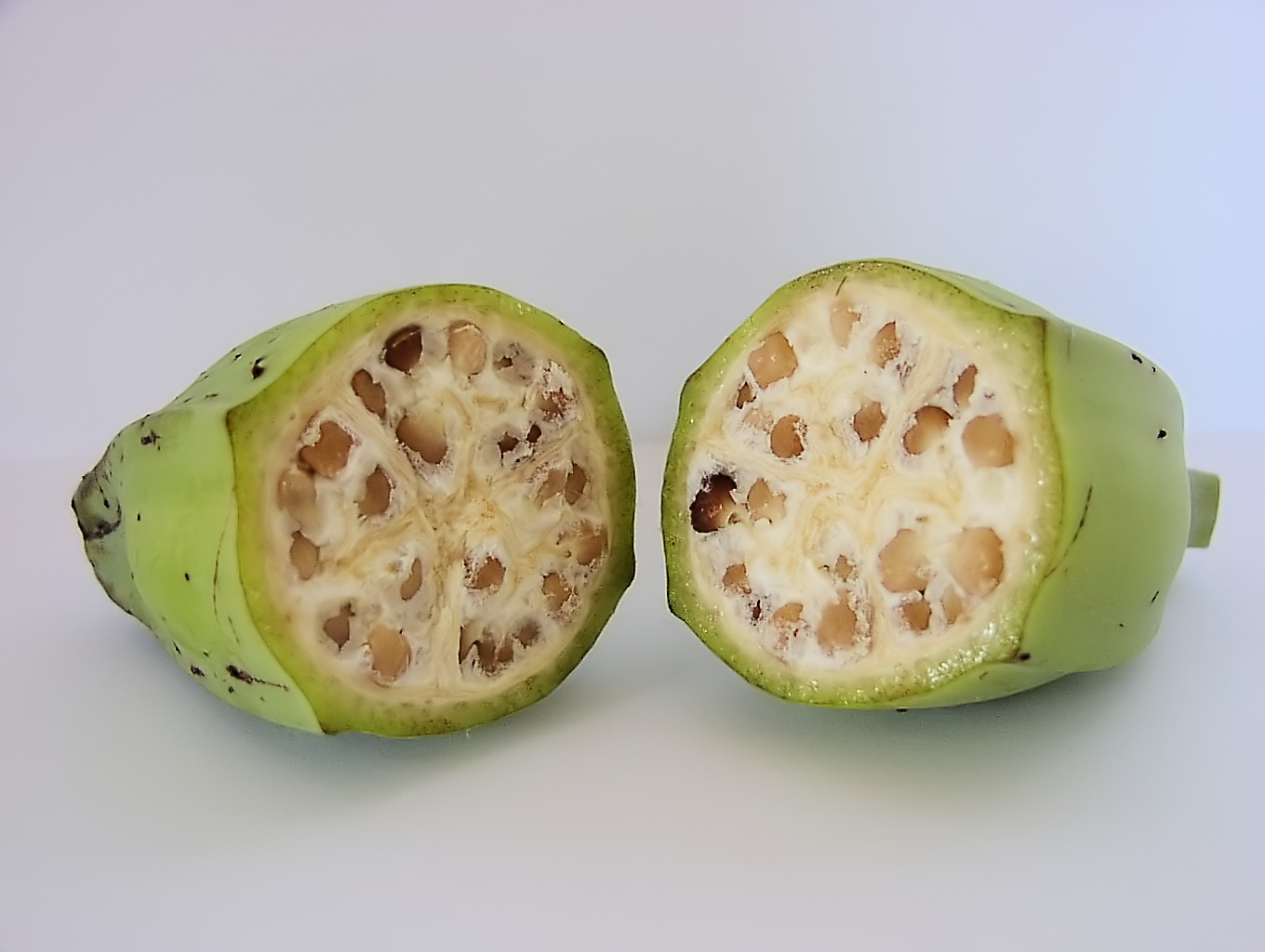
Especially considering that the banana as we know it is a cultivar, quite different from its wild ancestor. In particular, wild bananas have huge, inconvenient seeds in them, and are only marginally useful as a food item:

http://upload.wikimedia.org/wikipedi...ype_banana.jpg
Reply With Quote
  #16  
Old 12-07-2007, 03:09 AM
Mangetout Mangetout is offline
Charter Member
 
Join Date: May 2001
Location: Kingdom of Butter
Posts: 47,510
Quote:
Originally Posted by jayjay
Nope. Absolutely serious. Kirk Cameron is the Tom Cruise of nutty fundamental creationist Christianity.
He may still be nutty in plenty of ways, but it is worth noting that he has now conceded that the banana-fits-the-hand argument has no merit.

Last edited by Mangetout; 12-07-2007 at 03:09 AM.
Reply With Quote
  #17  
Old 12-07-2007, 05:24 AM
brazil84 brazil84 is offline
Guest
 
Join Date: May 2007
Quote:
Originally Posted by Colibri
I don't think there is any particular adaptive reason for it. The division of a citrus fruit into segments is simply a consequence of the structure of the original ovary. Similar structures are found in many other fruits. And you should remember that a cultivated orange is very different from a wild fruit. The original form did not divide into segments nearly so easily. It is very unlikely that the segmentation is designed to make it easier for fruit-eating animals to eat; most such animals do not peel the fruit and divide it into segments.
If you think of man as a fruit eating animal, and that mankind has cultivated oranges that are easier to eat, then couldn't one say that this is a kind of evolution and that indeed oranges are divided into segments because they are easier for people to eat that way?
Reply With Quote
  #18  
Old 12-07-2007, 05:37 AM
MrDibble MrDibble is offline
Member
 
Join Date: Mar 2001
Location: Cape Town, South Africa &
Posts: 12,178
How easily-segmented are the wild varieties of citrus, or the nearest wild relatives? I don't know, but if I was to make a prediction, I would say "not very", and the modern fruit are as removed from their antecedents as maize is from teosinte. They have easily-seperated segments because they were intelligently designed - by us!

Of course, if varieties like the Buddha's Hand citron turn out to be wild, this theory will need revising.
Reply With Quote
  #19  
Old 12-07-2007, 05:42 AM
IOMDave IOMDave is offline
Guest
 
Join Date: Nov 2007
unnatural selection?

Quote:
Originally Posted by yabob
What the HECK is that thing?!

Bananazilla is coming to get you...
Reply With Quote
  #20  
Old 12-07-2007, 05:58 AM
Colophon Colophon is offline
Guest
 
Join Date: Sep 2002
Quote:
Originally Posted by Sapo
Most dycotyledon plants (my guess from spanish, sorry if it is not the exact word) have their structure in fives or multiples of five (monocotyledon plants go in threes or multiples).
Hmm, I just grabbed an orange (well, it was a clementine actually) and it had, yep, 10 segments. I've never counted before - is this usually the case? It was the last orange in the bag so I can't check another one at present...
Reply With Quote
  #21  
Old 12-07-2007, 06:16 AM
Mangetout Mangetout is offline
Charter Member
 
Join Date: May 2001
Location: Kingdom of Butter
Posts: 47,510
I don't think oranges always have a multiple of five segments - the flower has fivefold symmetry, for sure - but the inside of the fruit is a little bit more chaotic (the rind has fivefold symmetry though - you can sometimes see this best in the little creases around the stalk and calyx, and in the pattern made by the oil glands in the skin.
Reply With Quote
  #22  
Old 12-07-2007, 07:53 AM
Bewildebeest Bewildebeest is offline
Charter Member
 
Join Date: Sep 2003
Location: Silver Spring, MD
Posts: 509
Quote:
Originally Posted by IOMDave
unnatural selection?


What the HECK is that thing?!

Bananazilla is coming to get you...
ETA: deleted obvious statement.

Last edited by Bewildebeest; 12-07-2007 at 07:55 AM. Reason: Deleted obvious statement.
Reply With Quote
  #23  
Old 12-07-2007, 08:06 AM
WhyNot WhyNot is offline
Guest
 
Join Date: Jul 2004
Quote:
Originally Posted by Peter Morris
designed?


... by some sort of intelligence?
Well, yes. A human one, or one, as brazil84 said. Colibri himself acknowledged that oranges in nature aren't so strongly segmented. It's not a leap to guess that humans designed oranges, through breeding and hybridization, to have segments which tear apart easily, as well as to be large, juicy and sweet.

Just like basset hounds were literally designed, by human breeders, to have short stubby legs so that hunters on foot could keep up with them at a trot. (Or so I've heard.)

In the natural world, "designed" is indeed a land mine of a metaphor. But once you're talking a domesticated breed of plant or animal, it's entirely appropriate.
Reply With Quote
  #24  
Old 12-07-2007, 08:07 AM
WhyNot WhyNot is offline
Guest
 
Join Date: Jul 2004
Quote:
Originally Posted by IOMDave
unnatural selection?
Called "artificial selection" in my old textbooks. AKA breeding.
Reply With Quote
  #25  
Old 12-07-2007, 09:26 AM
Surok Surok is online now
Guest
 
Join Date: May 2006
Quote:
Originally Posted by Colophon
Hmm, I just grabbed an orange (well, it was a clementine actually) and it had, yep, 10 segments. I've never counted before - is this usually the case? It was the last orange in the bag so I can't check another one at present...
Just grabbed one off a colleague and counted. 11.
Reply With Quote
  #26  
Old 12-07-2007, 09:33 AM
Peter Morris Peter Morris is online now
Charter Member
 
Join Date: Apr 2003
Location: ___\o/___(\___
Posts: 8,460
Quote:
Originally Posted by Colibri
Why on Earth would you think that's what I meant?
Relax, dude, I was just teasing you. Get a sense of humour, m'kay?

I'm sure you don't really think that oranges were "designed."
Reply With Quote
  #27  
Old 12-07-2007, 09:42 AM
Colophon Colophon is offline
Guest
 
Join Date: Sep 2002
Quote:
Originally Posted by Surok
Just grabbed one off a colleague and counted. 11.
Ah yes, but was one of those an undersized "adventitious segment", as it were? I notice you often get one segment smaller than the others.

Hmm... Johnny Citrus & the Adventitious Segments - I'd pay to see them in concert.
Reply With Quote
  #28  
Old 12-07-2007, 09:52 AM
Cervaise Cervaise is offline
Guest
 
Join Date: Mar 1999
Quote:
Originally Posted by Surok
Just grabbed one off a colleague
You have an orange tree for a colleague?
Reply With Quote
  #29  
Old 12-07-2007, 09:56 AM
Peter Morris Peter Morris is online now
Charter Member
 
Join Date: Apr 2003
Location: ___\o/___(\___
Posts: 8,460
Quote:
Originally Posted by Peter Morris
Dividing the orange into handy little segments makes it easier for monkeys to eat, and thus better for spreading the seed.
Are we certain this has nothing to do with it? I would have thought that a segmented fruit that breaks into handy bite sized pieces has a survival advantage over a less-segmented one.

If humans have selectively bred oranges with that feature, then isn't that a survival advantage anyway?
Reply With Quote
  #30  
Old 12-07-2007, 09:58 AM
Giles Giles is online now
Charter Member
 
Join Date: Apr 2004
Location: Newcastle NSW
Posts: 11,556
I'm not a biologist, but many other fruits apart from citrus are built up of mutiple similar parts, e.g., raspberries and pomegranates, to take two wildly different shapes. Might not the reason be that it's easier to build up a larger fruit by having multiples of the same structure rather than by having a larger single structure? And an evolutionary advantage to have a larger structure to make it easier for the animals to find the fruit, eat it, and disperse the seeds.

Last edited by Giles; 12-07-2007 at 09:58 AM. Reason: typo
Reply With Quote
  #31  
Old 12-07-2007, 10:06 AM
Frylock Frylock is online now
Guest
 
Join Date: Jun 2001
Quote:
Originally Posted by Peter Morris
designed?


... by some sort of intelligence?
Design does not imply intelligence any more than selection does. (For some reason people generally try to avoid the former while accepting the latter as ways to characterize evolution, but I've never been quite sure why.)

-FrL-
Reply With Quote
  #32  
Old 12-07-2007, 10:18 AM
Tastes of Chocolate Tastes of Chocolate is offline
Charter Member
 
Join Date: Aug 2003
Location: slightly north of center
Posts: 4,042
Quote:
Originally Posted by Colophon
Hmm, I just grabbed an orange (well, it was a clementine actually) and it had, yep, 10 segments. I've never counted before - is this usually the case? It was the last orange in the bag so I can't check another one at present...

In the interest of science, I just forced myself to eat an orange. 10 segments, all full sized.
Reply With Quote
  #33  
Old 12-07-2007, 10:24 AM
Peter Morris Peter Morris is online now
Charter Member
 
Join Date: Apr 2003
Location: ___\o/___(\___
Posts: 8,460
Quote:
Design does not imply intelligence ...

doesn't it? Looking at the dictionary, it gives lots of definitions for design, most of them directly state some sort of intelligence

http://dictionary.reference.com/search?q=design

definitions include:
  • To plan and fashion artistically or skillfully.
  • To form or conceive in the mind;
  • To plan out in systematic, usually graphic form:
  • To create or execute in an artistic or highly skilled manner.

and so on

Last edited by Peter Morris; 12-07-2007 at 10:25 AM.
Reply With Quote
  #34  
Old 12-07-2007, 10:34 AM
devilsknew devilsknew is offline
BANNED
 
Join Date: Nov 2003
Location: The Great Black Swamp
Posts: 9,178
On a related note, appropo the oranges structure relating to the flower-- Did you know that each length of corn silk in an ear of corn represents a single kernel of corn on that cob?
That, is the number of kernels on a cob equals the number of lengths of corn silk.
Reply With Quote
  #35  
Old 12-07-2007, 10:36 AM
WhyNot WhyNot is offline
Guest
 
Join Date: Jul 2004
Okay, in the interest of science (and teaching counting), my daughter and I just peeled an orange and counted segments.

After removing the lubricious integument* from a Sunkist navel orange, we found nine (9) large, equally sized segments, one (1) small, half sized segment, and a hard navel with an indeterminate number of its own compartments.


*Og as my witness, I never dreamed I'd be able to work it into conversation this soon!
Reply With Quote
  #36  
Old 12-07-2007, 10:38 AM
Surok Surok is online now
Guest
 
Join Date: May 2006
Quote:
Originally Posted by Colophon
Ah yes, but was one of those an undersized "adventitious segment", as it were? I notice you often get one segment smaller than the others.
No, they were all full-sized.

<OT>
And Cervaise, I will suggest to my colleague that an orange tree costume would be appropriate garb for the upcoming Christmas party.
</OT>
Reply With Quote
  #37  
Old 12-07-2007, 11:19 AM
Darwin's Finch Darwin's Finch is offline
Guest
 
Join Date: May 2001
Quote:
Originally Posted by Peter Morris
If humans have selectively bred oranges with that feature, then isn't that a survival advantage anyway?
Not really. We breed them to eat, not to make seed-scattering more efficient (indeed, when was the last time you planted the seeds from an orange - or any other fruit - that you ate?). If anything, it's a survival disadvantage (in the long term), as the juicier and more managable the fruit slices from a particular tree, the more likely that tree's fruit is to be sold at market and consumed, and its seeds subsequently discarded. At least, until the seeds are bred out of the fruit entirely, at which point the plant's survival becomes entirely dependent on humans.

Artificial selection has little to do with advantages to the organism, and everything to do with how that organism can be modified for our needs/wants.
Reply With Quote
  #38  
Old 12-07-2007, 11:40 AM
Peter Morris Peter Morris is online now
Charter Member
 
Join Date: Apr 2003
Location: ___\o/___(\___
Posts: 8,460
Quote:
Originally Posted by Darwin's Finch
Not really. We breed them to eat, not to make seed-scattering more efficient
Yeah, but orange farmers plant seeds from trees that produce the best oranges, and discard seeds from the less good ones, don't they? A plant that produces the best oranges, (best from the human POV), gets its genes passed down to the next generation.

Isn't that what evolution is all about?


Quote:
(indeed, when was the last time you planted the seeds from an orange - or any other fruit - that you ate?).
Funnily enough, about 3 months ago I had an avocado for lunch and on impulse decided to plant the stone in a pot. Now I've got a little plant growing on my window sill. Maybe in about 5 years I'll have my own crop of avocados.
Reply With Quote
  #39  
Old 12-07-2007, 11:46 AM
WhyNot WhyNot is offline
Guest
 
Join Date: Jul 2004
Quote:
Originally Posted by Peter Morris
Yeah, but orange farmers plant seeds from trees that produce the best oranges, and discard seeds from the less good ones, don't they? A plant that produces the best oranges, (best from the human POV), gets its genes passed down to the next generation.
Nah, it's all hybrids and splicing onto rootstocks these days, innit? I'm sure the oranges we're eating are all clones of the same two orange trees somewhere in South America. If you plant the seeds, you'll get wildly different trees from them.
Reply With Quote
  #40  
Old 12-07-2007, 12:07 PM
IOMDave IOMDave is offline
Guest
 
Join Date: Nov 2007
Fascinating; there doesn't really seem to be a definitive answer yet. From biological geometry, to selection.

I think Giles idea makes a lot of sense. The mechanical principles behind building something big out of smaller substructures are well known (Eiffel Tower anyone?). If this is simply an efficient design principle then that could be all there is to it. Not so much a case of why, as why not.

Perhaps the precurser to the modern raspberry was a "single segment" raspberry that then underwent a mutation (twins!). As this would be perfectly sustainable, there would be no real disadvantage to it; the advantage would be that animals would be more likely to eat from that particular plant because there was more of the good stuff. Natural selection at work.

Perhaps something similar happened with the orange. Perhaps I'm talking out of my ass.
Reply With Quote
  #41  
Old 12-07-2007, 12:28 PM
Stranger On A Train Stranger On A Train is offline
Guest
 
Join Date: May 2003
Quote:
Originally Posted by WhyNot
Nah, it's all hybrids and splicing onto rootstocks these days, innit? I'm sure the oranges we're eating are all clones of the same two orange trees somewhere in South America. If you plant the seeds, you'll get wildly different trees from them.
Actually the most popular orange for direct consumption, the navel orange, is seedless and therefore sterile, and as WhyNot recalls, derived from two cuttings from a single tree. I think that you'll find that most apple cultivars will only grow stunted trees if at all.

Quote:
Originally Posted by Peter Morris
Yeah, but orange farmers plant seeds from trees that produce the best oranges, and discard seeds from the less good ones, don't they? A plant that produces the best oranges, (best from the human POV), gets its genes passed down to the next generation.

Isn't that what evolution is all about?
This is artificial selection, in which characteristics are consciously selected for human service or consumption rather than reproductive value. You can consider it part of the larger context of selection overall (especially if you subscribe to the notion of an extended phenotype) in the sense that in they're now relying on humans to propagate the species. This is substantially different from natural selection, though.

Stranger
Reply With Quote
  #42  
Old 12-07-2007, 12:50 PM
Frylock Frylock is online now
Guest
 
Join Date: Jun 2001
Quote:
Originally Posted by Peter Morris
doesn't it? Looking at the dictionary, it gives lots of definitions for design, most of them directly state some sort of intelligence

http://dictionary.reference.com/search?q=design

definitions include:
  • To plan and fashion artistically or skillfully.
  • To form or conceive in the mind;
  • To plan out in systematic, usually graphic form:
  • To create or execute in an artistic or highly skilled manner.

and so on
That dictionary definition missed the fairly common sense in which the word "design" is used in scientific and pop-scientific contexts. That sense does not imply intelligence, just as the corresponding sense of "selection" does not imply intelligence.

-FrL-
Reply With Quote
  #43  
Old 12-07-2007, 12:55 PM
Frylock Frylock is online now
Guest
 
Join Date: Jun 2001
Quote:
Originally Posted by Darwin's Finch
Not really. We breed them to eat, not to make seed-scattering more efficient (indeed, when was the last time you planted the seeds from an orange - or any other fruit - that you ate?). If anything, it's a survival disadvantage (in the long term), as the juicier and more managable the fruit slices from a particular tree, the more likely that tree's fruit is to be sold at market and consumed, and its seeds subsequently discarded. At least, until the seeds are bred out of the fruit entirely, at which point the plant's survival becomes entirely dependent on humans.

Artificial selection has little to do with advantages to the organism, and everything to do with how that organism can be modified for our needs/wants.
I would have said that, though these traits would be disadvantageous in many situations, still, in the particular environment these plants are in right now--the artificial environment designed to breed them for human use--these traits turn out to be advantageous. It's nothing new that a trait can be advantageous in some environments and disadvantageous in others.

But would I have been wrong to say this?

-FRL-
Reply With Quote
  #44  
Old 12-07-2007, 01:19 PM
Hypno-Toad Hypno-Toad is offline
Guest
 
Join Date: Sep 2004
Quote:
Originally Posted by Colophon
Hmm... Johnny Citrus & the Adventitious Segments - I'd pay to see them in concert.
Yes, theirs go to "11."
Reply With Quote
  #45  
Old 12-07-2007, 01:29 PM
Grossbottom Grossbottom is offline
Guest
 
Join Date: Sep 2004
Here's the WAG of someone who grew up with an orange tree in his yard. Some birds like to eat oranges. They land on the fruit, and punch through the skin with their beaks, drinking the juice and eating the meat of the fruit. So, I'll suggest the possibility that the sections permit the greater part of the fruit to survive being penetrated by a bird beak: the membranes may operate to some degree to halt or slow down any subsequent rot or insects from getting to the rest of the segments, once the skin is breached in a particular spot.
Reply With Quote
  #46  
Old 12-07-2007, 01:36 PM
Sapo Sapo is offline
Guest
 
Join Date: Dec 2006
Quote:
Originally Posted by Grossbottom
Here's the WAG of someone who grew up with an orange tree in his yard. Some birds like to eat oranges. They land on the fruit, and punch through the skin with their beaks, drinking the juice and eating the meat of the fruit. So, I'll suggest the possibility that the sections permit the greater part of the fruit to survive being penetrated by a bird beak: the membranes may operate to some degree to halt or slow down any subsequent rot or insects from getting to the rest of the segments, once the skin is breached in a particular spot.
Titanic oranges.
Reply With Quote
  #47  
Old 12-07-2007, 02:44 PM
MrDibble MrDibble is offline
Member
 
Join Date: Mar 2001
Location: Cape Town, South Africa &
Posts: 12,178
So, they're bulkheads? Could be.
Reply With Quote
  #48  
Old 12-07-2007, 04:27 PM
Cervaise Cervaise is offline
Guest
 
Join Date: Mar 1999
"I'm King of the Fruit!"
Reply With Quote
  #49  
Old 12-07-2007, 05:09 PM
jayjay jayjay is offline
Guest
 
Join Date: Nov 2000
Quote:
Originally Posted by Cervaise
"I'm King of the Fruit!"
That's just a rumor...
Reply With Quote
  #50  
Old 12-07-2007, 05:22 PM
IOMDave IOMDave is offline
Guest
 
Join Date: Nov 2007
Now that's an interesting theory!
Reply With Quote
Reply

Bookmarks

Thread Tools
Display Modes

Posting Rules
You may not post new threads
You may not post replies
You may not post attachments
You may not edit your posts

BB code is On
Smilies are On
[IMG] code is Off
HTML code is Off
Forum Jump


All times are GMT -5. The time now is 12:06 PM.


Powered by vBulletin® Version 3.7.3
Copyright ©2000 - 2013, Jelsoft Enterprises Ltd.

Send questions for Cecil Adams to: cecil@chicagoreader.com

Send comments about this website to: webmaster@straightdope.com

Terms of Use / Privacy Policy

Advertise on the Straight Dope!
(Your direct line to thousands of the smartest, hippest people on the planet, plus a few total dipsticks.)

Publishers - interested in subscribing to the Straight Dope?
Write to: sdsubscriptions@chicagoreader.com.

Copyright © 2013 Sun-Times Media, LLC.