“If you bale freshly cut hay and put it in your barn, there’s a chance it’ll spontaneously combust (and you’ll lose both your hay and your barn).” Someone told me that. Having neither barn nor the need to grow, harvest, and bale hay, I didn’t give it much thought. But it got me wondering…
Is this true? How and why?
After cutting, is the hay left lying in the field to dry? If so, for how long?
What if it rains the day after the hay is cut? Wait a little longer for it to dry?
We owned a horse when I was a child. I recall one cardinal rule of hay bales (ready for the horse’s consumption) is that they were never to be allowed to get wet, lest they develop mold. But, I see big “rolls” of what I think is hay left out in the field in the rain. If it’s cut, allowed to dry, rolled up into those big rolls, and then allowed to get wet again, doesn’t that defeat the purpose?
Yes it is true. Wet hay starts breaking down like compost because of microorganisms. It can get hot enough to combust spontaneously under the right conditions and many a barn has been destroyed that way.
It depends on local conditions like sun and humidity but it shouldn’t be left out that long, maybe a day or two.
You are partially screwed and it is a big worry for hap farmers. A sustained rain can ruin most of the crop. The best thing is to check the weather carefully before you cut it in the first place.
Those big hay bails are like their own shelter. Water doesn’t penetrate that far down because the bail is tightly compressed.
Oh yes, it certainly happens. I remember several barn fires from where I grew up being attributed to it. The root cause is heat generated by microbial growth in the wet hay. A WSU extension article on the subject:
Yes, the farmers I knew left the hay in the field to dry. A sunny day or two before baling it up. They followed weather predictions and really hoped it didn’t rain. This was before they days of the big round bales, when you stacked the twine wrapped rectangular jobs onto a wagon and transported them to the barn. I believe if the round bales were baled dry, there’s little enough surface area presented to the elements that they can let it get wet.
Yes, it’s true. It’s a fermentation process of some sort that generates heat, though I can’t tell you exactly what the chemical process is. It can also happen with overly moist cereal grains in a bin.
Yes. It’s left until it’s sufficiently dry. How long that is depends on the weather. It can be anywhere from a day or two to weeks. “Sufficiently dry” is usually measured by feel - reach into the swath and twist the stalks around.
That’s why the saying goes “Make hay while the sun shines.” If it rains, you have to wait for it to dry out again, and you’ll have lost some quality by the time it does.
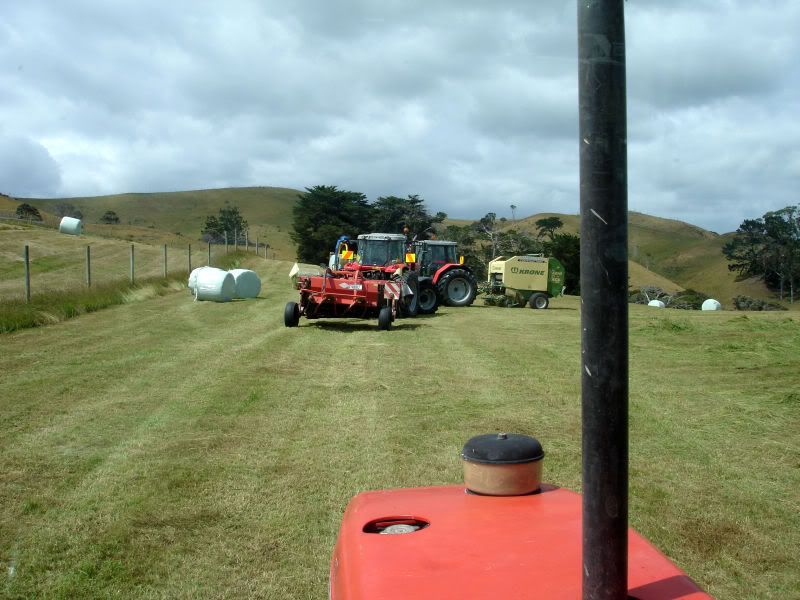
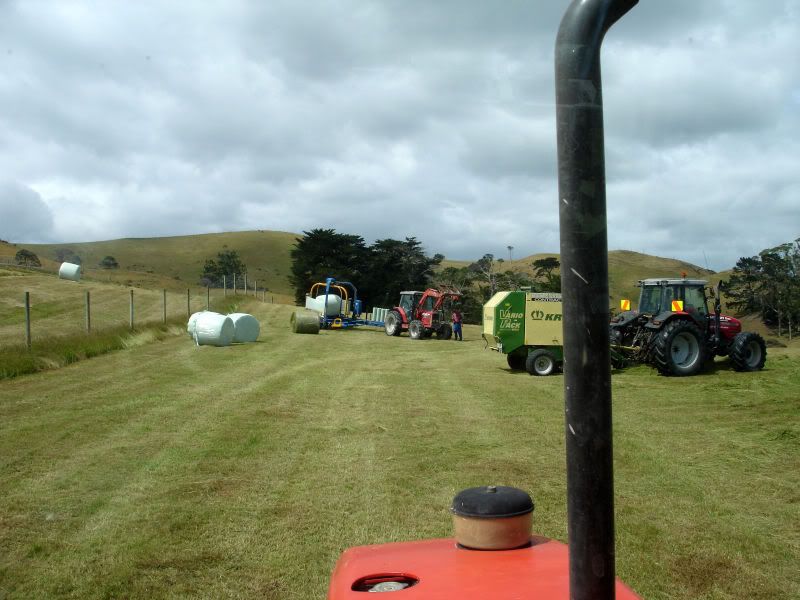
The “big rolls” are round bales. On their side they shed water fairly well (essentially a thatched roof, if you think about it), and only a small layer around the outside will get wet if they’re rained on. For long term storage they might be tarped or put under a roof, but being rained on in the field is no big deal. Small square bales are less rain-resistant, but still not the end of the world. In a large stack, it would only be the top layer of bales that would suffer noticeable damage. When stacking we’d pick poorer bales for the top layer if the stack wasn’t going to be tarped, and then when feeding we’d just take one top one with a bunch from lower down instead of a whole bunch from the top at once. The issue with squares is that these days no one stacks by hand, and you drop them on their sides off the baler to be picked up by an automatic stacker, so if they’re rained on between baling and being picked they soak up the rain like a sponge. One tries to avoid this.
Yes, it’s true, although it’s more likely the hay will just sit there and grow mold. Hay has to dry out. Hay which starts to mold starts to decompose, which produces heat. Leave wet hay in a pile and it can build up enough heat in the center to spantaneously combust.
There are various drying agents and mechanical methods to speed up the drying process, but basically, yes, you leave the hay in the field to dry. In the Great Plains, in the summer, even a thick cutting can dry in a day.
As noted above, there are ways to accelerate the drying process, but it’s always hay vs. weather.
It’s the inside of the bales you have to worry about, not the outside. The water will roll off of the outside of a bale. When moisture gets trapped inside, that’s where the mold starts.
I was familiar with one farmer who had a dryer. He’d bale up his hay semi-damp, and take it to the barn the dryer was in, where you stacked it over these big screens that had fans under them which blew air through the bales. Then haul them off to the barn for storage. Two disadvantages - you had to load and stack the bales twice, and after they were dried, they were loose and hard to handle. Not to mention using electricity to run the fans, I suppose. And that the bales were heavy as hell while still damp.
Not all round baled hay is eaten by horses, and other animals, like cows and goats, can stand considerably less quality in their hay without suffering ill effect. So, sometimes you see really crappy round bales that have been sitting on the edge of a pasture for 3 years, and then when one day they disappear, almost for sure they were not fed to horses. (When I was in Italy I saw them roundbaling cornstalks for winter cow fodder.) Round bales fed to horses are should be stored under cover.
The most nutritious part of the hay (especially good hay like alfalfa) is the tiny leaves, not the stalks. After the hay is cut and lying there to dry, a hard rain will knock a lot of the leaves off the stalks, to fall onto the ground and be lost from the hay when it is baled. So the resulting bale contains less protein than if it had not been rained on.
If you’ve waited too long or had the cut hay rained on repeatedly, you can still bale it and sell it for “ditch-bank” hay. This is the hay/straw used in mulching operations, or thrown out by the construction crew after dressing up the disturbed ground. It’s also good for fall decorations, or for bedding for dogs.
Hay in square bales or throw bales has the stalks of grass all running in the same direction. The same is true of big square bales that can run up to one ton in weight. This means that moisture wicks into the bale and dampens the whole damn thing. Moisture and warmth means mold. Horses are not tolerant of mold. Cattle are much more accepting of it and seem to like a little mold – maybe it’s sweet. Beef cattle do fine on mildly bad hay but dairy cattle require a good quality forage to keep production up.
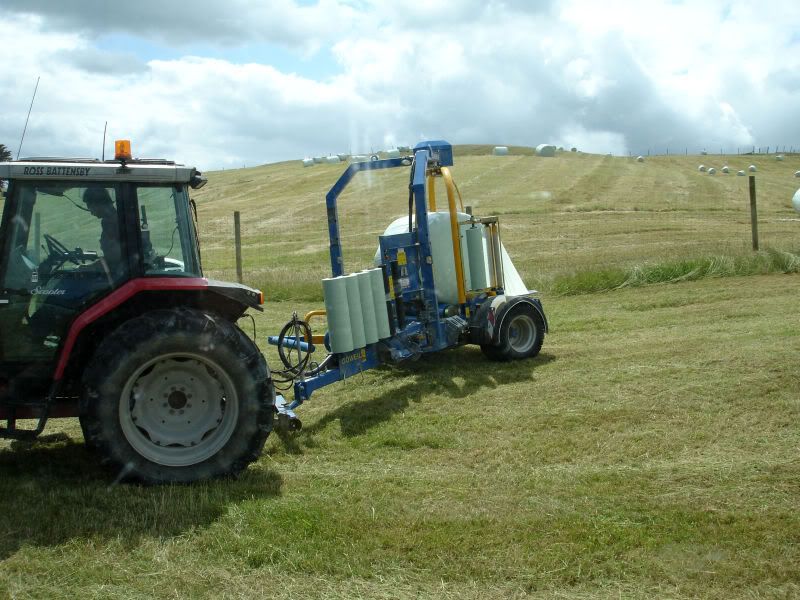
In the big round bales the grain of the grasses winds around the bale. The bailer essentially rolls the hay into a big spiral cake of grass. This tends to make the water run off the bale rather than soaking in. Often the big bales are wrapped in a fiber reenforced plastic wrapper which helps to prevent water damage.
Consequently square bales need to be gathered up and put under shelter quickly while big round bale can sit on the ground for a long time without any particular damage.
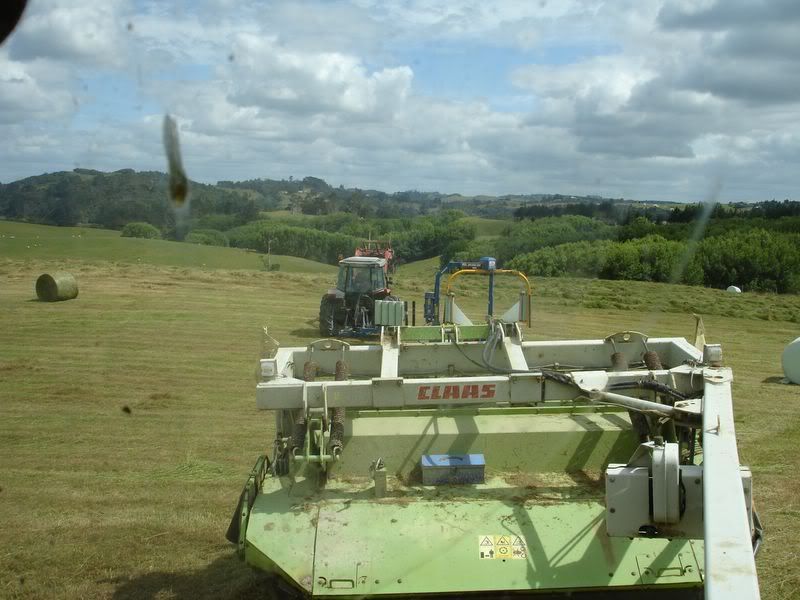
For hay, after mowing, the grass is “conditioned”. This can be done by the mower or a following machine. Conditioning removes some of the waxy outer coating of the grass, allowing the grass to dry quicker. It involves steel fingers running through the grass to remove the coating, for more legume-ous crops, crimping rollers are better.
The next day or two, the grass is “tedded”. That is lifted and flipped over to allow air to flow through and the sun to dry the top layer.
Then the grass is raked up and baled.
As noted by previous posters, if grass is baled too green and air allowed in, heat and fire can result. To create baled silage we bale at about 30% DM and wrap in plastic asap to reduce the amount of aerobic bacteria action.
As noted, round bales shed water to a degree and can be left outside. The quality isn’t as good as shed stored though.
I have fed out round bale hay with black, cooked smelling centres.
Somethink to consider regarding the wrapped bales, they are harvested with the hay greener than non-wrapped bale, the hay will then ferment much like silage.
However, should the wrapping get torn, oxygen will be introduce to the fermenting process and a toxin will develop, cows, being ruminant, are imune but the toxin can kill a horse.
Googling the terms “wrapped hay bale toxin kill horse” produces results that suggest that the toxin I mention above causes botulism for the horse and is not limited to wrapped bale of hay but any hay that has been left wet.
I’ve been around a number of horse farms, all of which stack by hand. Hot, scratchy work. I’m sure there are plenty of large food animal operations and/or hay producers which use automated systems, but stacking by hand is by no means extinct.
ETA: It appears on second glance that you are referring to what happens in the hay field during production, not at the point of storage. While I am by no means a hay expert, the hay producers I’ve seen around here have automated balers which spit the bales back onto a hay wagon where they are stacked by hand, all in the same trip.
J-P L: Actually, botulism is a soil bacterium that likes anaerobic environments. As you correctly noted, it grows better in wet environments, but letting air in does not promote botulism growth – it retards it. Cattle and horses are both susceptible to botulism. There are other bacteria and molds, whose names I do not know, which are acceptable in cattle hay but not in horse hay. UC Davis on botulism in cattle
Rain also causes nutrient loss by removing water soluble vitamins, sugar, and protein. In horses with metabolic disorders, such as insulin resistance, hay is purposely soaked and allowed to sit in water for half an hour to an hour immediately prior to feeding it in order to reduce the sugar content. It can not be stored wet, however – a new batch of soaked hay must be prepared for every feeding.
In these parts nowadays square bales are almost invariably handled with one of these. The baler is set to drop the bales on their side, and then you scoop them up with the bale wagon. You end up with a perfect stack and never have to touch a single bale.
When I was a kid we frequently pulled a hayrack behind the baler and stacked by hand as they came off. Then off the hayrack onto a bale elevator into the loft, and stack them again. Endless fun.
My best friends and I were some of the last people to do this commercially in our little corner of East Texas. Most people were transitioning to rolls. The few that were still baling small square bales were desperate for hay haulers. We charged 0.35 a bale. We could put 50 bales on a standard long-bed pickup truck. If the barn was close to the field, we could do a load in 30-45 minutes. It was decent money for teenagers, but it was brutally hard work. I remember working well into the night and getting so dehydrated that muscle cramps were a nagging problem. I remember picking up a bale and getting cramps in both biceps at once and having to get my friend to take the bale out of my hands and straighten out my arms.
That’s one part of my youth that I don’t miss one bit.
Yeah, that’s what most of the farmers of my youth did. There were variations, though. A few would drop the bales on the ground, and have another tractor with a haywagon or a flatbed truck pick them up separately. That way the guy running the baler didn’t have to stop to change wagons, etc. The guy I mentioned above who had the dryer did that, and hired a large crew. I had a neighbor who put sides on his haywagons, and had a kicker on his baler chute. He just let the baler launch the bales into the wagon in an untidy pile, and saved having to have anybody else in the field. Unloading the wagons at the barn was a pain in the butt, though.
The way your average farmer ran frayed extension cords all over the barn to position and reposition hay elevators as the day progressed would probably have given OSHA pause, too.
Of course, the old-timers when I was a kid used to talk about the old wire bales, as opposed to the twine tied things we’re thinking of.
About half the people I hauled for were still using wires. They were hell on the hands. I made myself a hay hook out of some round rod and got pretty good with it so I did not have grab the wires as much. The endless tangle of haywire laying around when you fed the bales in the winter was both a blessing and curse.
I helped an uncle in a custom baling operation one summer. We baled a field for an old timer that was notorious for being as tight as old Ebenezer Scrooge. We parked the baler in his field the night before we started baling. The next day, the haulers were complaining about the weight of the bales. We checked the baler and discovered that old goat had tightend down the press screws on the baler until it was packing about 120 lbs of hay into a bale. Since we charged by the bale, I quess he was trying to cut down on the total number of bales so he wouldn’t have to pay us so much. We adjusted the baler back to normal and didn’t say anything.