This question isn’t a homework problem…just a realization of a possible flaw in how I was taught to model a garden-variety parabola, y=x^2.
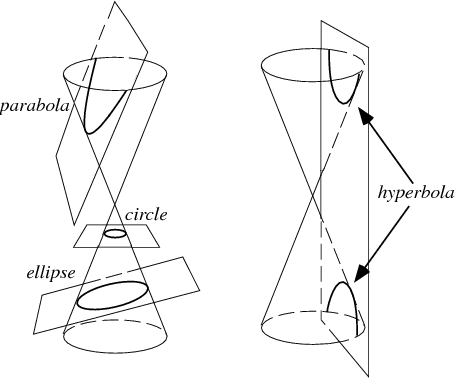
Using the conic section model, how would one cut the cone (remembing a cone has an upper and lower half) with a plane to produce the ordinary, vertical parabola (given by y=x^2)? You might say I should picture a plane passing vertically through the cone, but doesn’t that produce a hyperbola? And, surely a parabola is not simply the upper (or lower) half of a hyperbola, true? …their formulas are different!
Also, bear in mind, a cone extends forever in both directions, and whatever plane you choose is infinite in 2-D, as well. Thus, even slicing the cone with a plane pitched at a shallow angle (maybe 1 degree above horizontal) would still manifest a hyperbola, true?
IIRC:
Think of the cone as double-ended like a bowtie rotated, the two cone vertices touching. (A line rotated around an intersecting axis line.)
A circle is a slice of the cone at 90 degrees to the central axis. Obviously, it will only hit one of the cone pair, one circle.
An ellipse is a slice through the cone less than 90-degrees perpendicular to the axis, but less than parallell to the edge of the cone - so it will intersect one of the cone-pair, one ellipse.
A hyperbola is an intersection with an angle between parallel with the cone axis and the angle of the side of the cone. At that angle, there will be a matching pair - top and bottom cones, top and bottom parabolas.
A parabola is the special case where the plane of intersection is parallel to the side of the cone. As a result, it will intersect one cone, but not the other one of the pair.
(The other special cases are where the intersection plane either goes through the cones and the center point where they meet - the hyperbola reduces to an “X”, the parabola to a straight line, and the circle/ellipse to a point. )
Of course, it’s been decades since I took math, but I think that’s it.
For that matter, every ellispe has a twin! But, this is never mentioned when learning about the conic sections. Things are just handed down from one generation to the next and accepted without question as dogma. Hmm, then one must wonder why did the “twin” of the hyperbola catch people’s attention?
Wait, for the ellispe, the above post made me think the ellipse could only be unique when the angle of attack is parallel to one side of the cone. Still not convinced on the parabola, however.
Incidentally - it is applicable to orbital mechanics too, IIRC.
A circle is an orbit where speed and distance from primary are constant; when the orbit was started, the satellite was given exactly the right speed and direction for its distance.
An ellipse is where the satellite speed is less than escape velocity; and starts when the intial velocity and gravitational pull do not balance.
A parabolic orbit will happen when a body drops in from infinity and swings around the primary, then back out again. Spee equals escape velocity.
A hyperbolic path happens when the incoming body has more than the escape velocity of the primary - i.e. it enters the system with some additional velocity.
top and bottom hyperbolas … sorry - missed the edit window.
Circles and ellipses and parabolas do NOT (CANNOT) have twins. A hyperbola MUST have a twin. (Except the boundary case of the parabola intersection plane that goes through the apex of the cone, essentially a tangent to the cone pair on both ends and therefore a straight line in both directions.
No, a plane that cuts the cone at an angle lower than that of an element of the cone will cut it in an ellipse, no twin. A plane that cuts at a higher angle will cut both halves of the cone, still no twin, just one hyperbola that has two pieces. A plane parallel to an element of the cone cuts only one (unless it goes through the vertex of the cone, in which case you get two intersection straight lines) gives a parabola. In complex projective space (use complex coordinates and add a complex line at infinity) all conics look alike and have infinite extent.
Don’t all conics look alike even in real projective space? (I mean, yeah, ellipses touch the line at infinity never, parabolas are tangent to it at a point, and hyperbolas cross it at two points, but if you don’t designate a particular one, who’s to say which line is the line at infinity?)