|
|
|
#1
|
|||
|
|||
|
Tools that are no longer made ...
This is going to be a tricky one. Somebody at NPR has posited this particular question: Name a tool that is no longer used. Apparently, this is a tougher question than it might seem. Here's an NPR link, first off:
http://www.npr.org/blogs/krulwich/20...aya-mean-never So yeah, they still make carbon paper, steam engine parts and ... stone tools? Well, if people are knapping flint, for experimental purposes, they anything could still be being made. Over at Fark.com*, the consensus is that 5-1/4" floppys should not be being manufactured, and I say Kodachrome -- the film and related items. But I can't really be sure someone isn't making those just for the fun of it. So dopers, any better answers? *Oh, and in case someone on this planet doesn't know, if you go to Fark.com without ultra-armoring your browser against adverts, everyone at work will see you browsing bikini girls, so be careful, or be able to get away with it, or stay away and don't blame me. http://www.fark.com/comments/5922522...ill-being-made |
| Advertisements | |
|
|
|
|
#2
|
|||
|
|||
|
I'm sure you can find 5-1/4" floppies if you look hard enough. But does anyone still make 5-1/4" floppy drives?
|
|
#3
|
|||
|
|||
|
Yep. They even make them with USB interfaces now, since most computers no longer have a floppy drive interface on the motherboard.
|
|
#4
|
|||
|
|||
|
Quote:
|
|
#5
|
|||
|
|||
|
How about an armature growler, used to test for loose windings in motors and in alternators and generators? They are still used and they're handy, but I doubt that one has been manufactured in the last twenty-five to fifty years. I just searched ebay, McMaster-Carr, Amazon, and the Snap-On catalog and got zero hits.
|
|
#6
|
|||
|
|||
|
Do medical procedures count? (tool of the trade?)
Since ancient times women considered to be suffering from hysteria would sometimes undergo "pelvic massage" — manual stimulation of the genitals by the doctor until the patient experienced "hysterical paroxysm" http://en.wikipedia.org/wiki/Female_hysteria |
|
#7
|
|||
|
|||
|
There are a whole range of tools that were used to stoke and maintain coal fired boilers that had been very popular at one time that I doubt are being made any more.
|
|
#8
|
|||
|
|||
|
The Saturn V rocket is no longer being made. In fact NASA junked the plans so they couldn't make one today even if they wanted to. Not sure if that counts as a tool but if you're going to count cameras and storage devices, why not?
Last edited by Fiendish Astronaut; 02-01-2011 at 11:59 AM. |
|
#9
|
|||
|
|||
|
Yankee magazine ran a feature every month called something like "What is This?" Readers would send in pictures of peculiar antiques that other readers or staff members would identify. For all I know, they're still running it. It was filled with weird defunct tools.
http://www.kaboodle.com/reviews/vint...ent-gadgets.-9 http://www.amazon.com/Yankees-book-w...6583305&sr=1-1 Last edited by CalMeacham; 02-01-2011 at 12:02 PM. |
|
#10
|
|||
|
|||
|
Quote:
|
|
#11
|
|||
|
|||
|
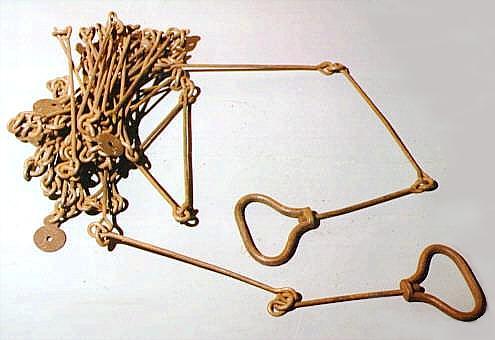
Gunter's Chain Historically used by land surveyors for English/American cadastral measurements. A handy item. A chain is 66 ft. long, made up of 100 links of 7.92 inches each, with a decimal trailer on one or both ends.
1 chain = 66 ft. 1 link = 7.92 in. 25 links or 1/4 chain = 1 rod (also known as a pole or perch) 10 chains = 1 furlong 10 sq. chains = 1 acre 80 chains = 1 mile 24 furlongs = 1 league 4 sq. leagues = 1 township I worked in land surveying before the advent of electronic distance measurement, but by that time the Gunter's chain had been replaced by an ordinary steel tape measure, usually 100 ft. long and marked in decimal feet. Some of the older land descriptions were still measured in the old units, but these were converted to decimal feet for surveying calculations and in current deed descriptions. Bearings were given in DD.MM.SS, and were converted to decimal degrees for calculations, but for some reason were converted back to degrees-minutes-seconds for the legal record. SS |
|
#12
|
|||
|
|||
|
Microfilm-readers and magnetic-tape readers of certain kinds. I don't remember all the details, but back in the 70s, NASA sent a (rather expensive) probe into space and put the data gathered onto magnetic tape, which was the common storage media at the time. Two decades or so roll by during which they are too busy with other stuff, but then they want to look at the data again, and can't read the tape because it has deterioated so much that it peels apart when put through the reader. (Okay, that's strictly more under the heading of "limited longetivty of archive material" plus "failure to immediatly switch storage mediums when new tech comes out"*). So the whole scientific data, gathered at great cost and valuable to many science areas, is irretrievable lost. (Even sending a second probe won't get the same data, as stars have shifted, gone nova etc.)
I think a similar case is with the US census taken in the 50s - it was stored on some computer-based medium which nobody has the reader hardware or software for anymore. The 1870 census, by comparison, was done on paper and therefore can still be used as baseline for comparisions. I've forgotten which kind of magnetic tape/microfiche exactly, but there's one kind which has only three machines in the whole world left, one in Germany, one in Japan, and one in the US(?). The companies that manufactured them went long out of business, the other institutions threw them away. If anything happens to one of the 3 remaining machines, the others will have to be cannabilzed for parts, because spare parts can't be reproduced anylonger. * This is also an unadmitted problem for libraries, esp. with limited budgets. In the 80s and early 90s computer programming books came with 5'' floppies at the back, and were stored in the closed shelf. In the 90s, 5'' are replaced by 3'', and later by CDs. Theoretically, all major libraries should've gone through their catalogues and converted all floppies from big to small and then to CD. Practically, there was no budget to pay a full IT person to be aware of this, or to pay somebody to do the copying, and there was enough normal work to keep people busy, so the books with floppies are still sitting on the closed shelfs, only now no normal PC can read them any longer (if they haven't deterioated already). Last edited by constanze; 02-01-2011 at 12:20 PM. |
|
#13
|
|||
|
|||
|
How do you define "tool"? I mean, from the looks of some of these replies, some machines are being defined as tools..so if you go that route: Nintendo and Super Nintendo is no longer being made.
|
|
#14
|
|||
|
|||
|
Quote:
But then I guess we'd end up arguing over the 5 1/4 floppies. |
|
#15
|
|||
|
|||
|
I think you have to distinguish between sold and manufactured. People sell all kinds of things that are no longer made.
I would posit that no one manufactures blank 8 track tapes anymore. |
|
#16
|
|||
|
|||
|
Surely this theory requires a very liberal definition of the terms "tool" "invention" "technology" "extinct" and "still in use."
I was listening to this story this morning in the car when my GF was dropping me off at the Metro and I immediately turned to her and said, "Iron maiden." |
|
#17
|
|||
|
|||
|
Based on the article, this is my interpretation via an example:
Let's say we answer "roller skate key" (let's assume they are no longer made, even if they are). Well, that would be disqualified, since it's nothing more than a specialized key. Keys are still being made. |
|
#18
|
|||
|
|||
|
Quote:
Now, what format would you like read? I can probably figure a work around to get it onto an external HDD or onto CD or DVD. I don't do blu ray yet so I cant do that. I am hardly the only geek packrat to still have pretty much every computer I have ever owned [though I did give away 2 laptops, an ancient thinkpad and an old HP because people needed them.] |
|
#19
|
|||
|
|||
|
I said "normal PC". That refers to both the PCs in the reading room of the library itself, and to the PC or rather, laptop, that the average student has at home. If you need to ask around to find a specialist in order to read a file, that's not accessible, compared to opening the printed book or popping a CD into the CD-drive on the average laptop.
I have a very old PC at home, too, but it's so old it only has 5'' and 3'' but no CD. I could rig up a home network and transfer the files to my laptop which has a CD-burner. But I'm not going to do this routinly for a guy from the street asking me how to read this old format, maybe for a friend privatly. Most of the students at the university are younger than 30, I wonder if half of them know what a 5'' floppy is. |
|
#20
|
|||
|
|||
|
Printer's quoins?
|
|
#21
|
|||
|
|||
|
Quote:
Quote:
But a lot of this is going to come down to how narrowly you define things, as the 'Model T' versus 'automobile' example. Or, as another example, long-distance communication across electrical wires is very much alive and well, but I seriously doubt any working installations still use telegraph technology (but then again, there are certainly museums with working telegraphs somewhere. If flint knapping is an existing technology, then is anything in a museum that could be repaired an existing technology?) Anyway, not a 'tool' specfically, but my nomination for lost technology is Greek Fire. |
|
#22
|
|||
|
|||
|
Mechanical powder testers. Gunpowder, both smokeless and black, still varies from batch to batch. Mechanical testers have been replaced with more precise electronic equipment.
Edited to add: I'm wrong. Replica flintlock powder testers are still made and sold through such outlets as Dixie Gun Works. Whether anybody actually uses one to test powder is questionable. Last edited by Scumpup; 02-01-2011 at 01:10 PM. |
|
#23
|
|||
|
|||
|
Quote:
|
|
#24
|
|||
|
|||
|
Quote:
I'll take a guess and say that mechanical adding machines are no longer made. There just isn't much use for them with the advent of electronic calculators. I think we ought to also draw a distinction between "in commercial manufacture" and "the occasional one-off built by highly skilled craftsmen" also. There are probably lots of the former, but just about anything could be made by the latter, and IMHO, it doesn't count as "still being made." Last edited by bump; 02-01-2011 at 01:45 PM. |
|
#25
|
|||
|
|||
|
Quote:
|
|
#26
|
|||
|
|||
|
That's exactly what I was thinking of when listening to the NPR story.
|
|
#27
|
|||
|
|||
|
Tape measures marked in cubits.
|
|
#28
|
|||
|
|||
|
#29
|
|||
|
|||
|
I'm 27, and I remember using 5 1/4" floppies in kindergarten and elementary school. They were on their way out even in elementary school, though, and I don't believe I ever saw them in middle or high school. In any event, I would expect a lot of people my age to be familiar with floppies of this size. Current undergrads, though (23 or younger) might not. And I'd be surprised if current high school kids were familiar with them.
|
|
#30
|
|||
|
|||
|
Still made. Besides the busy letterpress community, binderies use them to lock cutting dies in place.
|
|
#31
|
|||
|
|||
|
Nope, Thinkgeek still makes slide rules. www.thinkgeek.com
|
|
#32
|
|||
|
|||
|
Quote:
Last edited by johnpost; 02-01-2011 at 02:24 PM. |
|
#33
|
|||
|
|||
|
Quote:
recently there was a thread where circular ones were still being made; a Japanese company. i have one of there's somewhere. Last edited by johnpost; 02-01-2011 at 02:34 PM. |
|
#34
|
|||
|
|||
|
Button Hooks
|
|
#35
|
|||
|
|||
|
The buttonhook industry is alive and well.
|
|
#36
|
|||
|
|||
|
Why would they junk it? Doesnt make sense to me.
|
|
#37
|
|||
|
|||
|
Quote:
A popular urban myth has the blueprints for the Saturn V either lost or purposely destroyed. The blueprints and other plans still exist on microfilm at the Marshall Space Flight Center. Last edited by RadicalPi; 02-01-2011 at 03:12 PM. |
|
#38
|
|||
|
|||
|
Reel-to-reel answering machine, my neighbor had one, I'm sure they haven;t been made since the 70's.
Hand cranked dental drill and extraction key: http://antiquegadgets.com/dental.html Especially the extraction key - I'm guessing nothing like it is used/made anywhere today. |
|
#39
|
|||
|
|||
|
Quote:
8-inch floppy drives and floppies. I have one in my office, but they were obsolete 25 years ago. Presto Automatic Hot Dogger. Quite the appliance in dorms in the 70s. You put the hot dog between two electrodes and the current cooked them. A guy in the dorm made his own with a couple of nails, some wood, and an electrical cord from the outlet to the nails. Commercial models had interlocks to keep them from electrocuting you. Probably.
__________________
"One never knows, do one?" Provider of quality fantasy and science fiction since 1982. Last edited by RealityChuck; 02-01-2011 at 03:45 PM. |
|
#40
|
|||
|
|||
|
My god, my jaw just locked itself shut after seeing that extraction key.
How about old quack medicine products? Things like the Radium Emminator: http://www.orau.org/ptp/collection/q...umemanator.htm Which is a device intended to infuse your water with uranium. Really. People thought it was healthy. There are a whole bunch of products like that from the same time period. I suppose you could say that modern day radiation therapy for cancer is similar, but that's a real reach. |
|
#41
|
|||
|
|||
|
Looking through old tool catalogs from the late 1800s and early 1990s, I'm sure you could find plenty of tools that are no longer manufactured.
Whenever I've seen such catalogs at estate sales and the like, I swear the names for some of these implements were pulled out of thin air. "Yeah, that's a three quarter inch split jack wrench, that's a johnny-boy rod, that there's a nut lasker, and that's a half-core lay punch with an Unger grip. They ain't don't not make 'em like they used to." Last edited by elmwood; 02-01-2011 at 04:38 PM. |
|
#42
|
|||
|
|||
|
All I can really think of are specialized tools that were specifically manufactured for use with unique items, with precise size, weight or power requirements.
Does anyone think they can find a jig used in the assembly of, say, the wing structures of an extinct aircraft, maybe a B-29? A jig is by every definition a tool. It isn't an end product in itself, like a Saturn rocket. I'm sure a suitable replacement could be made, but I can't imagine that such items are still being sold, whether new or old. |
|
#43
|
|||
|
|||
|
Quote:
|
|
#44
|
|||
|
|||
|
Oh ... awesome idea of yours here ... therefore: "B" size batteries. We still use other sizes, AA, AAA, I have "D"'s in my flashlight and "C"'s in some other, ancient, equipment. But I believe Uncle Cecil covered this, we just don't need the amps "B" cells provide to run motors anymore.
|
|
#45
|
|||
|
|||
|
there are high power devices that still use tubes.
|
|
#46
|
|||
|
|||
|
Quote:
|
|
#47
|
|||
|
|||
|
What about really old computer parts? I am thinking things like mercury delay lines or magnetic core memory? For that matter, there is probably a lot of analog computer technology that isn't made anymore. When I was taking Computer Solutions of Differential Equations in the seventies we went to see an old analog computer used to solve differential equations. The requirements didn't go away, but it was too cheap to simulate the functions on a digital computer.
http://en.wikipedia.org/wiki/Analog_...alog_computers |
|
#48
|
|||
|
|||
|
Going back to computer storage ...
Personal anecdote ... In college in the late 70s I had a job for a professor to pull data off some existing mag tapes which were 200 or 556 BPI. See http://en.wikipedia.org/wiki/IBM_7_track for background. We also had a bunch of irreplaceable data on Remington-Rand ("RemRand") cards, which were a 1940s-1950s competitor to the IBM-format card that all of us from that era are familiar with. IBM won, RemRand lost. See http://en.wikipedia.org/wiki/Punched...C_card_formats In 1979 there was exactly one place in all of greater Los Angeles which still maintained a stable of ratty ancient equipment which could read the 200 BPI tapes & the RemRand cards and rewrite them both on modern ultra-high density 6250BI tape. 10-ish whole Megabytes baby on something big enough to break your toe if you dropped it. Woot!. Greater Los Angeles. The center of Aerospace for the entire planet. A city with hundreds of mainframe data vaults full of engineering & scientific data. Not to mention a bunch of plain old payroll records. One company was all that was left to handle all the old formats. That place was a weird time warp of ancient peripherals & some crazy old coot who kept them all running (sorta). Each job was a gamble; maybe we'd get good data and maybe the whatchamacallit relay would hang. He had a bunch of home-made (or at least home-improved) circuit assemblies to play the role of the computers & controllers which had long since gone to the big data center in the sky. Now that PC parts are made by the billions, there's gonna be a lot more 3-1/2" floppy drives still around decades after they left the mainstream. So reading a 3-1/3 floppy will be readily doable for some time to come as well. Back when 1000 units was a long production run for a model of read/write device, the last one dissappears & all the matching media becomes junk a lot sooner. Last edited by LSLGuy; 02-01-2011 at 06:07 PM. |
|
#49
|
|||
|
|||
|
Quote:
Plenty of people are making CRTs today. I doubt anyone is making CRTs that would be useful W-K tubes. (Another guess might be core memory but, knowing NASA and some of IBM's customers, I have a suspicion someone still has real uses for a few hundred kilobytes of core.) |
|
#50
|
|||
|
|||
|
[Bill Cosby voice] R-i-i-i-i-ight! [/Bill Cosby voice]
|
![]() |
| Bookmarks |
| Thread Tools | |
| Display Modes | |
|
|