The Straight Dope

Go Back   Straight Dope Message Board > Main > General Questions

Reply
 
Thread Tools Display Modes
  #1  
Old 04-29-2012, 02:09 PM
standingwave standingwave is online now
Guest
 
Join Date: Jul 2010
Was Nazi Germany already doomed before the invasion of Normandy?

We watched Rise and Fall of the Third Reich last night on the W̶a̶r̶ History Channel and it certainly supported the view that the Soviets had things more or less under control, combined with RAF and USAAF bombing raids to be sure. What would have happened had there never been a D-Day? Was the invasion as much about securing a Western post-war Europe from the Soviets as it was defeating Germany?
Reply With Quote
Advertisements  
  #2  
Old 04-29-2012, 02:27 PM
Quartz Quartz is offline
Charter Member
 
Join Date: Jan 2003
Location: Home of the haggis
Posts: 18,535
Aren't you forgetting the Allies attacking through Italy? Normandy was a third front, not a second. But the supply lines from Britain and America were much shorter with Normandy.
Reply With Quote
  #3  
Old 04-29-2012, 02:38 PM
Jim's Son Jim's Son is offline
Guest
 
Join Date: Oct 2006
I don't think in war that you want to give your enemy a chance to regroup and prolong the war, perhaps even end up winning it (see Rome in the Second Punic War after some disastrous defeats at Cannae and other places. They wouldn't sue for peace and ended up beating Carthage, leaving a number of people wondering what would have happened if Hannibal had marched on Rome). Certainly Great Britain has never wanted any one nation to become dominant on Europe, be it Spain, France or Germany, They wouldn't have wanted the Soviet Union to rule a huge chunk of Europe. The Americans had a Presidential election coming up in November 1944. I don't know if FDR would have lost if there was no D-Day. But people at home were getting weary about food and gas rationing and having 11 million men away from their families in the military. American and British 'governments could have over estimated how close Nazi Germany was to building an atomic bomb.
They weren't built since Germany was building V-1, V-2 missiles and jet ME-262 fighters, they may have figured they were close to an atomic bomb. The Allies showed a shocking insensitivity to the Holocaust in publicizing it but some part of them must have wanted to finish the war as quickly as possible to minimize that.
Reply With Quote
  #4  
Old 04-29-2012, 03:06 PM
jtgain jtgain is offline
Guest
 
Join Date: Jul 2007
Also, I think by 1944, the Americans and the British had both decided that the end of the war would only be a full and unconditional surrender. No WWI settlement that left Hitler in power with reduced borders.

So, when you pursue that strategy, it is necessary to go all out in pursuit of that goal. Don't take your foot off the throat of a wounded enemy so that they can set up a defense line that stalls you for years.
Reply With Quote
  #5  
Old 04-29-2012, 04:25 PM
Dissonance Dissonance is offline
Guest
 
Join Date: Apr 2003
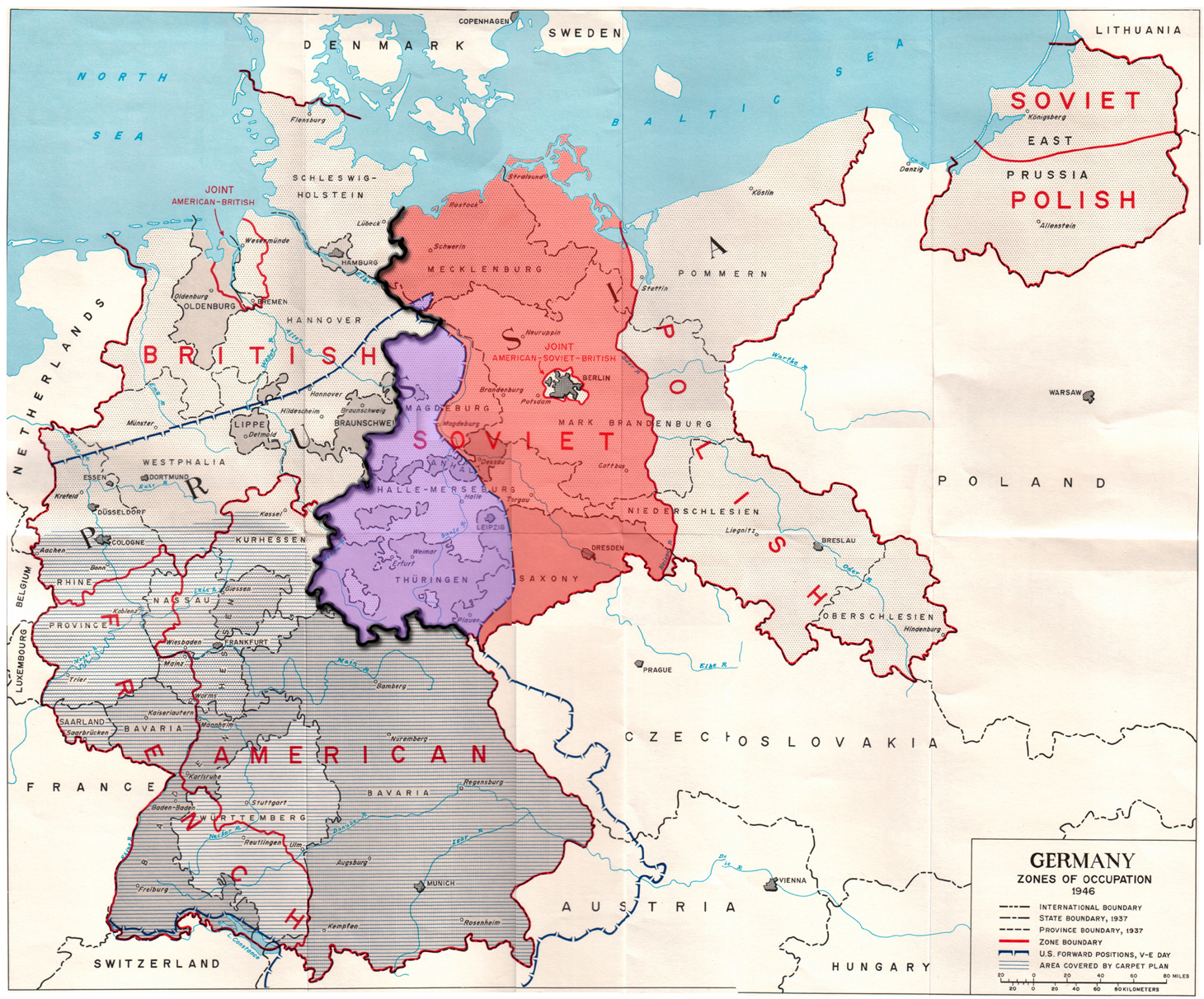
Yes, Germany was doomed by mid 1944, but the invasion at Normandy was about defeating Germany not about how post-war Europe would be divided. As can be seen here the Western Allies didn't stop advancing at the agreed upon post-war demarcation lines since it would be all they would 'get' of Germany after the war but neither did they try to keep the occupied territory for themselves. WW2 was a total war, and as jtgain said the only acceptable outcome for the Allies was complete and unconditional surrender. A number of Germans had delusional hopes about being able to reach a separate peace with the Western Allies both earlier in the war to be able to concentrate on the Soviets and at the end of the war to be able to surrender to the West rather than the Soviets, but they were just that, delusional. During the final surrender negotiations
Quote:
Jodl and Keitel surrender all German armed forces unconditionally: thirty minutes after the fall of "Fortress Breslau" (Festung Breslau), General Alfred Jodl arrived in Reims and, following Dönitz's instructions, offered to surrender all forces fighting the Western Allies. This was exactly the same negotiating position that von Friedeburg had initially made to Montgomery, and like Montgomery the Supreme Allied Commander, General Dwight D. Eisenhower, threatened to break off all negotiations unless the Germans agreed to a complete unconditional surrender.[9] Eisenhower explicitly told Jodl that he would order western lines closed to German soldiers, thus forcing them to surrender to the Soviets.[9] Jodl sent a signal to Dönitz, who was in Flensburg, informing him of Eisenhower's position. Shortly after midnight, Dönitz, accepting the inevitable, sent a signal to Jodl authorizing the complete and total surrender of all German forces.
Reply With Quote
  #6  
Old 04-30-2012, 02:23 PM
633squadron 633squadron is offline
Guest
 
Join Date: Jan 2001
Quote:
Originally Posted by standingwave View Post
We watched Rise and Fall of the Third Reich last night on the W̶a̶r̶ History Channel and it certainly supported the view that the Soviets had things more or less under control, combined with RAF and USAAF bombing raids to be sure. What would have happened had there never been a D-Day? Was the invasion as much about securing a Western post-war Europe from the Soviets as it was defeating Germany?
Did the program advance that view, or is it your opinion? Just curious.

In any event, I know of no evidence that D-Day was about securing Western Europe from the Soviets. In fact, the USSR had been pushing for a Second Front since 1942, as a way of diverting the Germans from the Eastern Front. Stalin wanted Churchill to launch something, even if it failed.

This wasn't at all practical. Churchill, after the failure of Gallipoli that led to the failure of the government in 1915, was certainly in no mood to try anything unless it was going to work. The British and French together were not in a position to invade France in 1942 or even most of 1943. By late 1943, the British and Americans together had enough strength to invade Italy. The strategic importance of that move is under-appreciated. The Italian campaign tied down German forces on a third front, prevented the Italians or Germans from establishing any counter-moves in southern France, and secured the Mediterranean. Having possession of the Mediterranean meant that the Americans could move supplies into the USSR through Iran, while the British could supply India through the Suez.

In mid-1944, the Soviets had stabilized their front with the Germans, but were still primarily fighting a defensive battle. The Normandy invasion tied up even more German forces; by the end of 1944, the western Allies had eliminated the threat of submarines from bases in France. Two weeks after D-Day, the Soviets opened their own offensive.

I seriously think that the Soviets did not want to "invade" all of Europe. They didn't see the point. It would have put them in direct conflict with the US, and they knew that they'd be hard-pressed to win that battle. Yes, they outnumbered us on the ground, but they didn't have the logistical support, air power, or sea power. Stalin figured that he could simply get governments that were sympathetic to the USSR, and leave it at that.
Reply With Quote
  #7  
Old 04-30-2012, 03:27 PM
Jackmannii Jackmannii is offline
Guest
 
Join Date: Oct 2000
D-Day was about winning the war. Not invading was not an option, as the Soviets were an ally and could not be left to carry an overwhelming share of the burden of defeating Nazi Germany by themselves.

If denying the Soviets control of Europe had been so important, the Western Allies would have cut back on supplies to the Soviets and pushed harder to occupy all of Germany for themselves (and quite a few important Germans would have been pleased to help, for fear of Soviet revenge and to attempt to get a softer peace from the Western allies).
Reply With Quote
  #8  
Old 04-30-2012, 03:32 PM
ralph124c ralph124c is offline
Guest
 
Join Date: Mar 2002
German Doom Sealed By August 1943

That date marked the end of Germany's LAST offensive in Russia (Operation Citadel/Kursk). Germany fought for 4 weeks, trying to surround 2 Soviet Army groups in a pincer movement.
It didn't work-the Russians fought them to a standstill-and 56,000 German troops were killed. In addition, over 600 tanks were lost, plus 300 plus aircraft.
These were losses that the Germans cold not make up-from this point on, all the Germans could do was to conduct defensive battles-the end was never in doubt.
That is why the Germans were so dangerous-they kept fighting-long after they had any real chance of winning.
Of course, defeatism was a dangerous philosophy in Nazi Germany-it could get you a bullet in the head.
Reply With Quote
  #9  
Old 04-30-2012, 09:08 PM
Dissonance Dissonance is offline
Guest
 
Join Date: Apr 2003
Quote:
Originally Posted by 633squadron View Post
This wasn't at all practical. Churchill, after the failure of Gallipoli that led to the failure of the government in 1915, was certainly in no mood to try anything unless it was going to work.
Churchill, along with the British general staff were rightly opposed to attempting an invasion of France in 1942 or even 1943 and Churchill was able to persuade FDR against it. The American general staff was much more gung ho about landing in France at the earliest date, even early 42 in Operation Sledgehammer and pushed for a landing in spring 43 in Operation Roundup which eventually became the basis for Overlord.

However, Churchill was still enamored with wild ideas like Gallipoli. He pushed hard for sending the Royal Navy into the Baltic in early 1940 using his idea to heavily modify several Revenge class battleships with super-bulges in Operation Catherine which was thankfully never carried out. The disastrous Dodecanese Campaign in 1943 was also his brainchild, as was the landing at Anzio which he insisted on being pushed through even though there was much less naval lift and available ground troops than he had anticipated. He tried to wash his hands of the whole affair, notably his famous "I had hoped we were hurling a wildcat into the shore, but all we got was a stranded whale." General Lucas became the scapegoat for the failure and was relieved of command. He was a mediocre corps commander at best, but the failure of the operation wasn't his fault; it was faulty at its core and pushed through regardless at Churchill's insistence.

Quote:
In mid-1944, the Soviets had stabilized their front with the Germans, but were still primarily fighting a defensive battle.
I'm a bit confused as to what you mean by this. The Germans were fully on the defensive and continuously being driven back by the Soviets since mid-1943. They were only on the offensive in mid-43 in the failed limited offensive at Kursk; prior to that they had been on the defensive since the Soviet 42/43 winter offensive.
Reply With Quote
  #10  
Old 04-30-2012, 10:21 PM
standingwave standingwave is online now
Guest
 
Join Date: Jul 2010
Quote:
Originally Posted by 633squadron View Post
Did the program advance that view, or is it your opinion? Just curious.
No, I was just wondering what a post-war Europe might have looked like had there never been a D-Day invasion for whatever reason.

Last edited by standingwave; 04-30-2012 at 10:21 PM.
Reply With Quote
  #11  
Old 05-01-2012, 09:55 AM
carnivorousplant carnivorousplant is offline
Romney Voldemort 2016
Charter Member
 
Join Date: Apr 2000
Location: Central Arkansas
Posts: 35,334
Quote:
Originally Posted by Quartz View Post
Aren't you forgetting the Allies attacking through Italy? Normandy was a third front, not a second. But the supply lines from Britain and America were much shorter with Normandy.
The first front being air attack from Britain?
Reply With Quote
  #12  
Old 05-01-2012, 10:13 AM
casdave casdave is offline
Member
 
Join Date: Mar 2000
Posts: 7,204
Nope, there was the invasion of Italy through Sicily.

Also worth remembering the 2nd lot of landings in the South of France - mainly a US show. Worked well too since the Germans were all tied up trying to defend Northern France.
Reply With Quote
  #13  
Old 05-01-2012, 10:21 AM
Earl Snake-Hips Tucker Earl Snake-Hips Tucker is offline
Charter Member
 
Join Date: Jul 1999
Location: South Carolina
Posts: 11,778
Quote:
Originally Posted by 633squadron View Post
Did the program advance that view, or is it your opinion? Just curious.
As I recall, the program advanced little in the way of views. It was a strictly a collection of contemporary home movies made by various people with some narration. No interviews or new footage.
Reply With Quote
  #14  
Old 05-01-2012, 10:25 AM
gunnergoz gunnergoz is offline
Guest
 
Join Date: Jan 2012
What is worth considering is the what if scenario had the D-Day landings failed. Eisenhower had considered the possibility and even had a handwritten note prepared in advance and in his pocket on June 5th/6th, taking all responsibility for the failure as solely his own. Lets say there had been more effective beach defenses, less solid individual initiative by the Allied troops and a faster, more vicious German counterattack on the beachheads - all things that could have happened. The outcome would have been catastrophic for the Allies in the West, both a humiliating setback and at the same time an opportunity for the Germans to gain some sort of initiative in the ensuing shock upon the Allies' morale. There could have been very damaging side effects upon Allied cohesion as well, perhaps with finger-pointing, blaming and political spinoffs on the home fronts on both sides of the Atlantic.

The overall effect might have been to prolong the war long enough to make the Allies' unconditional surrender demand less viable. There might have been increasing political will in the Allied countries to push for some sort of conditional surrender, with some form of German-designed and designated government, instead of the Allies being able to dictate the form of the postwar German state as they did historically.

If the Germans, by this D-Day defeat, got the time and space to manage to put off the Russian advance, such a scenario might have occurred, with unknown implications for the postwar world. Fascism Nazi style might not have been totally stamped out, but instead remained muted and concealed, to fester in postwar years and provide a further irritant in East-West relations.

The likely outcome would have been a much messier Cold War, in other words, with the possibility of a nuclear armed, independent and quite unpredictable German state in the mix.

My two bits, your mileage may vary, etc.

Last edited by gunnergoz; 05-01-2012 at 10:28 AM.
Reply With Quote
  #15  
Old 05-01-2012, 10:36 AM
carnivorousplant carnivorousplant is offline
Romney Voldemort 2016
Charter Member
 
Join Date: Apr 2000
Location: Central Arkansas
Posts: 35,334
Quote:
Originally Posted by casdave View Post
Nope, there was the invasion of Italy through Sicily.

Also worth remembering the 2nd lot of landings in the South of France - mainly a US show. Worked well too since the Germans were all tied up trying to defend Northern France.
So there is an Italian front-Sicily, Anzio, Salerno, a French front-Normandy and Southern France. The third front mentioned above was where?
Reply With Quote
  #16  
Old 05-01-2012, 10:52 AM
AK84 AK84 is offline
Guest
 
Join Date: Apr 2008
Its little known.
Reply With Quote
  #17  
Old 05-01-2012, 10:54 AM
carnivorousplant carnivorousplant is offline
Romney Voldemort 2016
Charter Member
 
Join Date: Apr 2000
Location: Central Arkansas
Posts: 35,334
Quote:
Originally Posted by AK84 View Post
I thought we were talking about the US and Brits.

Thanks.
Reply With Quote
  #18  
Old 05-01-2012, 11:23 AM
notquitekarpov notquitekarpov is offline
Guest
 
Join Date: May 2000
The Southern France front strategically was worthless - the resources required to support it would have been far better retained in Italy and used to accelerate the Normandy landings (especially specialist shipping of which there was a critical shortage).

The USA insisted upon it in part to deliberately hamper the Italian front as they did not trusted Churchill to resist getting them involved in the Balkans. But the Southern France front only happened as a support to Normandy and if Normandy had not happened then Italy would have been going full speed ahead by default.

As an aside, Normandy simply could not have been launched any earlier than Spring 1944 (1 May being original planning date) due to the critical path being a shortage of Landing Ship (Tanks) - LSTs being key to transporting armoured vehicles.

Once it was agreed the Southern France landing had to go ahead (there was a drive from the UK to cancel them and transfer their shipping allocation to the Normandy planning) then D-Day got inevitably delayed from May to June due solely to the need for more LSTs to be delivered to Europe. That month later proved critical in running out of time to finish off Germany before General Winter (weather) intervened.

Amateurs study tactics, professionals follow logistics - which is where the Normandy landings and indeed WW2 was won.

Last edited by notquitekarpov; 05-01-2012 at 11:27 AM.
Reply With Quote
  #19  
Old 05-01-2012, 11:26 AM
Lumpy Lumpy is offline
Charter Member
 
Join Date: Aug 1999
Location: Minneapolis, Minnesota US
Posts: 10,909
Given that the Soviets themselves had been screaming for a second front, to the point that they suspected Britain and the US of deliberately stalling in order to weaken the USSR as much as possible, it's a bit of an exaggeration to say that "they had things more or less under control". The USSR had broken Germany's advance but at a cost western democracies probably couldn't have survived: Everything west of Moscow was more or less a wasteland, Soviet soliders were dying like flies and Soviet workers were almost literally being worked to death as they froze and starved. As late as early 1945 the Germans were inflicting six to one casualties against the Soviets.

The Eastern front was like a velociraptor against an apatosaurus: an incredibly vicious and dangerous attacker against an opponent that only won because it could afford to lose huge amounts of blood and keep fighting.
Reply With Quote
  #20  
Old 05-01-2012, 12:17 PM
Elendil's Heir Elendil's Heir is offline
SDSAB
 
Join Date: Jun 2004
Location: Diogenes Club
Posts: 38,513
Quote:
Originally Posted by Dissonance View Post
...However, Churchill was still enamored with wild ideas like Gallipoli. He pushed hard for sending the Royal Navy into the Baltic in early 1940 using his idea to heavily modify several Revenge class battleships with super-bulges in Operation Catherine which was thankfully never carried out. The disastrous Dodecanese Campaign in 1943 was also his brainchild, as was the landing at Anzio which he insisted on being pushed through....
Heh. William Manchester quoted a War Cabinet aide as saying something like, "When Churchill was right, there was no one better, but when he was wrong, my God...!"
Reply With Quote
  #21  
Old 05-01-2012, 12:58 PM
Dissonance Dissonance is offline
Guest
 
Join Date: Apr 2003
Quote:
Originally Posted by notquitekarpov View Post
The Southern France front strategically was worthless - the resources required to support it would have been far better retained in Italy and used to accelerate the Normandy landings (especially specialist shipping of which there was a critical shortage).
I agree that the landing in southern France was attacking into a strategic vacuum and didn't serve much purpose; however it did provide the benefit of taking Marseilles intact as a major deepwater port, which became all the more important with the failure to secure Antwerp for use as a major supply port as it took until November to clear the scheldt and open up Antwerp to traffic even though the city had fallen on September 4th. From wiki:
Quote:
An expected benefit of Operation Dragoon was the use of the port facilities at Marseilles. The Allied advance after Operation Cobra and Operation Dragoon slowed almost to a halt in September 1944 due to a critical lack of supplies. Thousands of tons of matériel were shunted to Brittany in the French northwest because the ports at Le Havre and Calais were not yet available to the Allies. Marseilles and the southern French railway system were brought back into service, despite heavy damage inflicted during Dragoon. Eventually, the southern route became a significant source of supplies for the Allied advance into Germany, providing about one third of the total Allied requirement.
Quote:
Originally Posted by Lumpy View Post
As late as early 1945 the Germans were inflicting six to one casualties against the Soviets.

The Eastern front was like a velociraptor against an apatosaurus: an incredibly vicious and dangerous attacker against an opponent that only won because it could afford to lose huge amounts of blood and keep fighting.
I'm sorry but this is complete and utter bunk. The Germans weren't enjoying anything close to 6-1 casualty rates at any time other than the invasion of the Soviet Union in Barbarossa where huge bags of prisoners were taken in the encirclement battles. By 1945 the casualty ratio was closer to 1-1, and had been since mid-43 at best. Had casualty ratios been anywhere close to 6-1 the Germans would have handily won the war of attrition on the Eastern front. As it was even with the horrific losses in 1941 it was the Soviets who were on the winning side of the attrition once Barbarossa failed to deliver a knockout blow. Barbarossa didn't come cheap for the Germans either, by November 1, 1941 German casualties had reached 686,000, or 20% of the forces sent to the Eastern Front thus far.

As far as everything west of Moscow being a wasteland, the Soviets were able to relocate huge numbers of factories from the western USSR to east of the Urals before the Germans arrived and were able to maintain a very large lead over the Germans in industrial production throughout the war. They in fact were second only to the US in industrial production, and out produced the US in all categories of ground combat equipment as they had no need to use industry for naval applications and slightly less of a need for aircraft, particularly the more labor intensive 4 engine bombers.
Reply With Quote
  #22  
Old 05-01-2012, 01:14 PM
notquitekarpov notquitekarpov is offline
Guest
 
Join Date: May 2000
Quote:
Originally Posted by Dissonance View Post
I agree that the landing in southern France was attacking into a strategic vacuum and didn't serve much purpose; however it did provide the benefit of taking Marseilles intact as a major deepwater port, which became all the more important with the failure to secure Antwerp for use as a major supply port as it took until November to clear the scheldt and open up Antwerp to traffic even though the city had fallen on September 4th.
But if D-Day in Normandy had been launched a month earlier and with greater punch Antwerp might have been opened up far earlier. Not just the launch date of Normandy was pushed back by Dragoon but the whole pace of the follow up Divisions and supply coming into the beaches.

Also Dragoon led to the broad front strategy adopted by Eisenhower. If we had concentrated on Normandy alone then the Northern Group of Armies tasked with clearing the Low Countries and the direct route to Germany would have had ample troops and been a proper Allied effort rather than an Anglo-Canadian effort starved of Divisions and resources trying to execute the most important immediate tasks.

German should have been defeated in 1944 and almost certainly would have if Dragood had not been launched.

Dragoon was a fatal distraction - Southern France could have been taken from Italy if Italy had had the supply taps left full on. The United Nations only had the resources for two full blooded ground campaigns in Europe - Italy and Normandy and Dragoon was a key mistake.

Sorry for the hijack....
Reply With Quote
  #23  
Old 05-01-2012, 05:01 PM
Dissonance Dissonance is offline
Guest
 
Join Date: Apr 2003
Oh, I agree with you; I was just noting an unanticipated positive that occurred. The whole Antwerp situation was another enormous mistake. The Allies were lucky enough to take the city with the port entirely intact unlike for example Cherbourg where the Germans demolished the port requiring a lot of time to be spent repairing it. Unfortunately after taking the port, the British 11th Armored Division missed the opportunity to immediately cross the Albert canal which would have cleared the estuary and forced the defeat of the 80,000 German troops of the Fifteenth Army who were able to cross the estuary and was responsible for the prolonged and brutal fighting to clear the estuary later. The chance to clear it in early/mid September while the German position was still weak was then missed with all of the focus on Market-Garden. Such is the friction of war though.
Reply With Quote
  #24  
Old 05-01-2012, 05:32 PM
Johanna Johanna is offline
Charter Member
 
Join Date: Oct 1999
Location: Altered States of America
Posts: 10,937
Quote:
Originally Posted by Quartz View Post
Aren't you forgetting the Allies attacking through Italy? Normandy was a third front, not a second. But the supply lines from Britain and America were much shorter with Normandy.
Speaking of Operation Husky (the 1943 Allied move into Italy, starting with Sicily just like Garibaldi), reading your post made me wonder: What must Allied sea access to the Mediterranean (needed for Malta and the North Africa campaigns as well) have been like trying to get past the Pillars of Hercules? One side of the Strait of Gibraltar being Axis-controlled, and the other side an Axis sympathizer.
Reply With Quote
  #25  
Old 05-01-2012, 05:53 PM
septimus septimus is offline
Guest
 
Join Date: Dec 2009
Quote:
Originally Posted by Dissonance View Post
... the landing at Anzio which [Churchill] insisted on being pushed through even though there was much less naval lift and available ground troops than he had anticipated. He tried to wash his hands of the whole affair, notably his famous "I had hoped we were hurling a wildcat into the shore, but all we got was a stranded whale." General Lucas became the scapegoat for the failure and was relieved of command. He was a mediocre corps commander at best, but the failure of the operation wasn't his fault; it was faulty at its core and pushed through regardless at Churchill's insistence.
Letting American field commanders undertake a British-planned expedition they didn't understand or agree with may have been a key mistake. Certainly, some commentators would assign much more of the blame to Lucas and much less to Churchill than Dissonance does. At Wikipedia we find
Quote:
Originally Posted by John Keegan (noted military historian)
Had Lucas risked rushing at Rome the first day, his spearheads would probably have arrived, though they would have soon been crushed. Nevertheless he might have 'staked out claims well inland... [instead Lucas's actions] achieved the worst of both worlds, exposing his forces to risk without imposing any on the enemy.
And despite the mistakes, Anzio cannot be considered a complete disaster. Casualties finished up about equal on the two sides; the Anzio landings were useful practice for Normandy; the beachhead did survive and ultimately played a role in the destruction of German forces in Italy.
Reply With Quote
  #26  
Old 05-01-2012, 06:22 PM
septimus septimus is offline
Guest
 
Join Date: Dec 2009
Quote:
Originally Posted by Johanna View Post
What must Allied sea access to the Mediterranean (needed for Malta and the North Africa campaigns as well) have been like trying to get past the Pillars of Hercules? One side of the Strait of Gibraltar being Axis-controlled, and the other side an Axis sympathizer.
With the exceptions of the International zone of Tangier and the Rock of Gibraltar, the coasts near the Strait of Gibraltar all belonged to Spain during the War years; and Spain effectively annexed Tangier the same day that Paris fell. Despite his sympathies, Franco maintained neutrality. (Hitler said ""I prefer to have three or four of my own teeth pulled out than to speak to that man again!" in response to Franco's terms for joining the Axis.)

Nevertheless, control of the Straits by Britain's Gibraltar fortress, despite repeated bombings by the Axis, does seem remarkable.
Reply With Quote
  #27  
Old 05-01-2012, 07:29 PM
Dissonance Dissonance is offline
Guest
 
Join Date: Apr 2003
Quote:
Originally Posted by septimus View Post
Letting American field commanders undertake a British-planned expedition they didn't understand or agree with may have been a key mistake. Certainly, some commentators would assign much more of the blame to Lucas and much less to Churchill than Dissonance does.
Keegan was criticizing Lucas' actions, which he surely deserved, not assigning a greater share of the blame to Lucas than to Churchill. There were plenty of poor decisions and leadership at all levels from Churchill down through Alexander to Clark and to Lucas, but the ultimate failure was the insistence to carry out the flawed operation rests with Churchill. Clark, an Anglophobe and rather inept commander who has the dubious distinction of being the only general to have his own men get Congress to hold a hearing on his conduct had told Lucas not to stick his neck out. It wasn't an American expedition; half of the landing force was British. As far as driving into Rome or staking claims inland, meaning the Alban Hills, the words of Major General W.R.C. Penny, commander of the 1st British Division who was enormously critical of Lucas sums it up best "We could have had one night in Rome and 18 months in P.W. camps." The size of the landing force was simply too small, and size and speed of arrival of German forces for the counterattack to large and swift for the landing to have accomplished anything.

Quote:
And despite the mistakes, Anzio cannot be considered a complete disaster. Casualties finished up about equal on the two sides; the Anzio landings were useful practice for Normandy; the beachhead did survive and ultimately played a role in the destruction of German forces in Italy.
It wasn't a disaster, but it was as much of a folly as Gallipoli. None of the troops who landed at Anzio were at Normandy so it wasn't of much use as practice for that; the forces at Anzio that later invade France did so in Operation Dragoon, the invasion of southern France. The whole point of landing at Anzio was to break the stalemate in Italy on the Winter Line and Cassino in particular. Instead of achieving that, all it did was create another stalemate. Carlo D'este wrote an excellent, detailed and evenhanded account of the battle in Fatal Decision: Anzio and the Battle for Rome.
Reply With Quote
  #28  
Old 05-01-2012, 08:40 PM
Sailboat Sailboat is offline
Guest
 
Join Date: Aug 2005
Any argument that "forces could have been better used in Italy" is suspect -- the long axis of the Italian peninsula was the most defensible terrain in Europe, and the Allies never did entirely get through it. Germany collapsed from every other direction while still holding on in the Italian front, and anyone with a relief map could have predicted it. Every man and bullet sent to Italy was subtracted from the war as well as if he'd been stranded on the moon.

Last edited by Sailboat; 05-01-2012 at 08:41 PM.
Reply With Quote
  #29  
Old 05-02-2012, 05:20 AM
septimus septimus is offline
Guest
 
Join Date: Dec 2009
Quote:
Originally Posted by Sailboat View Post
Every man and bullet sent to Italy was subtracted from the war as well as if he'd been stranded on the moon.
Isn't the argument that Germany maintained a large Army in Italy that they could have sent to another front if there was no large Allied Army in Italy?
Reply With Quote
  #30  
Old 05-02-2012, 08:23 AM
ralph124c ralph124c is offline
Guest
 
Join Date: Mar 2002
Quote:
I'm sorry but this is complete and utter bunk. The Germans weren't enjoying anything close to 6-1 casualty rates at any time other than the invasion of the Soviet Union in Barbarossa where huge bags of prisoners were taken in the encirclement battles. By 1945 the casualty ratio was closer to 1-1, and had been since mid-43 at best. Had casualty ratios been anywhere close to 6-1 the Germans would have handily won the war of attrition on the Eastern front. As it was even with the horrific losses in 1941 it was the Soviets who were on the winning side of the attrition once Barbarossa failed to deliver a knockout blow. Barbarossa didn't come cheap for the Germans either, by November 1, 1941 German casualties had reached 686,000, or 20% of the forces sent to the Eastern Front thus far.

Correct-and this total included over 240,000 dead-the best of the front line troops.
That is why a meeting of the top Nazi leadership was held in November 1941-and Hitler uttered the phrase "how shall I end this war?". That was really an admission that Barbarossa was more that the Germans could handle.
Yes, the Germans were still able to be on the offensive through 1942-but the end was never in doubt-Germany would lose-time was NOT on their side.
Reply With Quote
  #31  
Old 05-02-2012, 09:28 AM
AK84 AK84 is offline
Guest
 
Join Date: Apr 2008
Quote:
Originally Posted by Dissonance View Post
:


I'm sorry but this is complete and utter bunk. The Germans weren't enjoying anything close to 6-1 casualty rates at any time other than the invasion of the Soviet Union in Barbarossa where huge bags of prisoners were taken in the encirclement battles. By 1945 the casualty ratio was closer to 1-1, and had been since mid-43 at best. Had casualty ratios been anywhere close to 6-1 the Germans would have handily won the war of attrition on the Eastern front. As it was even with the horrific losses in 1941 it was the Soviets who were on the winning side of the attrition once Barbarossa failed to deliver a knockout blow. Barbarossa didn't come cheap for the Germans either, by November 1, 1941 German casualties had reached 686,000, or 20% of the forces sent to the Eastern Front thus far.

As far as everything west of Moscow being a wasteland, the Soviets were able to relocate huge numbers of factories from the western USSR to east of the Urals before the Germans arrived and were able to maintain a very large lead over the Germans in industrial production throughout the war. They in fact were second only to the US in industrial production, and out produced the US in all categories of ground combat equipment as they had no need to use industry for naval applications and slightly less of a need for aircraft, particularly the more labor intensive 4 engine bombers.
Correct and for illustration just look at 1941, 42 and 43. In 41, the Germans launch a big offensive across three fronts. In 1942, its just on the Southern Front. In 1943, its in one sector of one front. They were bleeding men and were being worn down.

Further, the "Western Democracies would not tolerate these kind of casualties" is frankly bullshit. Any country which has a genocidal war imposed on it would react they way the Soviets did, they it was literally victory or death for them.
Reply With Quote
  #32  
Old 05-02-2012, 12:34 PM
Sailboat Sailboat is offline
Guest
 
Join Date: Aug 2005
Quote:
Originally Posted by septimus View Post
Isn't the argument that Germany maintained a large Army in Italy that they could have sent to another front if there was no large Allied Army in Italy?
IMHO it wasn't all that large. But more to the point, to ATTACK against prepared positions, the Allies needed a proportionately larger army. The traditional ratio is 3:1 for "generic" assaults, but of course, the mountainous spine that dominates Italy and is cut repeatedly by rivers running perpendicular to the axis of Allied advance (say that three times fast!) would suggest using more than 3:1 odds.

All those Allied troops and resources could have been used elsewhere just like the Germans they were supposed to be tying down...and that "elsewhere" would almost certainly have terrain better suited to breakthrough and advance.

Imagine you're a German strategist. You know the Allies are going to attack you, with significant force -- you can't avoid it. Given that, where would you be least concerned about the results? I imagine there was relief in the German General Staff HQ when they learned of the Allied advance into the toe of the Italian boot.
Reply With Quote
  #33  
Old 05-03-2012, 02:02 PM
DeptfordX DeptfordX is offline
Guest
 
Join Date: Sep 2008
Quote:
Originally Posted by gunnergoz View Post
What is worth considering is the what if scenario had the D-Day landings failed. Eisenhower had considered the possibility and even had a handwritten note prepared in advance and in his pocket on June 5th/6th, taking all responsibility for the failure as solely his own. Lets say there had been more effective beach defenses, less solid individual initiative by the Allied troops and a faster, more vicious German counterattack on the beachheads - all things that could have happened. The outcome would have been catastrophic for the Allies in the West, both a humiliating setback and at the same time an opportunity for the Germans to gain some sort of initiative in the ensuing shock upon the Allies' morale. There could have been very damaging side effects upon Allied cohesion as well, perhaps with finger-pointing, blaming and political spinoffs on the home fronts on both sides of the Atlantic.

The overall effect might have been to prolong the war long enough to make the Allies' unconditional surrender demand less viable. There might have been increasing political will in the Allied countries to push for some sort of conditional surrender, with some form of German-designed and designated government, instead of the Allies being able to dictate the form of the postwar German state as they did historically.

If the Germans, by this D-Day defeat, got the time and space to manage to put off the Russian advance, such a scenario might have occurred, with unknown implications for the postwar world. Fascism Nazi style might not have been totally stamped out, but instead remained muted and concealed, to fester in postwar years and provide a further irritant in East-West relations.

The likely outcome would have been a much messier Cold War, in other words, with the possibility of a nuclear armed, independent and quite unpredictable German state in the mix.

My two bits, your mileage may vary, etc.
Surely the more likely scenario if the Germans manage to stave of defeat a few months is the regieme going down in a string of nuclear fireballs, Berlin first, until they did unconditionally surrender.
Reply With Quote
  #34  
Old 05-03-2012, 03:30 PM
md2000 md2000 is offline
Guest
 
Join Date: Feb 2009
The suggestion was that the Dieppe raid in 1942 was a suicide mission to demonstrate to Stalin that the Normandy front was a difficult problem which would require massive resources.
Reply With Quote
Reply

Bookmarks

Thread Tools
Display Modes

Posting Rules
You may not post new threads
You may not post replies
You may not post attachments
You may not edit your posts

BB code is On
Smilies are On
[IMG] code is Off
HTML code is Off
Forum Jump


All times are GMT -5. The time now is 12:40 AM.


Powered by vBulletin® Version 3.7.3
Copyright ©2000 - 2013, Jelsoft Enterprises Ltd.

Send questions for Cecil Adams to: cecil@chicagoreader.com

Send comments about this website to: webmaster@straightdope.com

Terms of Use / Privacy Policy

Advertise on the Straight Dope!
(Your direct line to thousands of the smartest, hippest people on the planet, plus a few total dipsticks.)

Publishers - interested in subscribing to the Straight Dope?
Write to: sdsubscriptions@chicagoreader.com.

Copyright © 2013 Sun-Times Media, LLC.