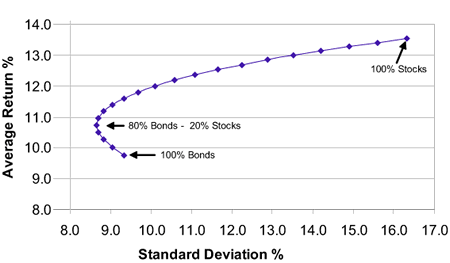
While I’m going to answer the OP’s question, this is rather general investing advice and represents my philosophy.
In general, you want to be invested in things with the highest average returns and lowest correlations. Bonds are not particularly correlated with stocks, but they aren’t 100% uncorrelated. In order to get as many different things as possible uncorrelated with each other, you want to spread out into as many different fields as you can find reasonable investments in and can stomach the time the manage them. For me, this is a lot of different things, but it sounds like for OP, not so much. The easiest way to get this kind of diversity is a retirement target date fund, but these are funds of funds and thus have two levels of fees. If you can do the same balancing yourself, you can save one layer of fees. But if you don’t want to bother and like the idea of division of labor, just throw it all into a retirement target date fund offered by Fidelity. Which target date to use if you’re smack in the middle of two, or are just unsure, depends on your tolerance for risk.
Going beyond that, if you can handle rebalancing 2 things, they should be a total stock market fund and a total bond market fund. I use Schwab, so I’ll just tell you that with them there are SWTSX and SWAGX. Develop a plan, either using internet resources or paying an advisor an hourly rate to come up with one, in which your allocation between the two slowly trends more towards bonds as you age. At least once a year buy and sell to get to the allocation desired for the current year.
If you feel like you can juggle more things, you can add a small-cap fund like SWSSX and change your main large-cap fund to an S&P 500 fund like SWPPX. Stocks of smaller companies tend to not be as correlated as the stocks of large companies, so your rebalancing is more likely to catch each of them when they’re out of equilibrium and thus get yourself a small bump in return by buying low and selling high. Again, develop a plan where you slowly move out of both equity funds and into bonds, and rebalance at least once per year.
If you want to juggle even more, you can look at a mid-cap fund like SWMCX, large-cap growth like SWLGX, and large-cap value like SWLVX. The more slices that you cut your portfolio into that are likely to be uncorrelated, the more you can gain from rebalancing by selling each segment at higher than average prices. If you have a taxable account in addition to your retirement accounts, I would recommend holding some international index funds, perhaps even branching out into international small and emerging markets equity funds. You could diversify into these in a retirement account, but you’ll pay foreign taxes on dividends and can’t claim the foreign tax credit. I wish I could find, but have yet to see, an international equity fund specifically designed to be held in retirement accounts by only investing in companies that either don’t pay dividends or are domiciled in countries that respect IRAs’ tax-free status, such as Canada, or countries that don’t tax dividends, like Singapore. (See here, down at the bottom - search for Singapore). You can instead invest in individual stocks in those places, but that entails more risk and more need to watch the market and pay attention.
So I’ve mentioned the various types of equities there are out there you could consider diversifying into, but there are also various types of bond investments to consider. When you’re young, you probably don’t want anything in ultra-safe investments besides an allocation to cash that you still put into the riskiest cash money market there is available, but there are bond investments that entail more risk and thus have higher return associate with them. There are three main categories here: Floating rate loans, Sub-investment grade Corporate bonds, and Emerging Market or even Frontier Debt. You can find funds paying around 6% for each of these, which is less than the average yield on stocks, but is comparatively safer while not resorting to the more anemic 3% on high quality corporate bonds or 2% on Treasuries or CDs. These are particularly suited to retirement accounts if you have a taxable account as well, since they produce ordinary income (not capital gain or qualified dividends), which you want to keep out of your taxable accounts as much as possible.
The story doesn’t stop with stocks and bonds though. And I’m not talking about options, futures, commodities, and such, as those are more gambling unless you’re in the business and want to hedge your holdings. I stay way away from those, since I like being a passive investor and staying with index funds. I have time to commit to rebalance frequently, but not to do research. Anyway, there’s other investments that are available to retail investors that are relatively new that I’ve gotten involved with and have a small portion of my portfolio devoted to.
One is peer-to-peer lending. I’m not going to mention any specific sites, you can use google to find some. Each loan is extremely risky, but with $25 minimum investments, you can diversify quite a bit. You can automate your investing and get a reasonable return, or you can take the time to look at each borrower’s credit profile and not invest in the ones you think are less likely to pay them back and hopefully enhance your reward. I’m somewhat concerned about what returns are going to be like once the next recession hits, but these sites offer access to an asset class that’s not available elsewhere, and as I said up front, diversity is my number one goal.
And then there’s real estate. If you’re really rich, you can invest directly in real estate, but most of us don’t have the kinds of funds to do so with commercial buildings and don’t either want to put a large percentage of our assets into a rental home or just plain don’t want to be land lords. There are mutual funds that invest in publicly traded REITs, and you can stick with them if you’re really risk averse and want to stay on your broker’s website, but there are a number of crowdfunding real estate websites set up that you can again use google to find that offer higher rates.
Both of these last two are long-term investments. Don’t put very much money into them, and don’t expect to be able to access it easily. Despite those cautions, I feel they are very good ways to diversify your portfolio beyond what’s offered at your broker. Both offer the ability to set up an IRA which you can roll over funds from a retirement account into, which is almost definitely what you want to do for them because they’re taxed as ordinary income (although with real estate, you might get the 20% pass-through deduction on REIT dividends - still not as good as qualified dividends though). Put less than 5% of your portfolio into each, and you’ll hopefully smooth things out a bit, having investments that are less correlated than if you stick to stocks and bonds.