Classic prank on newcomers to Galaxy Club. The smart ones build a mirror in advance to reflect it back, but most are caught unawares. One of the days these hazing rituals are gonna hurt someone!
A couple of reasons. One is that there are several important properties of the radio-frequency part of the EM spectrum that makes it well-suited for long-distance communication, not just terrestrially, but with our distant spacecraft, and so we use the RF spectrum for that purpose. The supposition is that at least at some point in their history extraterrestrial civilizations would have done the same. In the process, we’ve been building more and more powerful transmitters to do so. If we were looking at the solar system from a great distance and could “see” in the RF part of the spectrum, the earth would be (relatively) a bright source of RF radiation, even compared to the sun itself at certain frequencies. Conversely, as stated earlier, the exact opposite is true anywhere around the visible light part of the spectrum, where the sun overwhelms everything else by many orders of magnitude.
So detecting the leakage of such radio waves from some extraterrestrial civilization is one of the hopes of initiatives like SETI. But another possibility that SETI pins its hopes on is that, again because of the presumed ubiquity of RF for long-distance communication, there might be aliens out there intentionally producing encoded signals and transmitting them at very high power and perhaps directionally. The odds of catching such a signal due to a lucky confluence of time and space are incredibly unlikely, but it would be a shame if we missed it!
Of course, the word “lucky” here may turn out to be ironic. There is some disagreement about whether we should respond to such a message if we received one!

I’m weighing up whether to start a thread on the Dark Forest. I still don’t think it works as a Fermi paradox solution, but Kurzgesagt recently had an interesting take on it, with species preemptively firing off relativistic bombs.
And of course, it’s also possible that aliens are sending out strong, tightly-beamed radio signals precisely because they want to talk to us, which is another possibility that SETI is looking for.
According to Dave Barry, if we want to really get serious about space travel, we need to convince all the planet’s raccoons that there is food out there and they will find a way to get to it. 
Isn’t that one of the speculative answers in pretty much any and every Fermi Paradox discussion?
I’m not sure I’m following you here, and maybe my summary was insufficient.
In Kurzgesagt’s version of the dark forest, different species have vastly different abilities to wage war or defend themselves (this is indeed how pretty much anyone would see it, as with Homo sapiens mere centuries of technological progress would mean the power of trivial extermination of the inferior side).
However, they posit that a relativistic bomb – a chunk of mass of maybe just a few kg accelerated to 99% c or higher – would be essentially impossible for any species to defend against. Given that reality, the logic is that a species may send out such bombs preemptively fearing such an attack by any other species at any time.
It’s an interesting take, as I say, and does deal at least partly with one of my objections to the dark forest (that species reluctant to send signals should also be reluctant to go kill other species, as both are a kind of “signal” and the latter also signals to anyone watching that you are hostile). But not all of my objections.
It also of course implies all sentient species would be incredibly fragile. Relativistic bombs will eventually be something affordable to any rogue faction. (And if the logic holds up for inter-species preemptive annihilation, it holds for planets or even nations of a single species).
Which is pretty much the premise of this pair of books from 1987. It is a really old idea.
Well I did say “interesting take” not necessarily new.
But the thing that was interesting to me was the preemptive strike before even making contact with the other species. AFAICT from that synopsis, that’s not quite what that novel is alluding to, and not the normal way the dark forest is presented.
But regardless whether it was a new or old framing, it was food for thought for me.
Dogs, too says the guy who’s still trying to figure out how our pair made a box of crackers that were on top of the refrigerator fall to the floor
If you want a detailed description of this strategy, I recommend The Killing Star, by Charles Pellegrino and George Zebrowski. The Solar System is pre-emptively attacked as soon as the aliens detect craft capable of interstellar flight.
A series of extracts from this book can be found here.
http://www.projectrho.com/public_html/rocket/spacegunexotic.php#id--Relativistic_Weapons--The_Killing_Star
When I was kid, Mars seemed to be to covered in canals, or at the very least seasonal vegetation. This turned out to be an illusion.
Meanwhile Venus also appeared to show signs of life, or at least signs of activity. The dark side of Venus seemed to emit a faint light, which might have come from forest fires, lightning, volcanic activity or even city lights. They called this the Ashen Light.
Since the Ashen Light has not been sighted in recent times, the consenus seems to be that it is an illusion. From the point of view of a Martian astronomer, Earth’s city lights would be similarly elusive.
No, that’s exactly what the novels are about.
Sometimes alien species choose to preemptively kill any other intelligent aliens that they detect. In this case, the species sends our millins of von Neumann devices with super-science technology in all directions. One finds Earth, converts the moon Europa into a lump of neutronium and a lump of antineutronium and drops them onto Earth, where they sink to the core, orbiting each other in the near-vaccum that is ordinary matter until they collide. Meanwhile, a massive fleet is grown under the ocean to break apart water and make millions of hydrogen fusion bombs, which are lined up in underwater tectonic plate boundries. When the neutrinium bomb goes off, so do the hydrogen bombs, the entire Earth (along with the vast majority of its life) becomes a new asteroid belt.
But meanwhile other alien von Neumann probes have showed up chasing the killer probes, too late to save Earth but in time to build a few arks to take a few thousand humans (and as much cultural data as possible) to Mars to start over.
That’s the first novel. In the second, the remnants of humanity meet their saviors, who are a coalition of survivors of attacks by kill-first alien civilizations. Their law is that any species that has a kill-first policy gets a sentence of death. So a human-alien fleet locates and travels to the solar system of the aliens that made the killer probes and destroys every planet in it.
When they got out their beer, they slammed the door too hard and, presto – floor crackers!
Sunlight and artificial light are two distinctly different forms of light. The difference can be detected if we look for it. Right now, scientists are trying to determine if there is water on several planets that have been discovered.
We just need to retune some of these detectors to look for artificial light.
Yannow, it’s almost like you never read any of the replies between your original post and now coming back to repeat it. You asked whether we agree or disagree with your proposition. The answer was clear: it’s “disagree”.
Where in the spectrum below do you think artificial lighting would fall? And how much energy do you think all the lights on earth emit compared to the energy output of the sun (which, incidentally is about 3.9 x 1026 watts, of which about 1.7 x 1026 is visible light)? The energy consumption of the entire planet – in all forms – is 14 orders of magnitude smaller than this, and the light energy emitted to space is probably at least four orders of magnitude smaller still. So how do you propose detecting some hypothetical emission at an unknown frequency that represents 0.000000000000000001 of the energy blasting out from the star in the visible spectrum and is somewhere smack in the middle of that spectrum?
The detection of exoplanets, or water in their atmosphere, is a different matter entirely. When using the transit method of detection, the amount of dimming caused by a planet’s transit is very small, perhaps as much as 1% but usually smaller, but roughly of that order of magnitude, which is certainly realistic to detect even if it’s a few magnitudes smaller. It takes even more sensitive high-resolution spectroscopy to detect the spectral absorption lines of water in the planet’s atmosphere, but you’re dealing with sunlight/starlight passing through the atmospheric rim of an entire planet (and generally a pretty big one).
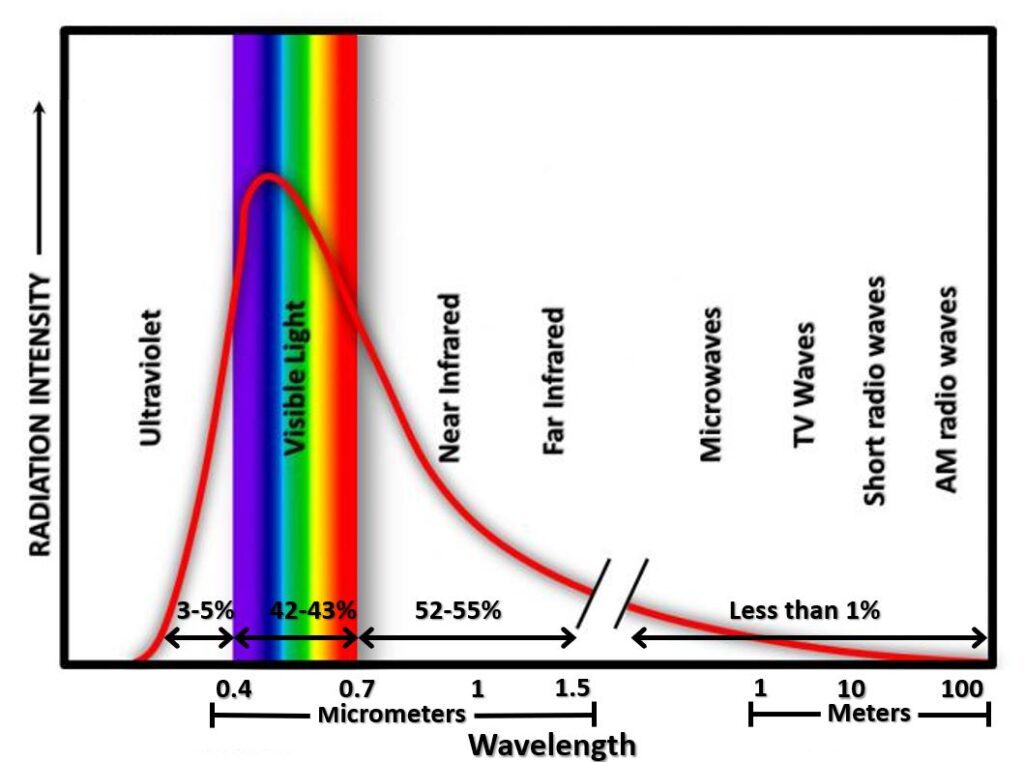
It would be worthwhile rereading my reply to your earlier post.
The idea that they are distinctly different basically isn’t true in context. Yes, given two sources of sufficient brightness to perform spectral analysis it is easy to tell the difference. But artificial light is so utterly feeble in power compared to stellar sources that the task is physically impossible. It isn’t just a matter of better sensors, or specifically tuned sensors. There are fundamental limits of the signal to noise possible. Artificial light sources will be so utterly swamped in the noise as to be impossible to detect no matter what the technology you might have to hand. Even in free space with no background light, no nearby sun to provide any other light, it is unlikely that even single photons would be detectable at the ranges involved.
It just isn’t possible from physical fundamentals.
There is a chance that very large artificial megastructures, such as orbiting Dyson swarms or structures supported by gas or light pressure, might emit detectable amounts of waste heat. Indeed, Dyson himself suggested that such waste heat could be detectable under certain circumstances.
Detecting waste heat is somewhat different to detecting artificial illumination, but it may be the first indication we get of the existence of advanced civilisations.
More than a chance. Assuming that what we know of about thermodynamics holds up, it is a certainty.
That said, maybe we don’t know about “one simple trick that your physicist doesn’t want you to know” that violates thermodynamics and would render such structures invisible in infrared, but it’s not where I’d put my money.