There are still classical mods at Oxford, though Wikipedia says that
it evolved in the 21st century from 11 or 12 three-hour papers across seven consecutive days into 10 or 11 three-hour papers across seven or eight days.
and that there are now options for promising students who have not learned Latin or Greek at A-level, namely taking beginners’ Latin or Greek.
If you really wanted to dazzle the academics at Medieval Oxford, just bring along some ballpoint pens. They’d be totally agog.
But I don’t see the point of trying to attend the classes there. I’d be bored stiff with the theology, which was the main course of study. At some later time they added law and medicine. I’d also be bored with the former and outraged with the latter.
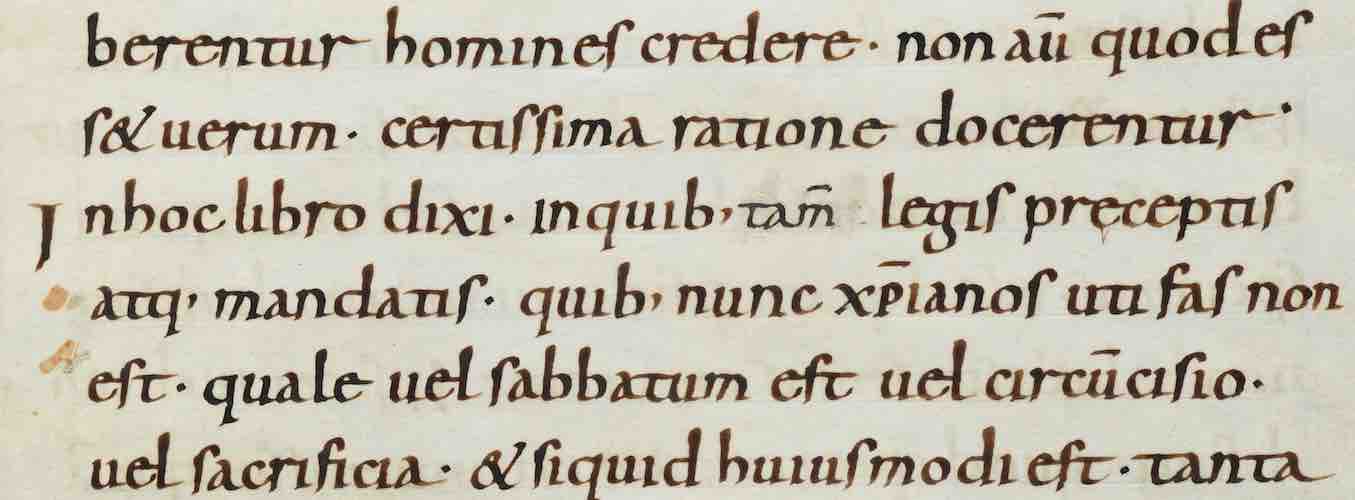
Yep. Better get good at reading Carolingian minuscule because that’s what your texts will be written in.
Notice, though, that the text in that image is in fact punctuated. Punctuation in European writings actually goes back to the 5th century BCE. Classical Greek playwrights used it to indicate pauses. Punctuation first appeared in England in the 10th c. CE, but didn’t become common until the Norman Conquest. Medieval scribes, especially monastic ones, expected the texts to be read aloud, and punctuation served for them the same purpose it had for Aristophanes and Euripides: to tell the reader when to breathe.
So they’ll change the way the write to something ballpoint pens are good at. Assuming they have a sufficient supply of them, which unless you brought back a huge amount, they won’t have.
Ballpoint pens are made with printing ink (at least that is one story about Biro), so, with all that tech, setting up a small press would be more valuable to the university (though people are already going back and forth through a time vortex and buying 4th-millennium textbooks, right?)
Although available in a wide assortment of colours and therefore potentially interesting for something like illuminated manuscripts, from many perspectives ballpoint pens are not that exciting compared to a simple quill. (The exception is portability, but that does not matter when sitting at a desk.) A well-engineered metal nib, on the other hand, is fantastic, because you do not have to waste all that time cutting quills.
That’s also definitely true, to a far greater degree, of astronomy, arithmetic, and geometry. Likely also logic. I don’t know enough of the history of grammar and rhetoric to say, there, but I wouldn’t be surprised if it were so.
The frontiers of mathematics are far more difficult nowadays than they were then, but they’re different frontiers. The stuff they were teaching in universities then, we teach to elementary-school students, because we’ve since learned how to teach them much better. Except you won’t be using the elementary school methods; you’ll be expected to use the God-awful medieval methods.
In other words, you’d already know most of the material, but there’s no way you’d be able to pass a medieval test on it.
Who’s talking about institutions? I’m talking about people who actually did the writing. Using a quill is slow and cumbersome. They knew that, but didn’t have anything better. Give them something lots better and they’ll drop the quills in a heartbeat. And while a metal nib is better than a quill, it’s not that much better. There’s a reason the vast majority of people do not use quills or nibs any more.
I was in Pakistan during the 1970s and our Catholic school didn’t allow ball point pens until 1982. I bet the scholar monks of the twelfth century had more in common with the Brothers running our school than the second half of the 20th century in the United States.
Our tennis club did not allow newfangled metal or fiberglass “racquets” for about ten years after all professionals were using them.
You mean, the people in the institution? Because medieval scribes were very much part of a larger institution that dictated their methods.
But it isn’t better for the writing they were doing, is my point.
It’s not like they didn’t have non-quill tools for jotting down quick words - wax tablets and silverpoint pens and chalk were all available in this period. But none of those would do for manuscript work.
The vast majority of people don’t use ballpoints, either.
If they aren’t better, then why did ballpoints replace fountain pens for pretty much all uses as soon as they were invented? Yes, some schools held out using fountain pens for quite a while (the first pen I was taught to use in a Catholic grade school was a fountain pen) but they were teaching an archaic technology.
Only because a new tech (computers) is displacing them. It’s not because they’re going back to fountain pens or quills.
By this time, the scripts used were completely different.
And because the outputs of that new tech are desirable.
The outputs of ballpoint pens would not be desirable for medieval scribes. The equivalent of medieval manuscripts weren’t the handwritten notes a ballpoint pen is used for. They are printed pages. Moveable type is what replaced the scribes.
I missed this thread first time around. Fascinating.
I think you would have to go the Mass all the proper times, but righteous? You’d be a college student, and back then they were even less righteous than us. There were frequent student - townspeople riots at Oxford, if I remember the history when I visited the university.
I’m not sure about English universities, but in Germany a student paid a professor per lecture, not the university for a package deal. So, bring money.