And finally, when the RCMP showed up to give my brother the evacuation notice, he said he understood but had been instructed to meet with the rest of the fire department shortly. The officer responded with, “if you are not leaving now, sir, I’ll need your name, date of birth, and the name of your dentist.”
I hope this never happens to me, but I read a book on forest fires and there’s a famous (?) instance of a fire on a mountain. Several firefighters were caught above the fire, which was racing up towards them. All of them scattered to the sides or upwards to race the fire. One firefighter recognized the futility of that and did the unthinkable - He started a new fire right at his feet!
Why?
The new fire ate through the combustible material in his vicinity. He followed it up the mountain and by the time the lower fire reached the spot where he had been, he was safely away from the firefront and survived. The remainder of his colleagues sadly died.
Of course, this is an extreme example and nobody except professionals should be starting forest fires.
I’ve heard that, in a grass fire, you should run straight towards the flames, through them, and to the already-burned area on the other side. I take it that that doesn’t work with a forest fire?
The grass fires I’ve seen are just a thin line of fire moving outward. The grass quickly burns to the ground with nothing burning behind it. I would guess that there’s lots of fuel for a forest fire. It takes a long time for trees and all the debris to burn up, so it seems the fire would be a lot thicker between the leading edge and charred remains.
Grass fires are significantly different than forest fires. Grassland is typically sparsely filled with dry material suitable for sustaining a fire and does not have a sufficient concentration of fuel to generate intense heat. Dense forest, on the other hand, will have a bed of decaying material and deadfall or standing dead trees and branches which are perfect fuel, as well as resin-filled live trees that are basically torches once the outer sap layer is consumed. The intense burning and reflection of heat from the canopy and nearby trees can concentrate enough heating to get temperatures several hundred degrees above the autoignition temperature of bare dry foliage. (This is the same reason that the temperatures of fires in the WTC Towers #1 and #2 could cause the steel structure to fail despite the autoignition temperature of Jet-A being much lower than the temperature at which the steel structure should have failed; the heat, which had nowhere to go, caused the temperature to increase monotonically until structural failure.)
Forest fires, once they get to a certain intensity, can move incredibly swiftly, much faster than you can hike, and will produce enough heat and smoke that trying to bunker or wait it out in a body of water is ineffective. They are not anything to fuck around with. If you see signs of a fire or heat a report of one nearby, even if currently under control, you should evacuate to a safer area.
Stranger
Taking shelter in a vehicle is a bad idea. Not only is the fuel tank a potential bomb, but so are the five tires. You do carry a spare don’t you?
A forest fire will leave some of the steel shell, but the shell may be warped beyond all recognition as a vehicle. Of course, at that point, the shape of the vehicle is no longer an issue for the folks in it.
On the other hand, even if you can’t use a vehicle as a shelter, you can use it as a vehicle. The best defense against a fire is not being there, and vehicles are good at making you not be somewhere.
Granted, once you see the fire, it’s probably too late, but then, by that point, it’s probably also too late for any other tactic.
“Once you see the fire,” escape by car is probably the only realistic option. It’s unlikely you’ll be able to outrun a swiftly expanding fire, but if you can drive away from it you can at least put some distance. What you cannot realistically expect is rescue; even if a helicopter crew could spot you, they aren’t going to risk themselves and a valuable piece of firefighting equipment trying to effect a rescue unless you can get to a point guaranteed to be clear of smoke or violent updrafts.
Stranger
Unless you’re on steep slopes or the wind is blowing like hell just calmly walk into the black burned area. You need pretty high fire activity to make flame front that you just can’t escape. If you look into firefighter fatalities the majority of them are pretty similar situations. The fire is below you, on steep slopes, with heavy vegetation and changing weather and humidity over the course of a day. If the weather report is for high winds, hot temperatures and low humidity I’d rethink the entire trip.
I would say that 99% of the fires I’ve been on you can easily walk into the burned area and be safe. You probably have a better chance of dying in a car accident while “escaping” the fire. So just stay calm. The majority of firefighters die in vehicle accident or from heart attacks. So don’t sprint up a hill, or drive off a logging road doing 60.
No offense but we are talking western forest fires here. There will be wind. Where do you suggest he waits before calmly walking back into the burned area. While I don’t question your statement about firefighter fatalities, Beeeezil sounds more like a casual camper. No radio support, unknown age and fitness level, and responsible for his family.
Here is a 2 minute YouTube video that looks like a 30 minute time-lapse. Its not.
Yeah, these are not wet deciduous forests; wildfires in the Cascades, Mammoth, Siskiyou, Coastal, and other West Coast/Oregon ranges are populated by resin-rich coniferous forests (which actually require periodic fires for healthy growth) and can literally flash across the landscape due to all of the ready fuel on the forest floor. If you get caught in one your survival may be estimated in tens of seconds. I’ve been caught on the periphery of fires in the Sierras and Trinity Alps, and those fires can move so fast that they become difficult to even establish containment. (Near real time satellite imagery has become a boon for wilderness firefighting efforts as even aerial surveillance is often not fast or complete enough.
Stranger
Here, this might be helpful. At the moment the worst fire in the path of totality is the Warm Springs fire, that’s around Mt Jefferson and the fire line is a bit south of Olallie Lake. I was out there yesterday and it was a bit hazy but not too bad. The Olallie Lake Resort’s web site is updating regularly with smoke reports, new fire information and the status of campsite availablity. I am personally about 100% sure that the goddamned state is going to burn to the ground starting circa Tuesday from all the clueless idiots who don’t understand how dire the fire danger is right now in Central/Eastern Oregon. Good luck to us all!
There is an element of “it depends”. I live in an area rated as “high risk” for fire. Side of a hill in South Australia. We have had deadly fires on the other side of the hill. There is a huge difference in what constitutes a wildfire. But some things that are just plain wrong get bandied about.
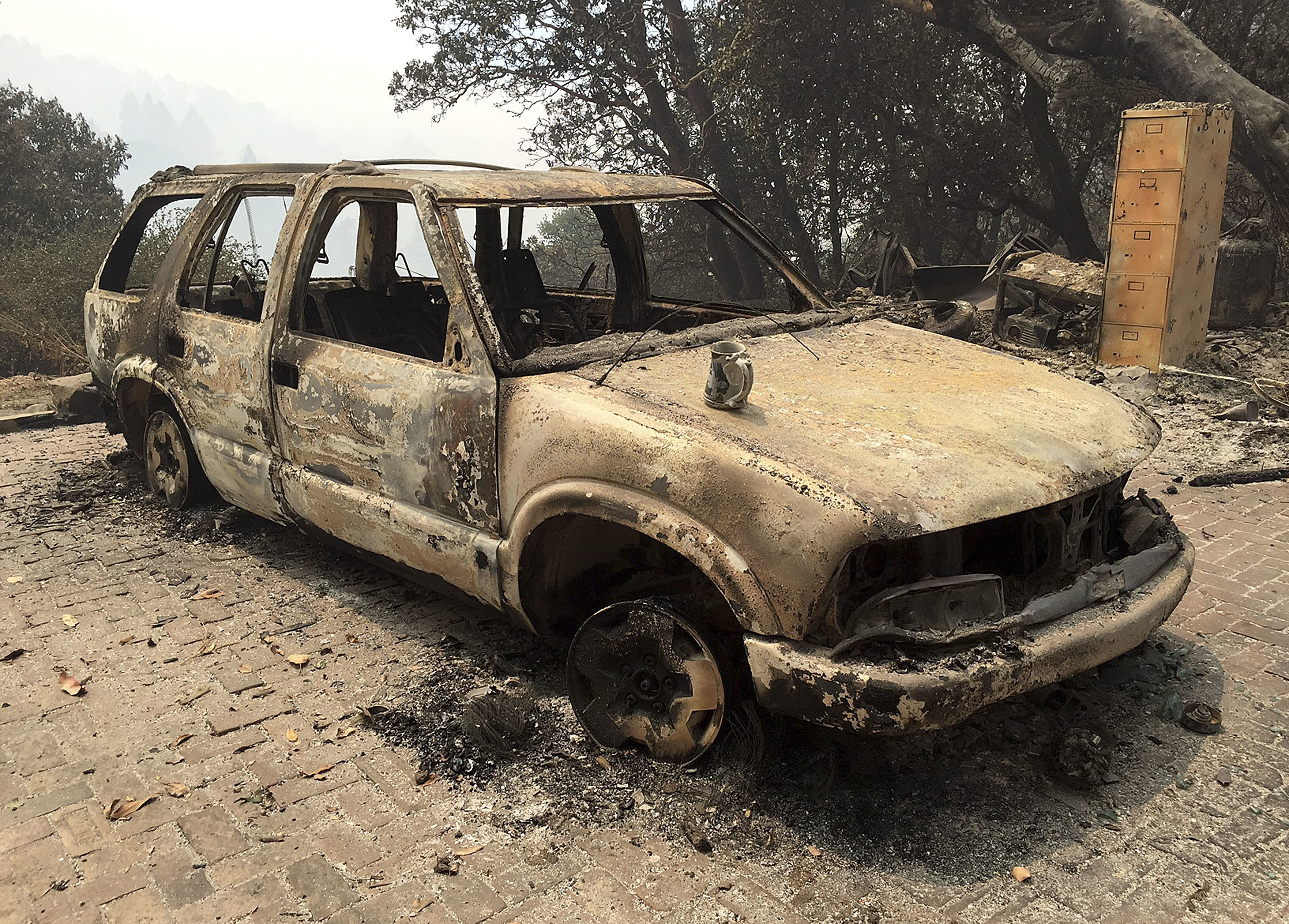
A car is actually reasonable protection. But you have to be clear about the nature of that protection. Driving in a fire is going lo kill you. But, a car’s gasoline tank will only catch fire in Hollywood movies. What you do need is protection from radiant heat. The advice for sheltering in a car is to stop the car. Get on the floor of the car (or as low down as you can, and to cover yourself with whatever you have to hand. The car will be destroyed. But so long as you keep low in the car the fire front will pass and you will be OK. Reflective blankets are good for protecting from radiant heat, although they protect from little else. They would certainly work if you were sheltering in a car. But you must protect yourself from the radiant heat somehow. Even newspaper will help.
Radiant heat in a forest fire is more than you can imagine. Because the source is extended in both length and height, once you are within a hundred feet of the fire front, the intensity of heat from the fire ceases to fall off with distance to any useful amount. The heat is nearly as great as if you were in the fire proper. The heat will cause things to spontaneously ignite at a distance. Again, you must protect yourself from the radiant heat.
You cannot outrun a fire front. Especially not travelling uphill. But even on the flat it will outrun you.
The sheer physical violence of a full blown forest fire is past human expectation. Winds reach hurricane levels, and the intensity of the fire is commensurate. Think blacksmith forge fire fanned by that hurricane.
The best advice is not to be there. And to get out as soon as there any danger. But it is clear that Monday is going to be a day where that isn’t always going to be viable.
This is video of a driver trying to evacuate last year’s fire in Fort McMurray Alberta, Canada. Fortunately there was no eclipse bringing an additional couple million people into the area.
This is what worries residents.
I’d like to see someone have survived in this car. Even if they could somehow shelter from the radiant heat, outgassing from plastic interior and insulating materials would almost certainly be toxic notwithstanding the lack of air to breathe.
Most ‘fire deaths’ are actually due to asphyxiation or searing of the lungs rather than radiant or convective heat, and this would certainly be the all-enveloping environment of an aggressive wildfire.
Stranger
Eventually you reach the situation where you are not going to survive, no matter what. You can do things that improve your chances, but that is about it.Sheltering low down in a car versus standing outside and yelling at the approaching fire may be your only choices.
Fire fighter’s trucks are designed to allow surviving a fire. Doesn’t always work sadly, but with care it does. Again, radiant heat control has been found to be the big issue.
“Shake n bakes”
Its also critical that you create a clear space to deploy them, the bigger open space you can clear of grass, debris, leaf litter, etc the better. They also offer zero protection from flaming chunks of upper limbs dropping on you from 50 feet up, or trees falling. so you want to be as far away from trees as possible.
Best plan is to stay away from forest fires as much as possible. Forest fires can exhibit bursts of ground speed movement that can outrun cars…on the road.
It’s amazing the unlikely fatal scenarios some folks obsess about.
It’s INCREDIBLY amazing how many quasi-experts that manage to pop up and feed this obsession with their notions.
that was scary!
Depends what you mean by unlikely.
I have stood on the roof of my house watching the helicopter and fixed wing water bombers fight a fire that came within a few hundred metres of my house. You know it is a bad day when there are 13 fire fighting appliances in your street ready for the approaching front, and you know that in the last fire 5 houses were lost on the other side of the hill with a number of fatalities. Sadly, come summer wildfire threat is a part of life here. We prepare for the risk every year.