This article from Trains Magazine (apologies, may be behind a paywall) on the crash includes mention of something that I’ve seen on other media coverage this morning: the grade crossing where the collision occurred had been recommended for an upgrade to a “controlled” crossing (i.e., lights and a gate).
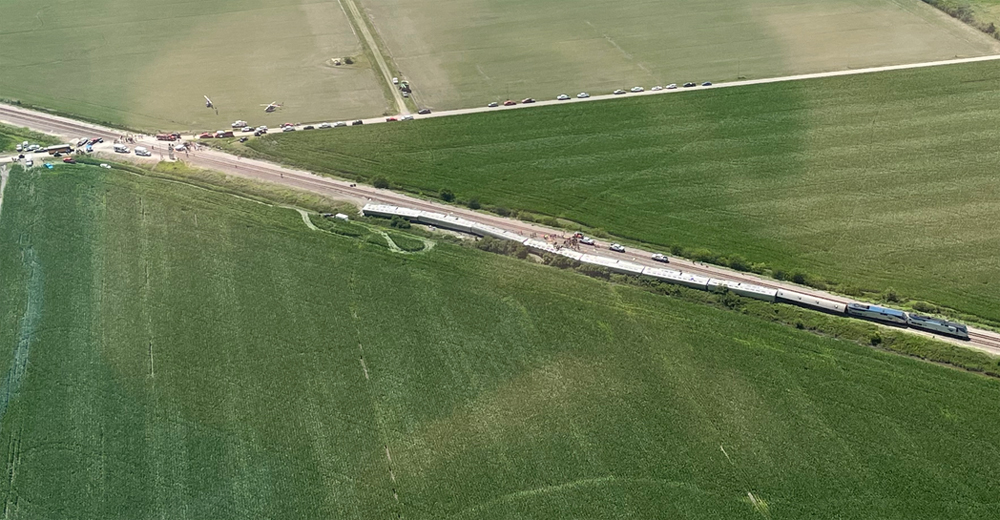
The article also includes an aerial photograph of the crash scene. You can see that every one of the passenger cars (and baggage cars) derailed and tipped over. The train’s two locomotives are at the far right side of the picture; it looks like the second locomotive is partially tipped over as well.
Here’s a picture that was taken by one of the passengers, in the aftermath of the crash. It appears that this stretch of track is “double track” (i.e., two parallel sets of tracks), and that the Amtrak train was running on the right-hand track, which is typical operating procedure on most U.S. railroads.
While it’s a little hard to make out, the track that the train was on has been completely torn apart by the derailed cars running along it. Look near the person in the lavender shirt, in the bottom center of the picture – the left-hand rail has been rotated, a long series of ties has been displaced, and the right-hand rail appears to be buried underneath the ballast (gravel).
Thank you, so do our family. She had come out to California to assist a family friend with his asylum hearing (which got postponed- again), and was on her way back to her husband in Michigan.
It’s interesting how the lead engine is still upright - I wonder if it is still on the tracks? But yeah, I can see how a rapid deceleration would cause the following cars to “buckle” and hop off the tracks. What a mess.
At least for the train. Likely that train was doing about 80 (the fastest I have ever observed on the EB in eastern MT), a passenger vehicle would be not quite vaporized. The overhead image shows no discernable damage to the lead locomotive, but I cannot see anything of the dump truck.
When a freight train comes to a sudden stop, the cars frequently accordion as the energy dissipates.
Passenger cars are equipped with the AAR Type F coupler (“tightlock”) that limits slack action to a fraction of an inch instead of the four or five inches the regular Type E afford.* I conjecture the tightlock couplers forced the train to the side and off the tracks instead.
*There is also draft gear with wedges and springs that allow several more inches of controlled movement.
Hugs to you, and her and your family too. Is she conscious? I’m guessing she is, if she’s on fentanyl; they often use that in patient-controlled analgesia, which is very commonly used after surgery or trauma.
Something must have been left of the truck, because the driver did not die instantly. He was thrown from the truck, and comforted by a Boy Scout who found him, mortally injured, in a ditch. This is something no teenager should ever have to witness, let alone do. I saw a picture of him in another story, which named him too; he’s the boy in Troop 73 who wears glasses.
One Scout was T&R’ed at a local hospital, and they were put on a bus in Columbia and headed home. I heard that the parents chartered a bus, and if that is true, I hope they can be reimbursed by Amtrak.