What do the laws and regulations actually say? Does it actually say white people are required to carry a permit, or just any non-member of the local indigenous group? Would the regulations apply to an African American?
Please be more precise about what exactly you are talking about.
I’ll add (for clarification) that the “homeland” of which Colibri speaks is a comarca – a subnational administrative unit, equivalent to a US state or a Panamanian province. It’s not like a US Indian reservation, which is laid on top of the system of states, so to speak. It’s more like if, say, the entire state of Oklahoma were run by Indians, and Indians (collectively or individually) were the only ones allowed to own land within it.
Yes, the Comarcas are equivalent to Provinces. I think “Indigenous Homeland” is probably the best translation of the concept, although (amusingly) the usual translation of “comarca” in Spanish is “shire.” There currently are three provincial level Comarcas in Panama, Guna Yala (the oldest), Ngabe-Bugle, and Embera-Wounaan. There are several others at the sub-provincial level.
I don’t know what the laws said at the time that you were demonstrating at university, but certainly there is currently no law which says anything of the kind.
The position is basically this:
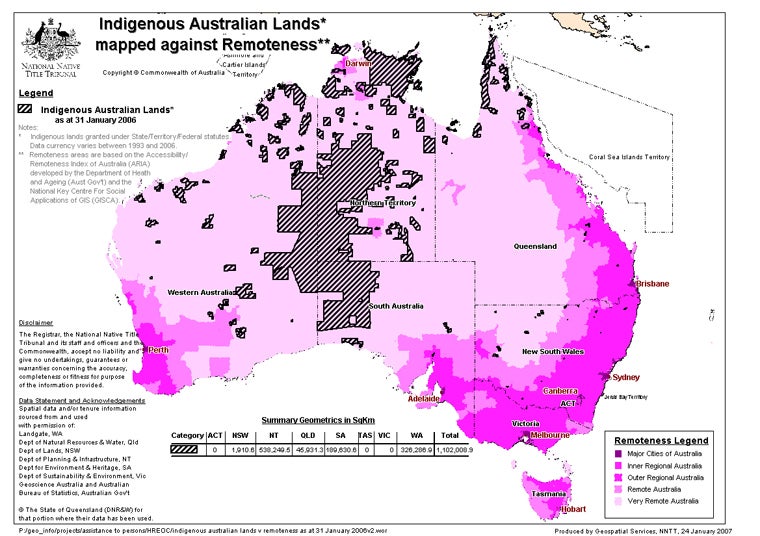
There are areas of land in Australia to which Aboriginal peoples own inalienable freehold title. These areas are usually called “Aborginal land” for convenience.
For such an area, the freehold is held collectively by a particular Aboriginal people (different Aboriginal peoples for different areas) and it can’t be sold or transferred. Apart from that, it’s like any other freehold. As freeholders, the owners can invite you in, or ask you to remain outside.
The permit system exists to regulate access to Aboriginal land. The basic purpose is to enable the owners to discharge their responsibility for country. So policies and practices about the issuing of permits will take account of things like the need to protect and care for sacred sites, ensure the privacy of ceremony and cultural events, protecting the environment, etc. If you are refused a permit it could be because there’s a ceremony taking place that it would not be appropriate for you to see, or because the road is flooded.
There is no rule that says that whitefellas need permits and blackfellas don’t. Basically everyone who is not one of the owners needs a permit, unless he comes within a list of exceptions. Exceptions will vary from land to land, but they are things like:
Government workers entering for the purposes of their work
Anyone entering to visit a public facility like an art centre, the Shire office, etc
There are often different levels of permit - a transit permit will allow you to drive through the land on public roads, but not to divert and, e.g., enter a community. If you want to do that you need an entry permit.
The system is racial only in the sense that every member of the class of people who don’t need any permit - the owners - is an Aboriginal Australian. But they don’t enjoy this right by virtue of being Aboriginal Australians, but by virtue of being, e.g., a Warlpiri man. Aboriginal Australians who are not Warlpiri men or women - which is most of them - would need a permit to visit Warlpiri land.
Permits are usually issued by the relevant Land Council. I don’t know whether Land Councils are entitled to charge for permits, but I’ve never been charged for one.
It’s very limited. S. 92 of the Constitution provides that “trade, commerce, and intercourse among the States, whether by means of internal carriage or ocean navigation, shall be absolutely free”. Tellingly, it’s headed “Trade within the Commonwealth to be free”, which points to the main concern of the drafters. It probably does guarantee protect freedom of individual movement, but only across state borders. There’s no constitutional protection of freedom of movement, if your movement doesn’t happen to take you across a state border. Some of the aboriginal lands cross state borders, but most do not.
(In general, the Australian constitution is notable in making no comprehensive attempt to identify and protect individual or personal rights. There’s no equivalent to the US Bill of Rights, with the sole exception of a prohibition on “any law for establishing any religion, or for imposing any religious observance, or for prohibiting the free exercise of any religion”.)
To be precise, the acts says that “‘Aboriginal’ means a person who is a member of the Aboriginal race of Australia.” It says that “a person shall not enter onto or remain on Aboriginal land or use a road unless he has been issued with a permit to do so” but that “An Aboriginal who is entitled by Aboriginal tradition to enter onto an area of Aboriginal land may enter onto that area of Aboriginal land.” and that “An Aboriginal who is entitled by Aboriginal tradition to remain on an area of Aboriginal land may remain on that area of Aboriginal land.”
So no, it doesn’t say that only White people have to carry a permit at all times.
It does explicitly state that anybody who is not a member of the Aboriginal race has to carry a permit at all times.
Those regulations would, of course, apply to an African American, since an African American is not, normally, a member of the Aboriginal race of Australia.
There are any number of other similarly racist laws in Australia.
An Aboriginal can hunt native animals on public land, a non-Aboriginal doing so will be subjected to hefty fines and, in the case of endangered species, lengthy jail terms.
There is common law that says that Aboriginals are exempt from animal cruelty laws so long as they deem the practice to be cultural, and are thus able to torture animals to death and so forth.
Aboriginal people are able to administer torture, beatings and mutilation as “traditional justice” without fear of legal reprisal. Being subjected to such beating, torture or mutilation must be seen as mitigation in criminal cases for Aboriginal people but can not be taken into account for non-Aboriginal people.
Aboriginal people are able to nominate whether they want their criminal cases heard in an Australian court where guilt and punishment is decided by a magistrate, or in a "traditional court, where guilt an punishment are decided by relatives nominated as “Elders” and rubber stamped by a non-Aboriginal magistrate.
The list of very specifically racists laws in Australia is quite extensive.
Yeah, there sure is something like that, insofar as it’s around 10% of the country that you require a permit to enter. Most people would regard 10% of an entire continent as “huge swathes of the country”.
Well, no, it doesn’t quite say that. You’ve omitted important language from your quote.
What section 4(1) of the Aboriginal Land Act (NT) actually says is “Subject to this Part and to any provision to the contrary in a law of the Territory, a person shall not enter onto or remain on Aboriginal land . . . “ etc etc. And there are other provisions of the law of the Northern Territory which create exemptions. You actually quote one of those provisions yourself - s. 4(3) of the same Act, which covers “An Aboriginal who is entitled by Aboriginal tradition to remain on an area of Aboriginal land”.
So the default position is that everyone needs a permit. There are a number of exceptions. You quote one which is specfic to Aborginal people, and even then it doesn’t cover all or most Aboriginal people. There are other exceptions, and they apply without regard to race.
\
The sign you link to doesn’t say anthing like that, though, does it? It makes no reference to race or colour at all. It suggests that everybody requires a permit (which is indeed the default position) and fails to mention any of the exceptions.
Any Aboriginal person, defined racially, can enter Aboriginal land by default, just as the legislation says.
And by default all Aboriginal lands require a permit. Some have waived that requirement, but they are a tiny minority.
You really are engaging in the worst kind of nitpicking here. Some Blacks in apartheid South Africa were doctors and lawyers too. Those tiny exceptions don’t mean that the laws weren’t racist.
The Australian laws are explicitly and expressly racist. Yes, there are exceptions, just as there were under the apartheid laws mentioned in the OP. People not of the Aboriginal race don;t need a permit if they are police officers, for example. That doesn’t change the fact that the laws are racist and require 99% of white people to carry a permit and do not require 99% of Aboriginal people to do so.
It references an act which specifies that permits are only required by a person who is not a member of the Aboriginal race of Australia. How the hell is that not referencing race?
Uh huh. So you believe that the people who live there and the relatives who visit them all require permits?
There is no appropriate response to that aside from :rolleyes:
Well, not really, as some of the other stuff I posted I knew was correct from other sources. In that particular case, I didn’t, and so I said so.
Not sure why you are making this a “thing”. If I tread on some sort of sensitivity I was unaware of (and to be honest, I’m still unaware of it, as you haven’t actually explained it), I apologize.
“Alleged” is one of those words which are often used to mean “read this in the worst possible way”. Add it to posting other direct from Wiki wrong (oversimplified) information and it caused a big :dubious:
I still have no idea what “worst possible” read was in play here.
So I’ll ask you straight out: what “big :dubious:” thing did you think I was hinting at?
The point I was making was that, while (according to Wikipedia, which you have yourself said was occasionally wrong or oversimplified), there was a debate over allowing the same right to descendants of Moriscos as to those of Shephardim, to date it hasn’t happened, and so this particular ‘right of return’ is one-sided.
Tell me if any of that is factually wrong, give a good source, and I’ll cheerfully correct it.
It is not factually wrong (for once that one is more accurate in Wiki than in your recounting), but the one part of what you posted which was not factually wrong is the one you expressed doubts about.
“Allegedly” only expresses the fact that someone doesn’t have personal knowledge that a statement is correct. If you wished to clarify the issue it would have been helpful if you had actually clarified it, rather than posting a one word question. And you still haven’t clarified your perspective on the issue.
That is not what the legislation says. You quote it yourself, but let me highlight the bit whose meaning you didn’t quite grasp: “An Aboriginal who is entitled by Aboriginal tradition to remain on an area of Aboriginal land may remain on that area of Aboriginal land.”
So it’s flat-out wrong to say that any aboriginal person can enter Aboriginal land by default. He can only enter any particular Aboriginal land if he has a tradition right to enter that particular Aboriginal land (or if he is covered by any of the other exemptions).
I don’t know what proportion of Aboriginal lands are subject to a permit requirement. I would add that this is not a simple binary; there are plenty of areas of Aboriginal land where there is a general right for anyone to go anywhere except into the settlement, which requires a permit.
I’m not nitpicking, really. I’m pointing out that your repfesentation of the permit system is quite wrong. You started by asserting, and you continue to assert, that all Aboriginal people are entitled enter Aboriginal lands without a permit, simply by virtue of being Aboriginal. This is simply not true. An Aboriginal person only has a legal right to enter lands which he or she has a traditional right to enter, and that typically requires membership of the people whose land it is, or (in some cases) of a particular neighbouring mob. For any area of Aboriginal land which is subject to the permit system, the great bulk of Aboriginal Australians will not have a traditional right of entry, and are subject to the permit requirement.
You keep saying this, even as you cite laws which appear to say something quite different. Is it your belief that 99% of Aboriginal Australians have a traditional right to enter all Aboriginal land, regardless of whose land it is? And if that is your belief, have you any evidence for it that you can show us?
Again, Blake, that’s not what the Act says.
And rolleyes right back at you; you cannot possibly have though I was saying that. I said that the notice didn’t mention the exceptions, not that there were no exceptions.
The people who live there, if they are traditional owners, and their relatives, if they too are traditional owners, will not require permits. Anyone else who lives there will require a permit, unless they come within one of the other exceptions. This isn’t that hard to grasp, surely?
I would suggest they would not, even in somewhere as large an area as Australia.
That was my point - I’m not denying there are areas where non-Aboriginals can’t go for the sheer hell of it, but you’re implying (especially to our overseas readers) that much of Australia outside the cities is a no-go zone for nearly all Australian residents, and that’s patently untrue.
No, I haven’t. I’d like to, but I’ve worked enough in regional and rural areas of Australia to know it’s a pretty empty place too.