This is what I came in to mention. I’ve driven lots of manual cars, but one day my FiL let me try out his old 911, and I felt like I was trying to work some kind of old-timey Rube Goldberg device. Really awkward.
I learned to drive a stick-shift Volvo 240 station wagon. It had a really stiff clutch, the gas pedal and shifter were moderately stiff to move. This was my “main” driver from years 16 through 18.
From age 18 all the way to today (50), I have been driving Japanese cars, both stick shift and automatic, Nissans, Toyotas and Subarus. They all have had very soft throttles (gas pedal), clutches and shifters. So much so that, looking back at the Volvo, I have often said it was like learning how to drive a tank.
Which mid range ones? The one I drove was a now somewhat older E46 316i, preface lift, so around 20 years old, maybe the ones your brother had were newer or he simply got used to it. The guy I drove with also didn’t complain, he said it was perfectly normal, so he probably just got used to it, like how I got used to small car pedals.
Just to throw some possible confusion into the mix, up until the 90s, most manual transmission cars had cable clutch linkages - a steel cable from the pedal to the throwout. Now, most cars have hydraulic clutches operating on the same general principle as brakes - there’s a small master cylinder at the clutch pedal, and a hose connects from there to the transmission. The major benefit is that as long as there’s fluid in the system, it’s adjustment-free, unlike the cables linkages that needed fairly frequent adjustment.
As for feel, it’s possible to use a master cylinder with vacuum boost to “lighten” the pedal, either designed and built in, or as a retrofit.
I’ve driven countless cars (and a few small trucks) in my lifetime, but since most of them were automatics I can’t really comment much on the differences in clutch feel. The sensitivity of the brake pedal seems to me to be about much the same across all vehicles with power-assisted brakes, which is probably just about all of them nowadays. What I’ve noticed is a difference in the feel of the accelerator pedal. Some vehicles take a very light touch – like the wife’s former GMC Acadia, which is surprising for a rather large/robust SUV.
Irrelevant aside: my first car was one of the original VW Beetles, and the silky-smooth quality of the four-speed gearshift was truly a delight. My understanding was that the basic technology was shared with the Porsche of the same era. The Beetle IMO was low-cost because it was so minimalist, but many aspects of it were really high quality, including its reliability. Not sure that there’s a car out there today – or that it’s possible to build one that is street-legal – that combines such basic simplicity with high quality.
I had a '79 Corolla that had a hydraulic clutch. That is fairly low-end, so it was not some sort of fancy-ass thing. It was what was on my early '80s Rx-7 as well. It was not exactly as uncommon as you suggest.
I did drive a late-70s vehicle that had a clutch cable, and it did abruptly, in heavy traffic, bestow upon me the one major disadvantage of cables. You see, hydraulics tend to fail gradually, and you could put some 30W in the master to make them last a little longer, till you could get it fixed, whereas the cable will just snap catastrophically and there you be.
In my distant past, I owned a couple of Porsches, a1973 911 Targa and a 1976 911SC. While the shift throws were not exactly short and crisp, they weren’t bad. And the clutches were completely ordinary, no unusual force required and certainly not grabby or hard to modulate.
On the other hand, I once drove a friend’s Jaguar XKE (late '60s model, as I recall). It had the stiffest throttle spring I’ve ever seen. And the clutch was pretty stiff too. Impossible for me to drive smoothly.
Yeah, I can’t really think of a time that a particular clutch actuation mechanism is predominant. It seems like for most of history each manufacturer picks one style for certain layouts and runs with it for awhile. I had several older Fords with hydraulic clutches. I actually had a F100 crack the firewall where the hydraulic cylinder was mounted, almost certainly from my abusive operation.
I also had a much older F100 with a mechanical clutch linkage that would unfortunately fail by dropping an actuating rod out in traffic after it had worn through it’s cotter pin. I learned to hang that part from the frame by wire so I didn’t have to run out in traffic searching for it to get home before eventually figuring out the cause was a broken engine mount causing the whole assembly to move back and forth.
Top end 320 series, the 4 cylinder ones, over the past 15 years as company cars. I had always heard that BMWs had a very slick gear shift. In the seventies I had a 1972 Opel Manta with a gear shift that was fast and positive but had a fairly long throw and was moderately heavy
I have a Miata and BMW Z4. Both are easy to shift. And the Z4 is even easier to shift than the Miata.
My 1997 Jeep Wrangler, OTOH… 
I read an article a few years ago in a motorhead publication which said that car industry surveys of female drivers firmly demonstrated the idea that “easy to drive” really meant “had low control forces” and vice versa for “hard to drive”.
It went on to say that in the last 10-15 years (from the article date) manufacturers have really recognized that women are a distinct population of car buyers with distinct preferences. Who knew 50% of humanity their customers were different from the other 50%! :smack:. And like any good business, they’re altering their product offerings to appeal to these newly found demographics among the customers.
As such, the Japanese manufacturers in particular were altering all their control forces towards lighter and lighter. Power steering with more force amplification, gas pedals with weaker return springs, increased mechanical advantage (or the cyber-equivalent), etc. But other manufacturers were also leaning in that direction at various rates.
At the time I read the article it certainly made sense with what else I was seeing in the car industry and their marketing.
And for personal anecdata … my middle-aged European car is pretty far towards the performance end of things and has rather heavy pedal feel and very precise although not particularly stiff steering. It’s an autotranny so clutch & shifter forces are NA.
Here’s a six minute basic manual transmission video. You can find others with rods acting on the gears or forks. The gears aren’t always in mesh; or in a heavy truck transmission - are actually “braked” during a double clutch shift. There are constant mesh transmissions like on sport bikes where you hear the mechanical thrashing (whine) as they go by. You also run into dual clutch transmissions like on the new Corvette or current VW GtIs with the DSG. I’m sure there are many more types/systems as well.
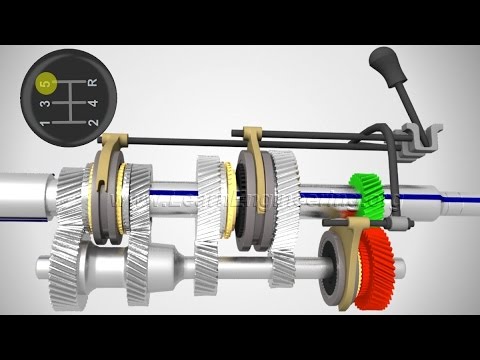
Now that we’re 32 posts into this thread and the discussion is allowed to drift a little bit . . .
The same is certainly true with airplane controls – not only do the required control forces vary widely from one kind of plane to another, but also in different instances of the same kind of plane.
I think that may largely be a matter of age and maintenance. For any mechanical mochine with a lot of moving parts, from car to airplane to washing machine, the gears, pulleys, bearings, etc., may get corroded or otherwise stiff and crusty with age, or they may get worn and loose and wobbly. Also, older machines get beat up, dented, the parts get pushed out of place. That can impinge on the moving parts.
I had the opportunity to have a couple of flying lessons in two different Schweizer 2-32 gliders. One of them (specifically, this one) was a total pleasure to fly – the controls were so light, it seemed like all I had to do was think what I wanted to have happen, and it happened. The other one was stiff and rather difficult to handle. It also had an older and more beat-up look to it.

Cables? Most U.S. cars had mechanical bellcrank setups at least until they started making subcompacts. My '67 Dart sure did.
Anyway, I always guessed that many U.S. market cars that had hydraulic clutches were that way because of the different driving side compared to Japan and England. I never looked into it to confirm it, however. So, would a right-hand drive MG Midget or Celica have a mechanical or hydraulic clutch setup?
I had a '68 Beetle for a while. It wasn’t an ancient car – I bought it in '77. For what it was, it was a pretty good car. Cheap and reliable.
I now own a 2002 VW Passat (with manual transmission).
Compared to the Passat, I wouldn’t call the shifting on the Beetle “silky-smooth.” But it might have been for its time, for all I know.