Over is a bit dangerous, I wouldn’t recommend.
Under is just Darwin Award winning stupid.
Over is a bit dangerous, I wouldn’t recommend.
Under is just Darwin Award winning stupid.
yeah my stepdad said " sounds like something you’d do … and then id have to kick your ass twice once for thinking about it and twice for doing it if you lived … "
There are crossings in the USA that have “four-quadrant” gates, it’s just more expensive and there is no regulatory push to mandate them. The gates are physically incapable of “trapping” a car, but of course drivers might not realize that or be thinking clearly, so there’s a delay on the second gate, and ideally there is an entire car length between the track and the gate. There are more expensive solutions too, such as radar monitoring of the tracks that will keep the second gate open if the car is detected.
This. It’s been scientifically proven that the smartest and hippest American is 3 times as stupid as the average shit of any other person on the planet.
Exactly. My father was a railroader (not an engineer or conductor; he worked on passenger trains), and he was once on a train that hit a car at a level crossing. Of course, the train stopped, and the staff got off. Dad found a human foot. Not attached to a leg or a body–just a foot, clad in a shoe and a sock, a result of the car-train collision.
When I was a child, we spent summers near a railroad track, and had to cross it in order to get to the corner store, where we could buy candy. Dad instilled in us that when we walked across the tracks, to Stop, Look, and Listen. If there was any hint of a train coming, then we were to step well back from the crossing and let the train pass. Never try to beat a train, Dad said; the train will always win.
Today, I still remember those lessons; Dad taught me well. A level crossing means that I will slow down to look both ways if not stop if a tree line gets in the way of seeing, roll down my window (so I can hear any whistle), and only proceed if the way is safe. I have no wish that my sock-clad, shoe-clad foot will be found a hundred feet away from my dead body.
Many of the unused crossings that I can think of aren’t attached to functioning tracks. They just didn’t want to pay the cost of replacing the road section, so it’s left unused rather than being removed. Pretty sure the military only uses active, well-maintained tracks for such things, and we have a robust network of active and well-maintained tracks.
Well, since the trains would be automated, ignoring a signal wouldn’t happen, but I suppose the scene might need to be checked over for evidence of any other type of crime. If nothing else, the train simply not stopping would make it difficult to gather evidence should the person in the way be there because they were forced in some way. It’d make murdering people with trains a lot easier to get away with, I guess. So it’d still have to stop, but the goal should be to absolutely minimize the time it remains halted, so the train should still be built tough enough to plow a vehicle out of the way with no compromise to its functionality. That way the scene can be recorded and quickly investigated, and if no crime is apparent, get the train back on its way.
Mainly cost. the USA has many, many more railroad crossings than Europe.
Also, the majority of USA crossings are not single bar; they are zero bar! Many without even flashing lights, just a plain “Railroad Crossing” traffic sign.
Most of the western US, especially rural areas, was plotted out in 1-mile-square sections, so the railroad tracks will have a rural gravel road crossing them every mile. Putting automated crossing bars or even flashing lights on every such crossing would be extremely expensive, and the cost of keeping them working would be high. Many of those locations don’t even have electricity nearby.
Also there is little statistical difference between the accident rates at crossings with automated bars, or with flashing lights, or with nothing but a sign. Why spend money on these, when they don’t result in any significant reduction in crossing accidents?
There’s a track running along the back of my property, which gets maybe three or four trains a day; due to the condition of the tracks, not moving very fast. Like other people living near the tracks, I sometimes walk on them.
I timed it once: from when I first hear the whistles, I have a good five minutes to get off the track, and a good bit of it from when I first hear the train itself. It takes only a few seconds to get off the tracks. If I even think I hear a train, I don’t wait any part of those minutes. I get off the tracks immediately.
And turn off the radio.
Not too long before I moved here, there was a murder in the area that people were still talking about (we don’t get many of them.) It was a domestic violence case, and the murder put his victim’s body on the railroad tracks; apparently under the impression that the medical examiners wouldn’t be able to tell that the damage done by the train was postmortem.
I used to drive for my employer-sponsored carpool in an eleven seat Dodge van. In our training, we were taught to stop at any RR crossing we came to. It was the law. 99% of my commute was on the freeways, so I didn’t have to stop much, though. 
Day before yesterday, speaking of impatient drivers, a guy in my neighborhood on a motorcycle tried to beat a red light. He broadsided an Escalade. And lost.
I have no proof, but I suspect that the people who get caught between railroad crossing bars are the same ones who stop in pedestrian crosswalks at regular intersections. The “I drive a car and that makes me king of the road” gang. I like the $500 fine you can get in Austin for being stopped within the crossing zone EVEN if a train isn’t coming. I’d make it higher.
I haven’t gone through a train crossing in probably 20 years. They where simple wooden arms that came down that a car could easily drive through with a little bit of damage.
I wonder how many people are doing this because so many RR crossings have webcams, and they’re hoping to make a viral video.
This one went bacterial, although in this case, I don’t think the truck driver knew what happened at the time. I’m sure he did later on.
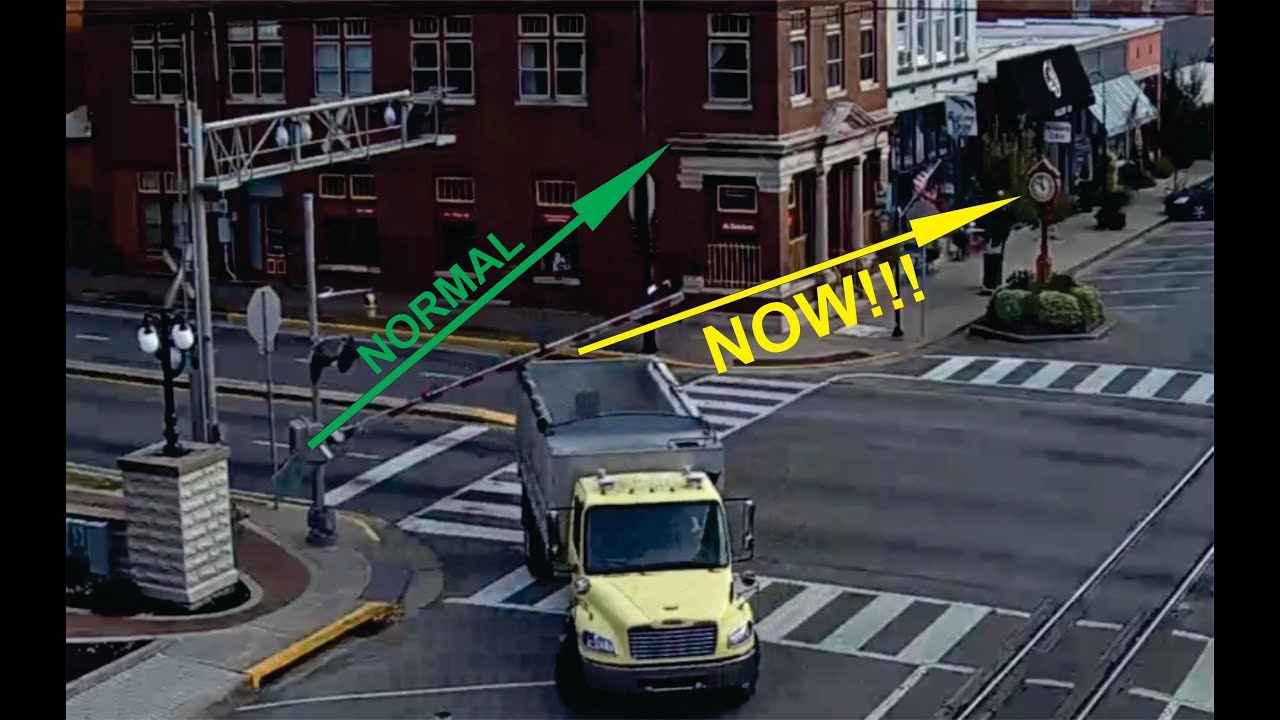
NM. Upon re-watching it, the driver came back to the scene of the crime.
That was one high-tech fix. It’s a wonder what they can do with computers these days.
That used to be more common in previous years, when stickshifts were more common. One thing that my Grampa drilled into me was “never shift gears on the tracks.”
Every so often, a novice or nervous driver would stall the vehicle on the tracks while shifting.
I see a lot of Youtube videos where a long semitrailer is high-centered on a crossing with a short, significant grade before the crossing.
There are three hot springs in the vicinity of Burning Man and the B:M closes them to public access during the event to prevent too many people damage. A handful of Earth Guardians are at each pool to enforce that and are changed out three times a day.
The Black Rock Rangers drive the van and two of them are about 20 miles north but the third is close to the city, just on the other side of the UP (ex-western Pacific) tracks. The trains barrel through at 60+ and the SOP is to pause at the crossing with the windows down, make everybody shut up, then cross the tracks.
N. C. Wyeth, perhaps the most famous person to be killed at a railroad crossing, with his 3-year old grandson. Witnesses reported seeing Wyeth holding his hands up as if to ward off the collision in his last moment.
Last year, during the early stages of the pandemic, many if not all of the commuter rail lines here were temporarily (for months) shut down. Are you saying a transit agency that suddenly found itself in financial hardship (ridership down 80-90%) should spend lots of money & effort to remove tracks, only to replace them some months later when they want to reopen the roads? Do you realize the wasted cost, & effort, & driver inconvenience & inspections required to do this?
Sometimes railroads, especially short-line ones, go out of business; it would be a significant hit to their remaining assets to make them remove all of their grade crossings & it won’t solve the issue of the grade crossing of a railroad that went out of business last year or last decade, or even longer ago.
Around here, we have sidings that go to a business, sometimes separate from & curving off of the main line. Should the railroad be responsible to remove that crossing if that customer goes out of business/switches to trucking? Should the railroads raise their rates/require a surety bond from the customer in case they stop using the railroad? What if the customer temporarily shuts down due to supply chain issues or flood/fire damage. It could take a year or two to rebuild after a bad fire. That’s if they even do rebuild, after all insurance is settled, the company could decide to move that business somewhere else or sell that division off.
::snicker:: Okay, & just where are you proposing all of the money comes from for eminent domain proceedings to take all of those houses & business to make your ideal sight lines. While a lot of the urban/suburban crossings that I can think of have lights &/or gates, they got shite for sight lines
As someone else stated, some rural crossings don’t have power, you not only want those crossings powered but to be on two separate circuits or have maintained battery backups?
You do realize if a car/truck part got caught under a train, it could become dislodged, catch on a RR tie & then cause a train derailment up the tracks somewhere, where it’s much harder to fix/remove passengers because it’s now in a remote area, or that a brake line isn’t damaged, which will prevent the train from stopping at the end of the line. I’ve seen people back over a curb-height cement parking lot ‘tie’; they weren’t required to stop because nothing else was damaged, yet when they tried to reverse direction, the bumper now got caught & ripped off the car. I can tell you if I’m in any type of accident I’d walk a walkaround to make sure all is safe before driving off, & I’d damn sure want any transit agency carrying me to do the same
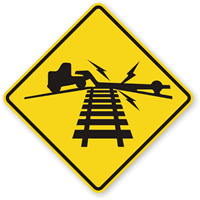
US-13, along MD’s Eastern Shore has a RR parallel it; pretty much every crossing has this sign alerting trucks to the clearance issue.
Not familiar with this term… and it seems to apply to any crossing… what would a non-level crossing look like?