When I say they can’t, it’s because I’ve never seen any evidence that they can. Do you have any?
Explode? No, not really. Birds of prey do not rely on numbers to survive from other predictors and they’re usually territorial. They would certainly find the pigeons easy pickings and their population would grow. But not explosively.
+1. I can’t bring anything to mind about native management of forest crops.
I cannot be the only one that saw the title and thought, “How can you overestimate a population of zero?”
I’m sorry I can’t remember where I read this, but here it is. The source claimed the passenger pigeon had an unfortunate behavior when members of the flock were killed. Some of the live birds would go back to where the others had died. In the wild, maybe this would discourage predators. In the gun sights of humans, it was a terrible strategy.
Elephants do the same thing, much to the delight of poachers, who can run off with two or three pairs of tusks after one lucky kill.
From Wikipedia’s article on the Carolina Parakeet:
Right idea, wrong bird …
As I’ve noted on this Board, more than once, when I was a kid (in the 1960s – we’re not talking about Ancient Times here) flocks of some kind of bird used to appear in the sky forming a dark “river” that went from Southern to Northern horizon in an unbroken flow. It wasn’t nearly as wide (although, oddly, it had well-defined “edges”), and it didn’t “darken the sky”, but there were a helluva lot of birds up there at once.
I don’t know what kind of bird it was, because they were up too high, but you could hear their cries from far off. And this moving river of birds was continually moving, and appeared to have n o beginning and no end. You could stand there, staring up, watching this flock for45 minutes without seeing the whole thing. I don’t know how long it lasted,. because I never tried to wait out to the end. To this day, I don’t know what kind of bird it was. Starlings, maybe. But, having seen a partial skyful of birds, I can easily believe a sky completely filled with birds. They wouldn’t have to literally “eclipse the sun”, or cover the ground with droppings (I don’t recall seeing any from these swarms of my childhood), but that didn’t mean that there weren’t an awful lot of birds up there in a largely organized mass.
When I mentioned this on the Board before, someone asked what the front of the flock looked like. This showed that he wasn’t paying attention. THERE WAS NO FRONT. Or, at any rate, the start of this apparently endless river of birds was well over the horizon, and the end was over the opposite horizon. THAT’S how many birds there were.
I haven’t seen anything like this in decades and decades. That probably suggests that something has gone awry with the world – even if they were starlings (an invasive species not native to the US), it means that the environment has undergone some extreme change since then. Over-urbanization, perhaps.
This probably deserves its own thread but…
It sure is easy to make a statement without any ability to prove it one way or the other.
You say that the Park Service can’t estimate crowd numbers within 50%, and yet you have absolutely no way of supporting that statement, do you? Since they have access to data that most people don’t (entry gate counts (personnel with little “clickers” counting attendees as they enter), aerial photography, and the amount of cleanup required), and since they are a more-or-less unbiased organization, I trust their numbers much more than I do those of the people who are disputing them - since they have an axe to grind.
Of course, this opens up the entire policy-by-numbers can of worms. For example, the unemployment rate is constantly being touted as a measure of well (or poorly) the economy is doing - but this is a number that can only be calculated by crunching enormous amounts of data, and the average person has no way to verify it’s accuracy. I always find it amusing when the unemployment rate is adjusted many months after the fact, due to some re-analysis of the data - I think to myself how absolutely useless the actual number is after all, if it is that ephemeral.
Check out 1491 by Charles Mann.
Though I don’t think he says the mast crop resulted in large populations of passenger pigeons.
He also points out that in native american middens there are few passenger pigeon bones. He concludes that the pigeon population was much lower before whites arrived. Whether that was because the native americans harvested the mast crop or some other reason is unknown.
One of his key conclusions is that a large native american population in the N. America maintained the forested areas as cropland using fire. By frequently burning the underbrush, they would keep the fires from harming the trees and provide young growth for deer etc.
Might check that book out, thanks!
I’ve told my kids and young relatives this time and again. The last big flocks of anything I’ve seen were in 1980 or so. It’s nearly impossible to relate to kids a huge river of birds crossing from one horizon to another for hours at a time.
When you’re a little kid traveling from Detroit or even Evansville to Savannah on a quarterly basis, there’s not much to do but look at the sky and billboards. I clearly remember a handful of times when the sun would be blocked by a huge flock of what I now think were starlings. It became an issue in Nashville in the late 70’s that the starlings would congregate somewhere in huge numbers, pooping and eating and driving people crazy. They would fly planes or choppers at them, shoot at them, and nothing would make them move at all. Their final solution, if you will, was to just hose them down with water, and they would freeze overnight. It worked well, IIRC, and I don’t think the starlings have bothered Davidson county much since then. Maybe other towns, but not there.
Even putting aside billion numbered flocks for a moment, I still remember so many more unimaginably huge flocks of something in the 60’s and 70’s that just aren’t seen today, and it’s just sad to think we won’t see them anymore.
As Cal says, it’s probably the environment that has changed, but what part I cannot say.
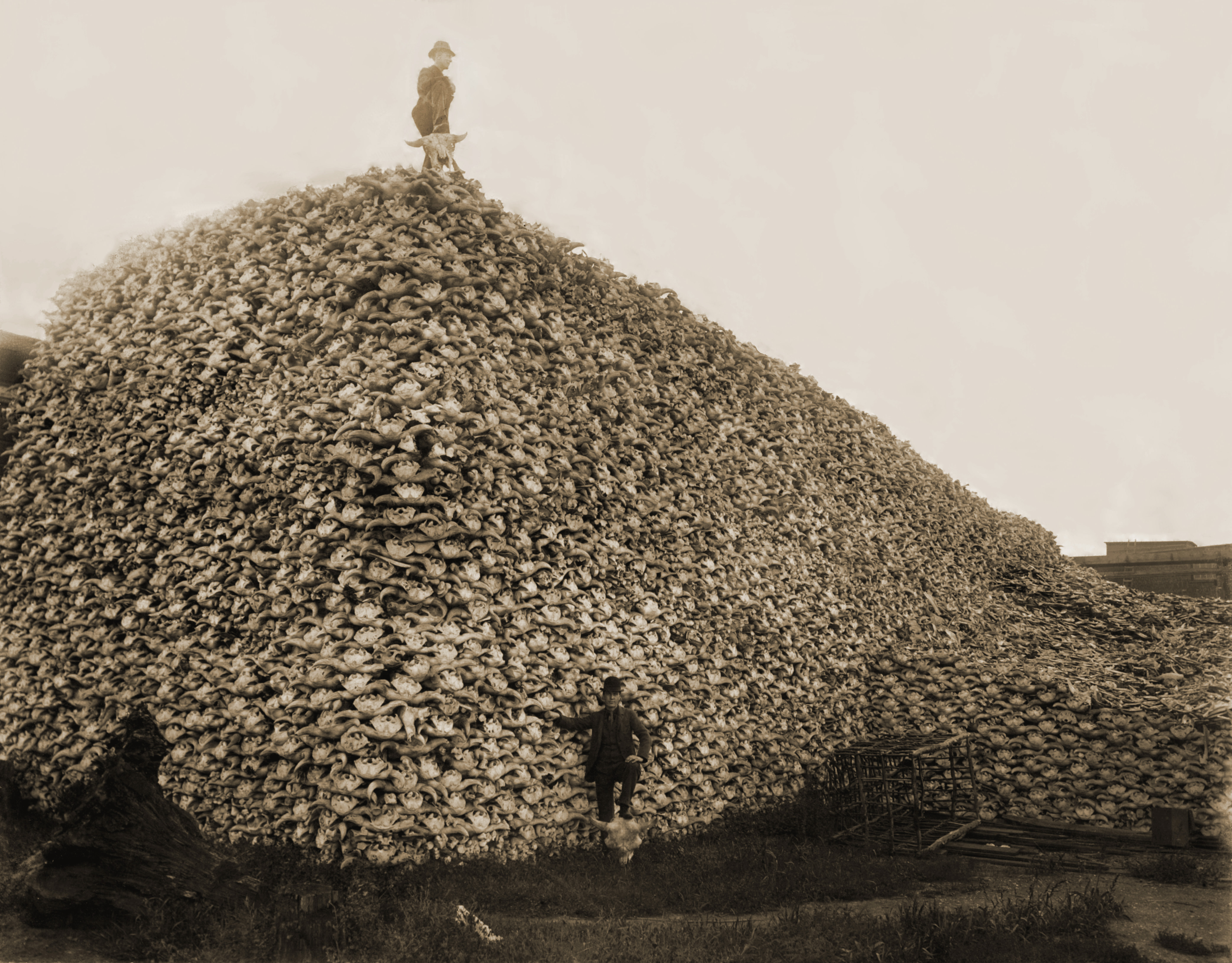
Don’t get me started on Bison…
I see I’ve been ninjaed on my own citing, but yes, that was all drawn from (my memory of!) Charles Mann’s 1491. Getting time to re-read it yet again …
At one point he quotes the settlers marvelling that that could drive through the forests of trees in their horsed carriages, as if they were in a park or an orchard … it never occurred to them they were in fact in an orchard!
Am I wrong in thinking that hunting pigeons is pretty tough if you don’t have a shotgun? I’m happy to hear about non-firearm techniques for bringing down useful numbers of small birds.
Yeah, I opened the thread eager to read about a small flock recently discovered extant. 
Isn’t it the equivalent of shooting fish in a barrel? Why aim? Point and hit.
I have been under a flock of weaver birds that literally blotted out the sun, and took over 3 hours to pass, outside the Kruger NP here in South Africa.
Hit with what? A rock, an arrow? Pre-firearms, is it reasonable to think that the Native Americans would consume a large quantity of Passenger Pigeons if hunting them is more trouble than it’s worth?
Sorry, I misunderstood your intent. I was thinking of the single shot rifles of the 18th century.
The answer lies in the unusual developmental pattern of the p.p.
Flightless young as large as adults, tumbling to the ground by the millions, make easy prey. If there were one or two nestings a year, then you timed them like any other game. Nets could be woven to gather in live birds foraging near the ground. At other times, collapsing trees and other incidents would kill birds and they could be “harvested” after the flock passed. I’m sure experienced hunters watching actual behaviors could come up with more and better means.
The flocks were so dense that simply throwing a club among them could bring down birds. At nesting colonies it was possible to knock roosting or nesting birds down with long sticks. And of course, you could also use nets.