That’s just a Google Play Store quirk, I think. You have to click the “About this app -->” to show the full description:
That’s just a Google Play Store quirk, I think. You have to click the “About this app -->” to show the full description:
Huh…odd.
A few weeks ago I asked my AI (Claude) if it could write things that would not be detected by something like Pangram (see above) and Claude said it could not do that. The way Claude works means its output can be detected.
So, I would be surprised if any AI could output text that would not be detected as AI generated. Perhaps some AI will find a way around this eventually. Would not surprise me.
FWIW I installed Claudish which re-writes Claude output to be less AI like and it does better with the detector but is still mostly flagged as AI (and I don’t like the re-write so…).
ETA: FWIW here is the answer Claude gave me when I asked –
Partly, but probably not as reliably as you’d hope.
Why prompting alone rarely works. Pangram isn’t looking for obvious tells like “delve,” em-dashes, or tidy three-part lists. It’s a classifier trained on large amounts of human and AI text, and it picks up on statistical patterns in word choice and phrasing that run through the whole piece. Asking Claude to “vary sentence length,” “be more casual,” or “avoid AI phrases” makes the writing read better to a person, but the underlying word-by-word choices still tend to look model-generated. Pangram has also specifically trained against the “humanizer” and paraphrasing tools sold for this purpose, so those often fail too.
What does work is changing where the text actually comes from, rather than disguising it:
Any tech company worth their salt can create an AI detector, and bundle it with a tool that will modify text so that it passes their own AI detector. Fooling others is always harder.
Pangram is really good at what it does — quite surprisingly so.
It really is. Not perfect but close (97.5% detection rate):
As an aside I do not think outright blocking of AI content is something I’d want. You never know what is being blocked and just hope it is doing what you want. That cannot ever be guaranteed and I would not want some program making those choices for me.
YMMV
I don’t trust when a company links to “third-party” evaluations of their product, and I also don’t trust when an evaluation of a tester of any sort only provides a single number (you need two).
I also don’t trust any AI detector that’s bundled with a “humanizer”.
I do not think Pangram has a “humanizer.” It just says it can detect output that has been through a “humanizer.”
Not so.
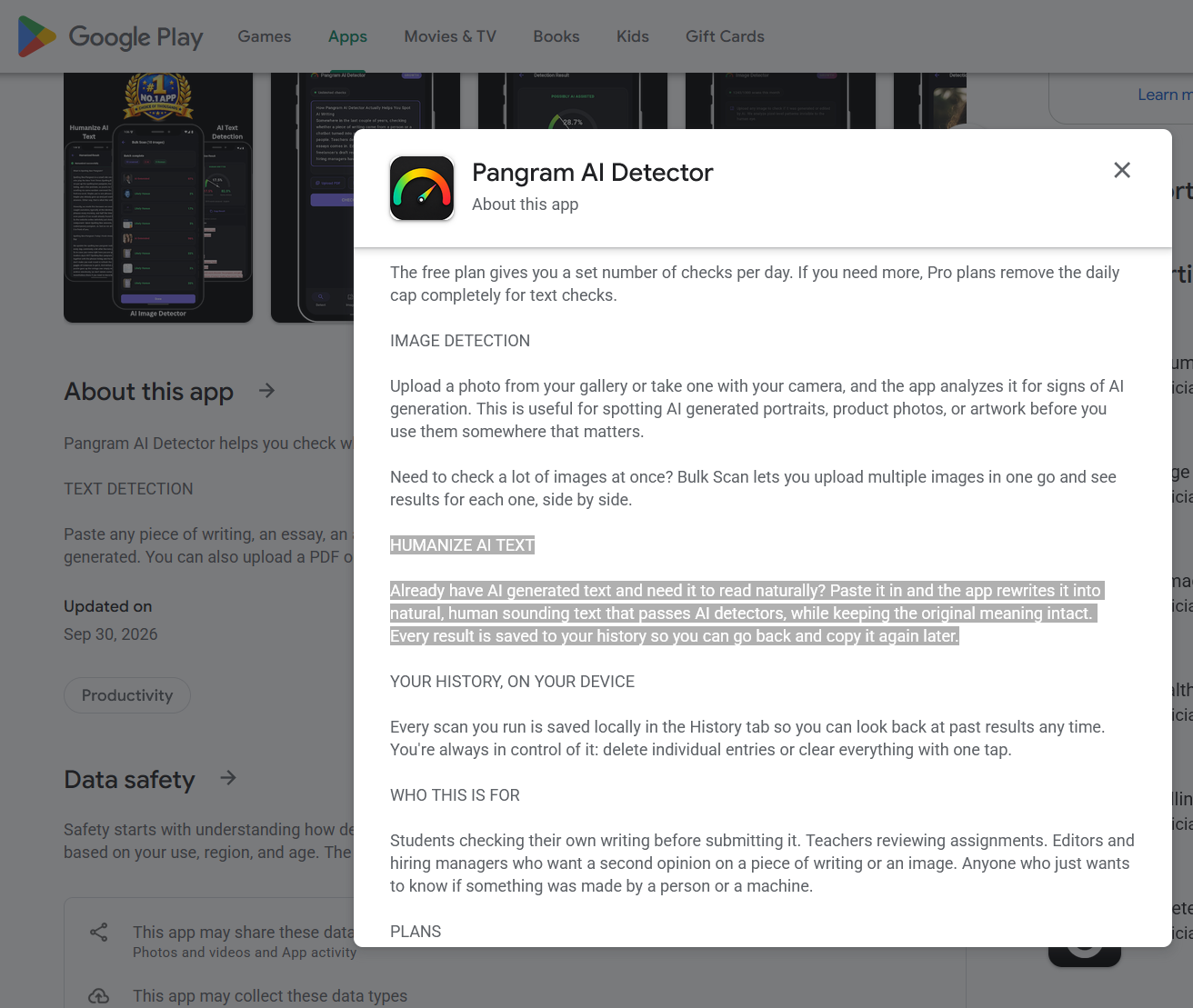
From the app’s Google Play page you cited …
HUMANIZE AI TEXT
Already have AI generated text and need it to read naturally? Paste it in and the app rewrites it into natural, human sounding text that passes AI detectors, while keeping the original meaning intact. Every result is saved to your history so you can go back and copy it again later.
As I commented upthread … They use an AI to do that transformation. It’s AIs all the way down. Such is our (wretched) future.
I think (but am not 100% sure) that the Android app is a third-party knock-off. Or maybe not a knock off per se (they might use the real API), but a cheap wrapper around the official service. Somebody just vibe coded that to pass it off as official; their account is full of other similar slop.
Pangram’s official methodology paper upthread is quite interesting and worth a read. It’s statistics all the way down.
I don’t believe the real company offers a humanizer. I’m also not sure if the app’s humanizer would be able to pass the real Pangram test.
That text is specifically set for bots and links, and now one-boxes. If you can be bothered, in a broswer visit the page, right-click, choose “view source” or similar.. you’ll find the words in “meta tag” code in the HTML headers:
<meta name="description" property="og:description" content="Detect AI content in text & images, then humanize text in seconds.">
it is human-readable but not primarily meant for humans.
Actually, I should have said at least two, and probably more detail than that is needed. What’s the denominator being used? If it says that it has a 99% sensitivity to AI text, is that 99% of all texts that are produced by AIs, or 99% of texts that are presented to it? How is it weighted by different AI sources? How is it for AIs that are specifically attempting to sound human (either a humanizer, or an AI that’s instructed in the first place to “sound more human”)?
Some of those questions are addressed in the Technical Report (Pangram’s own), and there are also some third-party studies out there (AI found and read some, but I won’t spew them at you).
I think the more interesting test is this… try it yourself at their demo page, no account needed, and see if you can fool it either way (false positive or false negative), with any AI or humanizer that you find.
Use an incognito window if you get limited after 4-5 samples.
It’s pretty impressive stuff and really surprised me. I’m inclined to believe their claims as a truly effective methodology, at least against current models, rather than marketing fluff.