I would think that limiting payload to that which can be carried without refueling would be a Good Idea. Doing away with in flight refueling is removing something else that can go wrong.
Eh, it can go wrong, but it can’t go badly wrong. First, you send up all of your fuel loads. If something goes wrong here, don’t send up the manned mission until it’s fixed. Then, send up the manned mission to rendezvous with the fuel depot. If something goes wrong there, the manned mission presumably still has enough fuel to get back to Earth. And this lets you do the manned part with a smaller, more reliable rocket. It’s probably safer than trying to launch everything all at once with one ginormous rocket.
Also, we (humans) have already been to the moon, the only non-propagandistic value I see in this mission is to figure out things like in-space refueling.
Yeah, the Lewis and Clark expedition has been done. Now they need the Oregon Trail setup.
The manned rocket to the moon doesn’t do in-flight refueling, it is the Srarship lander that has to refuel. And it isn’t carring its full cargo capacity just to ferry the crew plus some equipment from lunar orbit to the surface and back. But the Starship is so ridiculously oversized for the job that even with no cargo payload whatsoever it probably needs some amount of refueling to reach the moon (but I can’t find how much).
This is a Starship lunar lander vs an Apollo lander:

It is like Apollo landed on the moon in a Volkswagen Bug. For a modern program they would benefit from a panel van. But they don’t have one so they are using an 18-wheeler.
Estimates I’ve seen called for 20-40 Starship flights to fill up a Starship lunar lander for 1 mission.
How are they going to be certain it’s not going to tip over if it lands on an uneven surface? Yes, it’s extemely bottom-heavy, but it’s still way taller than a lunar lander should be. And the weak lunar gravity makes it lots easier to tip.
Hopefully the solution will be “don’t land on an uneven surface”. The moon has been mapped to fairly high detail; if they can aim the landing precisely it should be possible to find decent landing areas.
Up to a resolution of a few square meters of definitely flat ground? And if yes, are they able to land that precisely?
I mean, they can land on their own launch pads. And the Moon is easier than Earth, what with the lower gravity and no atmosphere.
And you don’t need to map the whole Moon that precisely, just the region where you want to land.
Yes.
Hopefully, they’ve fully tested the launch escape system.
Except you can have a level of soft lunar dust covering a jagged ridge. If that happened with the original Apollo lander it would not tip over.
The Apollo 15 Lunar Module landed at about an 11-degree angle due to one of the legs sinking into a depression.
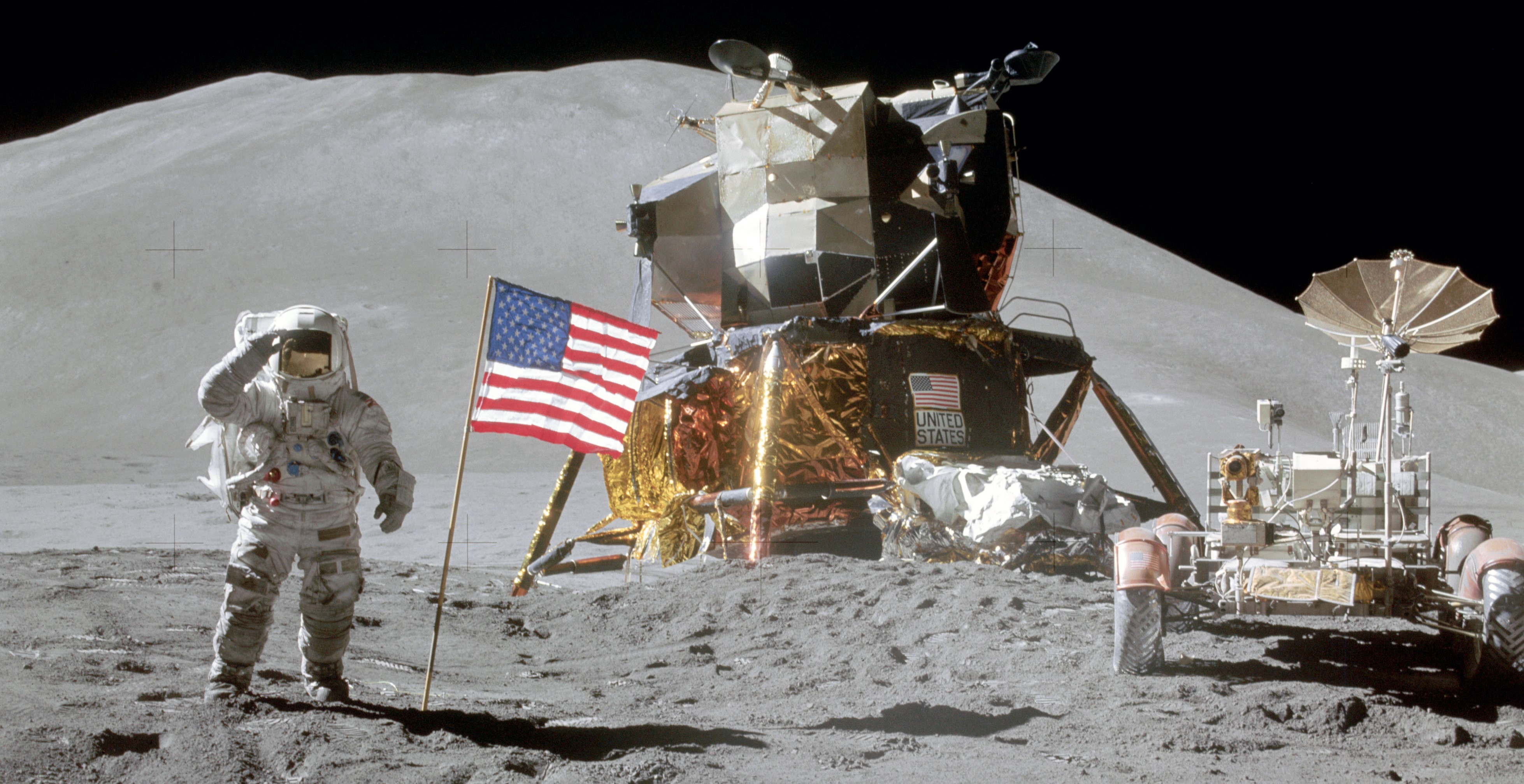
What do you even mean by “soft dust”?
Whatever “soft dust” is, lunar regolith isn’t it, it is randomly-sized (because it hasn’t been sorted by water or wind) and jagged (because it hasn’t been ground by water or wind). There are not going to be deep drifts of dust and even if there were the lander wouldn’t be sinking into it like it was quicksand in a 1950s jungle movie.
It didn’t “sink into a depression”, it landed in a crater. And a good plan for future missions is, don’t.
It landed on the edge of a crater, with one leg partly into the crater depression.
Which means it didn’t “sink into it”. It landed in a hole.
Armstrong had to take over and maneuver over several boulders, as I recall. Apollo 12 did land within EVA distance of a surveyor probe, however.
, didn’t basically all the last unmanned missions to the Moon fail because they did not manage to keep the wheels down?