Okay we’re at about T + 13:33:00 (13 hrs, 33 mins) into the mission. There was a minor glitch on board Integrity, with the toilet. This was one of the early tests they needed to run before the TLI burn to go to the moon — Translunar Injection. The fan for the urine collection system was stuck. It was affecting only #1 collection, not #2 collection, but they were able to fix it. Christina Koch, Mission Specialist, took on the role of space plumber and NASA walked her through the fix.
Riveting stuff, we might think, but when you’re in a space capsule and can’t pull over at the next gas station to go, that could become a bigger problem. They do have backup plans for such glitches — the CCU, or Collapsible Contingency Urinal. Basically a space-rated ziplock baggie. Fortunately they can still go with Plan A (or Plan #1, as this case may be).
CapCom Amy Dill: “Happy to report that toilet is go for use.”
The upcoming TLI burn is scheduled for T + 25:37, or a little more than 12 hrs from now which is about 0012Z (12 minutes after midnight on Friday), or 2012R or 1712U on Thursday.
Z = UTC
R = Eastern time zone USA
U = Pacific time zone USA
The TLI burn lasts about 6 minutes.
To remind, launch time was about 11 minutes late, at 2235Z = 1835R = 1535U on Wed 01 Apr 2026.
I was 3 in 1972, born between Apollos 11 and 12. Can’t recall if I saw any live mission coverage, but I do recall, growing up, seeing a lot of film footage from Apollo on TV. It was very popular, especially the shot of the stage adapter ring between S1 and S2 blazing with light as it caught some of the second stage’s plume (which was, being an H2/O2 system, a near invisible flame).
The video feed from the Orion was kind of a disappointment. No internal shots of the astros in the cabin that I could see, and the external view was rather spotty–they were having TDRS issues, but is it usually that bad? Even the visualization simulation (animated view) was wonky at times. I suppose everyone, including SpaceX, has to develop their own in-house systems, and I didn’t like the live coverage as much for this mission as others. They did have a simple timeline bar along the bottom, but were missing speeds and altitudes, which I am very interested in. (SpaceX provides this.)
As you point out, there’s about 12 hours to go before TLI, and that time will continue to be used for a thorough checkout of all systems. Lots of things could still be found that would abort the mission, even if it was just through an abundance of caution.
For those of you who remembered those launchings what did you expect would happen next: did you expect continued frequent trips, setting up a lunar moon base and then going on to Mars–or did you realize that this was it and the U.S. would quit for the next 50 or so years.
11-12yo me was expecting onwards to permanent lunar bases and Mars.
I also grew up in SoCal and many of my friends’ fathers worked for aerospace firms building the whole stack. My immediate next door neighbor was a mechanical engineer who worked directly on the LM design. Aviation and then Space was very much in the air and water of greater Los Angeles in those heady days.
I had just turned 4 a couple of days earlier. I have clear memory of watching the launch with my dad. I think the memory stuck with me for a couple of reasons.
One, it was probably the first time he told me to watch something on tv with him. Before that, tv was cartoons and educational programs for me, news and sports for him
Second, he said he wanted me to see it because it was the “last one,” something I had a lot of questions about and am pretty sure I didn’t understand at all. But I remember thinking it was a pretty sad occasion.
I guessed we would continue exploring the other planets. As a tie in with the Apollo 11 broadcast, there was a short time-filling film of NASA sending a puppet on a long duration voyage to the outer planets (because they don’t need life support). So I guess I believed it was possible, and the next logical step. I was 7. I thought Milwaukee was a long way away. The concept of space distance was beyond my understanding.
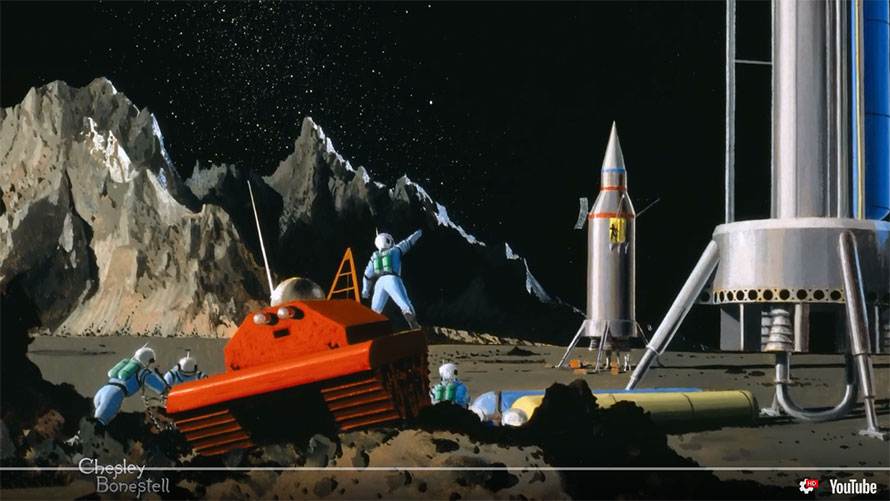
I knew we weren’t going in Chesley Bonestell finned rockets, but I thought they would be something, maybe like 2001’s Discovery.
By the time Capricorn One came out, I knew there was no way they were going to Mars in an Apollo capsule and a LUNAR lander.
This may have been broaced already, but I didn’t want to slog through the whole thread. Why? What is the point of a habitat on the moon? We’re not going anywhere from there that I can fathom. If there are valuable minerals out there, how can they be transported? It all just seems like a colossal waste of tax dollars to me.
I was just a kid, but an avid space enthusiast, and like almost everyone else, I naturally believed that manned space flight would evolve exactly as you described. Mars was especially intriguing as it would be several more years before we got the first pictures of the surface from Viking I.
There was a famous difference of opinion between Kennedy and then NASA administrator James Webb about Kennedy’s challenge to put a man on the moon by the end of the decade. Webb felt that this aggressive pull-all-the-stops approach was not amenable to systematic evolution and would be a dead end. Kennedy might even have agreed, but his objective was political, not technological or scientific. So in a sense they were both right.
Many of us space enthusiasts were surprised and disappointed when NASA seemed directionless after the last Apollo flight. And I always felt that the Space Shuttle was an uninspired kluge.
If we’re going to do that expansionary sci-fi stuff someday, this is a good first step - it’s local, we can run rescues to it relatively quickly, it has some resources. Can we build stuff there? Let’s see! Plus the other guys are going to do it to, so let’s get there first etc.
I’m actually lukewarm on the whole thing, but I see the argument.
The first landing was during my college orientation. They had a for-the-time huge TV screen set up in the student union, and angled so it could be seen through the windows.
And yes, I expected more landings leading up to a moon base and then eventually one on Mars; with “eventually” being well within my lifetime. If we didn’t nuke ourselves first, of course; which also seemed like a distinct possibility. But I don’t think the idea that we might just not bother even entered my mind.
Beat me to it. I’ve just become jaded on the whole space exploration thing. I well remember the excitement of the first orbits by the Soviets and Glenn, and the first moon landing. But it all just seems so pointless, when we have real problems to be solved right here on Earth. Those billions of dollars could sure feed a lot of people and make our home a better place to live.
I thought it was wonderful! Getting away from expensive throwaway rockets was a major step. A reusable spacecraft! And with a cargo bay he size of a school bus. You could load the entire Apollo command and service module in there with room to spare.
Just because it didn’t live up to the promise doesn’t mean the idea was bad.