[QUOTE=jshore]
Assuming I understand your question correctly, the answer is that it can. Take, for example, the feedback loop between CO2 and water vapor. If CO2 levels start to rise, then this warms the climate, which causes water vapor in the atmosphere to increase, which causes further warming. Thus the water vapor feedback amplifies the warming effect due to the rise in CO2. Conversely, if CO2 levels start to fall, then this cools the climate, which causes water vapor in the atmosphere to decrease, which causes further cooling. Thus the water vapor feedback amplifies the cooling effect due to the fall in CO2.
[/quote]
Philisophically, couldn’t one take a “snapshot” of these variables and state which direction the feedback should lead (assuming that the theory is correct). For example, knowing the Earth’s current temperature and CO2 levels, doesn’t the theory predict that the temperature will rise?
And vaccines are related to increases in temperature how?
And radio is related to increases in temperature how?
And radar is related to increases in temperature how?
[/QUOTE]
This is a quick over-simplified answer, but I think it adequately answers your questions.
Each of those items requires either electrical energy to make use of the item, electrical energy to produce the item, or some combination of both. Currently electrical energy is produced by many sources, some of which increase the atmospheric CO2 content. And as established earlier, increases in atmospheric CO2 content are one of the factors that can lead to an increase in temperature.
[QUOTE=brazil84]
Philisophically, couldn’t one take a “snapshot” of these variables and state which direction the feedback should lead (assuming that the theory is correct). For example, knowing the Earth’s current temperature and CO2 levels, doesn’t the theory predict that the temperature will rise?
[/QUOTE]
If by “snapshot” you mean a single moment in time, then no - you can’t tell the direction of expected feedback. The direction and magnitude of feedback loops is dependent not on the absolute values of the variables that are driving them, but by the changes in those variables. A snapshot gives you the values without telling you anything about whether they’re changing.
[QUOTE=kangaroo_in_black]
This is a quick over-simplified answer, but I think it adequately answers your questions.
Each of those items requires either electrical energy to make use of the item, electrical energy to produce the item, or some combination of both. Currently electrical energy is produced by many sources, some of which increase the atmospheric CO2 content. And as established earlier, increases in atmospheric CO2 content are one of the factors that can lead to an increase in temperature.
[/QUOTE]
If that’s the only relationship, it follows that the temperature increase did not CAUSE these advances which resulted in improvements in human well being.
[QUOTE=Enginerd]
If by “snapshot” you mean a single moment in time, then no - you can’t tell the direction of expected feedback. The direction and magnitude of feedback loops is dependent not on the absolute values of the variables that are driving them, but by the changes in those variables. A snapshot gives you the values without telling you anything about whether they’re changing.
[/QUOTE]
So it follows that if mankind stopped producing extra CO2 tomorrow, we do not know which way the temperature would go, right?
[QUOTE=brazil84]
So it follows that if mankind stopped producing extra CO2 tomorrow, we do not know which way the temperature would go, right?
[/QUOTE]
I have no idea how you made such a huge (and incorrect) leap. Your conclusion absolutely does not follow from your premise, because we have a long-term temperature record rather than just a snapshot.
For the record, if all combustion emissions were ceased tomorrow, there would probably be a short term rise in temperature. This rise would be caused the differing response time between various climate driver - in this case, between aerosols and CO2. Sulfate aerosols, a byproduct of hydrocarbon combustion, increase the albedo of the earth, reflecting sunlight. These aerosols have a residence time in the atmosphere on the order of days (I want to say 10 days, but I can’t look it up right now). CO2 has a residence tie on the order of hundreds of years. If we stopped all emissions immediately, the reduced albedo would lead to a short, sharp increase in global temperature, and then a gradual temperature decline as the CO2 levels in the atmosphere fell.
[QUOTE=brazil84]
If that’s the only relationship, it follows that the temperature increase did not CAUSE these advances which resulted in improvements in human well being.
[/QUOTE]
I think that it is reasonable to assume that given a cold enough climate, most of human civilization would not have progressed as far as it has at this point in time.
That is not to say that if there is an increase in temperature there is an increase in the progress of civilization. Rather that there is a temperature range at which human civilization is able to focus more of its energy at progress rather than mostly at survival.
Up to now, I’ve been rather elusive because I want you to find your own answers. I’ve pointed out that the answers to your questions are known and I’ve pointed out where to find them. I might not post again until after Christmas, so I’ll be a little more straightforward in this post.
It’s still imperative that you read the IPCC report(s) (at least their summaries) and do your own research. This is exactly what you requested - the raw data, unfiltered by political blogs and policy wonks. I am only holding you to your promise to examine the data personally and to be intellectually honest.
[QUOTE=brazil84]
That’s nonsense. Your actual calculation contained no variable for CO2. It’s as simple as that.
[/quote]
It does; the CO[sub]2[/sub] constitutes a certain percentage of the total greenhouse effect - Lindzen says it’s 5%, Wikipedia 9-26%. You can derive it if you know the relative concentrations of H[sub]2[/sub]O and CO[sub]2[/sub] and their relative greenhouse warming potentials. The GWP’s can be derived from their radiative cross-sections as a function of wavelength normalized by the Wien Law radiative emissions from the Sun.
No, it doesn’t. That the Clean Air Act has reduced all the negative-forcing particulates and sulfates has nothing to do with whether CO[sub]2[/sub] is a positive forcing agent. If you read the IPCC report carefully, you’ll note that all the negative anthropogenic forcing is pretty much balanced out by the non-CO[sub]2[/sub] anthropogenic positive forcing. We generally ignore particulates, sulfates, NO[sub]x[/sub]'s, CFC’s, and ozone because all those factors are (a) minor and (b) balance out. CO[sub]2[/sub] is the only unbalanced factor, so first-order calculations involving CO[sub]2[/sub] tend to be pretty accurate. If you want to include all the other factors, you can, but they’ll overall balance out.
False as addressed above.
I quoted myself directly after the line you quoted. I don’t see how you could have missed it.
Then show me the data that shows the SRES scenarios have a temperature dependence on CO[sub]2[/sub] levels and sensitivity to CO[sub]2[/sub]. You claimed those as your dependent and independent variables - so let’s see this alleged correlation you say exists.
In post #7, you claimed that scenarios have different sensitivities. You then claimed correlation between the temperatures and the different sensitivities. In a later post, you said that sensitivity is the response to CO[sub]2[/sub] for a unit increase. If the different SRES scenarios have different unit increases, and you agree that temperature changes are based on these, then it’s unsurprising that temperature changes in the SRES scenarios are proportional to the CO[sub]2[/sub] increases they respectively give.
First principle calculations require no citation. What’s a cite for the Pythagorean Theorem? There is none required - you can derive it yourself (as you can derive the Wien Displacement Law or the Stefan-Boltzmann Law).
If you can’t derive it yourself, look it up on Wikipedia.
It got too hot outside and people went inside to do science.
YOU asked to see the evidence for global warming. YOU wanted to see what else was out there except for the proxy temperature records.
If you’re unwilling to read, understand, or address the scientific literature, then stop pretending to have an open mind. If you’re continuously going to cite personal blogs and oil industry websites against scientific evidence, that’s a far more basic problem than I can help you with.
Nobody’s asking you to bet your life savings on anything. They’re asking you to look at the evidence that supposedly shows I’m Liz Taylor.
When you have taken even a cursory look at the evidence, you can determine whether the odds of me being Liz Taylor are 1:1, 1:10, 1:100, or 1:1,000,000. And then you can take your odds properly.
No, you’re your own research assistant. I’ve done my research. I’ve read the evidence and looked it over before posting.
You have not.
[QUOTE=aptronym, post #110]
if you read the IPCC report, you’ll note that only “most” of the warming in the back half of the century is attributed to anthropogenic causes - half (the bottom end of “most”) of the half of the observed +0.8[sup]o[/sup]C warming is +0.2[sup]o[/sup]C.
[/QUOTE]
I don’t understand why don’t you answer immediately?
I mean, surely you’ve already known what I quoted and considered it prior to making definitive “No” statements in post #15, right? Or are you conceding that you made those statements without ever having read the scientific evidence on the matter?
To reiterate my first point: this thread is more about getting you to actually do your own research on the subject before making wild, unsubstantiated claims about science. I strongly suggest you read the IPCC report summaries, and beyond the value in you simply understanding what you’re arguing against, I believe that you’ll find much in it to support your argument(s).
It may actually surprise you to find out after 140 posts that I actually agree with you when it comes to the economic front - the IPCC reports don’t give a picture of catastrophic warming; the first few degrees really don’t matter; and while we’re justified in putting in a small investment into fighting it, we can rely on strong economic growth to solve most of the problems.
But I didn’t come to that decision lightly, nor did I come to it with an uneducated misunderstanding of science. Even if our conclusions are more similar than dissimilar, my conclusion is rational and yours is not.
[QUOTE=Enginerd]
I have no idea how you made such a huge (and incorrect) leap. Your conclusion absolutely does not follow from your premise, because we have a long-term temperature record rather than just a snapshot.
For the record, if all combustion emissions were ceased tomorrow, there would probably be a short term rise in temperature. This rise would be caused the differing response time between various climate driver - in this case, between aerosols and CO2. Sulfate aerosols, a byproduct of hydrocarbon combustion, increase the albedo of the earth, reflecting sunlight. These aerosols have a residence time in the atmosphere on the order of days (I want to say 10 days, but I can’t look it up right now). CO2 has a residence tie on the order of hundreds of years. If we stopped all emissions immediately, the reduced albedo would lead to a short, sharp increase in global temperature, and then a gradual temperature decline as the CO2 levels in the atmosphere fell.
[/QUOTE]
Putting aside aerosols and holding all other things equal (unrealistic I know, but this is a hypothetical question), wouldn’t the temperature and CO2 ultimately reach an equilibrium?
[QUOTE=kangaroo_in_black]
I think that it is reasonable to assume that given a cold enough climate, most of human civilization would not have progressed as far as it has at this point in time.
That is not to say that if there is an increase in temperature there is an increase in the progress of civilization. Rather that there is a temperature range at which human civilization is able to focus more of its energy at progress rather than mostly at survival.
[/QUOTE]
That could be. But I don’t think it undermines my basic point about the rise in temperature in the last 100 years.
[QUOTE=aptronym]
Up to now, I’ve been rather elusive
[/quote]
Whatever.
No it doesn’t. Here is your calculation:
Nothing about CO2.
In which post? And why are you being so evasive? It’s a simple yes or no question.
I’ll answer it for you: The answer is that one could reduce the error bars significantly if one knew precisely the climate’s response to CO2.
It’s not a matter of data, it’s a matter of logic. If the scenario predicts a range of temperature increases for a given amount of CO2, what other explanation is there?
Perhaps, but so what?
Perhaps, but so what? I didn’t “insist” on a first order calculation.
Cite?
Perhaps, but that’s besides the point. You claimed without any support that small warming over the last century caused GDP to drop 99% from where it otherwise would have been. Then you demanded a cite from the IPCC to prove you wrong.
As before, I’m not your research assistant. But I do find it amusing that you limited things to the IPCC.
Fine, so show me the evidence that the negative effects of AGW will greatly outweigh the positive effects of economic growth. Show me evidence that the trend of the last 100 years will dramatically reverse itself.
Because I want to give it some thought.
I concede that I made those statements without reading the quotes you gave me. I will read the quotes and re-consider.
Oh, and please give me a cite for the claim that Lindzen’s 0.2c is over the “back half” of the last century.
[QUOTE=brazil84]
Putting aside aerosols and holding all other things equal (unrealistic I know, but this is a hypothetical question), wouldn’t the temperature and CO2 ultimately reach an equilibrium?
[/QUOTE]
Making sure I understand your question:
Assume that mankind immediately halts all CO2 emissions, and neglecting aerosols and holding everything else equal, would the temperature and CO2 concentrations eventually reach some kind of equilibrium?
Is that right? Given those assumptions, I think the CO2 and temperature would reach an equilibrium. It would take a long time, due to the residence time of CO2 in the atmosphere - on the order of a couple of hundred years - but it would get there eventually.
You’re not going to be able to extrapolate that answer to Earth’s climate, though, unless you can come up with some kind of mechanism to hold every other variable steady for 500 years.
You’re not going to be able to extrapolate that answer to Earth’s climate, though, unless you can come up with some kind of mechanism to hold every other variable steady for 500 years.
[/QUOTE]
Of course not - it’s a purely hypothetical question.
I’ve been giving some thought to this statement, and in the meantime, I have a question.
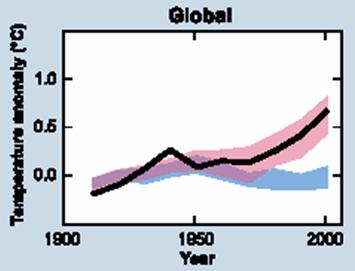
Here’s what purports to be a closeup of one aspect of the chart:
Do you agree that the chart seems to be saying that without anthropogenic effects, world average temperature would have started decreasing around 1950 and continued decreasing through 2000?
[QUOTE=brazil84]
Putting aside aerosols and holding all other things equal (unrealistic I know, but this is a hypothetical question), wouldn’t the temperature and CO2 ultimately reach an equilibrium?
[/QUOTE]
Yes, but at a higher temperature than now. This is the “Constant 2000 Levels” scenario listed among the SRES scenarios in the IPCC report.
I agree there is nothing in the section you quoted about CO[sub]2[/sub]. I disagree that you have accurately quoted the whole calculation. Read more carefully.
In post #106, as in “aptronym, post #106, HEY LOOK THE QUOTE”. Did you really need to ask which post I was quoting?
Yes, but we could reduce the error bars by a larger amount if one knew precisely the CO[sub]2[/sub] concentration as a result of economic activity. That is what my quote means.
That each of the SRES scenarios account for different levels of aerosols, nitrates, and sulfates from burning dirty coal; that each accounts for different forcings per unit aerosol, nitrate, or sulfate; that each has different evaporative responses to warming; etc.
LOOK AT THE RADIATIVE FORCING CHART. IT CONTAINS ALL THE UNCERTAINTIES FOR CLIMATOLOGICAL FORCINGS.
I’ve given as many cites in support of the “global warming caused increases in quality of life” hypothesis as you’ve given in support of “economic growth caused increases in quality of life” hypothesis.
Without understanding the IPCC report, you cannot disprove that possibility. Unless you demonstrate having read something about the current state of science, you cannot eliminate the possibility that we will have +10[sup]o[/sup]C warming, nor can you eliminate the possibility that warming will be catastrophic.
I don’t think it will.
But I write that with rational confidence, knowing exactly what causes, is causing, and will cause global warming, how much warming there will be, and what effects warming will have.
You write it with irrational confidence and ignorance of the known facts.
I never said you were wrong, only that your opinion was unjustified.
I’ve already done my research. Have you?
In response to my previous question, apparently not. After 153 posts, perhaps 30-40 by you, you’re finally reaching the point where you’re doing what I asked you to do in post #1.
I have explained twice why I do so. In summary, I do it because it’s been validated by the NAS, that it’s complete, that its authors have taken steps to make science accessible, and it’s available for free online. Basically, I do it for your benefit. But if it makes you feel better, you can chew on this (proper) reference for temperature predictions.
Let me know what you think and I can give you some more.
Be clear on this - you want to give the facts a thought, or you’re furiously looking through blogs to try and find something that addresses what I’ve posted?
If you want, I can post a RealClimate link to answer your CoyoteBlog link.
I have never done that - not in any single post on this thread, in the temperature record thread, or in the economic hockey stick thread. Is it because RealClimate knows less than I do, or because they spend less time than I do? Neither - it’s because RealClimate is an unreviewed blog. I make an effort to make sure my information comes from peer-reviewed, transparent sources.
I insist you do the same.
I disagree that this chart says anything at all. For one thing, there is no key on the graph, and no chart description (it appears to be part of a larger set since the title just says “Global”). There appears to be only 10 or so data points, based on the roughness of the line, which is grossly inconsistent with the IPCC graph I linked you to (i.e. it’s certainly not a zoom-in of any graph I’ve linked).
I refuse to comment on anything about this randomly linked picture.
I agree that Figure 9.5b in the IPCC 4AR WG1 report shows that average temperature should have decreased around 1950 if it weren’t for anthropogenic effects.
Lindzen, R.S.; Giannitsis, C. Geophys. Res. Lett.2002, 29, 12, 1583.
The astute will note that the latter is not a peer-reviewed reference since it’s a Note; however, since the request was for a citation of Lindzen agreeing to a 0.2[sup]o[/sup]C increase (not whether a 0.2[sup]o[/sup]C increase is correct), I think it qualifies as an accurate citation.
Also, I pulled the quotes from the galley proofs posted on Lindzen’s website because I don’t subscribe to AGU journals, so if the final printed version is slightly different from my quotes, I apologize.
[QUOTE=aptronym]
however, since the request was for a citation of Lindzen agreeing to a 0.2[sup]o[/sup]C increase (not whether a 0.2[sup]o[/sup]C increase is correct), I think it qualifies as an accurate citation.
[/quote]
I’m a little confused. The request was for a cite to back up your claim that according to Lindzen, the anticipated warming from CO2 in the “back half of the century” is 0.2C.
Are you stating that the cites you provided back up your claim?
I agree that Figure 9.5b in the IPCC 4AR WG1 report shows that average temperature should have decreased around 1950 if it weren’t for anthropogenic effects.
[/QUOTE]
Ok and here’s the next question:
What is the natural forcing in these computer models that would have caused temperatures to start falling in 1950 and then continue to do so?
I agree there is nothing in the section you quoted about CO[sub]2[/sub]. I disagree that you have accurately quoted the whole calculation. Read more carefully.
[/quote]
Sorry, but I must have missed it. Feel free to re-quote it. Or to weasel a little.
Of course I do. A simple yes or no question and you’ve been dodging and weaving for pages now.
Finally! And no, I don’t see why the reduction from one is necessarily larger than the reduction from the other.
Fine, I will take a look.
False and evasive. Feel free to demand cites of me for my claims. Just as I’m demanding a cite from you.
[QUOTE=brazil84]
Are you stating that the cites you provided back up your claim?
[/QUOTE]
Did you read the quote, or are you arguing that because Lindzen wrote “past 50 years” in 2002 and I called it “the back half of the 20th century” (1951-2000) that I’m wrong?
I don’t know. I neither run the models nor review the papers they were published in nor do I have the expertise to evaluate the models. If you have technical questions about the models, you are free to contact the authors of the paper. In scientific publications, one author (usually either the first or last author) is starred and contact information is provided.
Feel free to read more carefully.
[QUOTE=aptronym, post #1, bolding added]
The greenhouse effect is what keeps us alive - based on Earth’s distance from the Sun and the Stefan-Boltzmann blackbody radiation law, Earth should be a frigid -15[sup]o[/sup]C on average. Yet its average temperature is +20[sup]o[/sup]C - a 35[sup]o[/sup]C warming which is due to greenhouse gases - about 95% due to water (H[sub]2[/sub]O), and 5% due to carbon dioxide (CO[sub]2[/sub]), with all the rest of the gases contributing some miniscule amount … increasing the CO[sub]2[/sub] (or H[sub]2[/sub]O, but we don’t generate enough) will increase the greenhouse effect. This difference is anthropogenic global warming. Experimentally, we’re seeing a 38% increase in CO[sub]2[/sub] levels since the Industrial Revolution, which, if the greenhouse effect were linear, would correspond to about a 0.7[sup]o[/sup]C warming. Just to be clear, the greenhouse effect is certainly not linear, but we’re in the right ballpark here.
[/quote]
I’ve been dodging and weaving intentionally to really emphasize the fact that your question was answered before it was asked. That you are asking at all is indicative of not reading carefully, not that I have something to hide.
Again, simply reading what I have written would help in this regard.
[QUOTE=aptronym, post #1]
This is an important point - how bad global warming will be is mostly a function of the scenario. The interscenario variability is greater than the intrascenario variability in most cases.
The B1 (united, environmental) scenario is obviously the best case. A 1.1-2.9[sup]o[/sup]C warming is anticipated (negligible to mild) and sea levels will rise 7-15".
The A1F (united, economic, fossil fuel based) scenarios are the worst, with warming of 2.4-6.4[sup]o[/sup]C and sea level rises of 10-23".
[/quote]
Which matters more, exactly what climatological parameters are being used with the B1 SRES, or what economic parameters are being used between B1 and A1F?
I’m adding this to the list of things I expect you to respond to, along with all those quotes I gave you. Don’t think you can stretch this thread out to the point where I will forget - you looking at actual evidence-based statements and then forming your opinion on evidence is the entire point of this thread.
I demand a cite from you first. If you can’t provide a valid cite, then my counterclaim is moot.
You asking for citations is mostly a ploy to a non-existent audience at this point. I’ve stated repeatedly (and explicitly) that I do not actually believe the quoted statement - I stated it specifically to counter your assertion that without knowing any of the effects or magnitudes of global warming (past or future) that you could rely on economic growth to outweigh it.
You then admitted there are circumstances in which global warming might outweigh economic growth. That concession is the end of your position; we now return to the question of what scientists actually predict to be the magnitudes and effects of global warming.
[QUOTE=aptronym]
Did you read the quote, or are you arguing that because Lindzen wrote “past 50 years” in 2002 and I called it “the back half of the 20th century” (1951-2000) that I’m wrong?
[/quote]
Does that mean “yes” or “no”? Simple question. Not that I’m expecting a simple answer.