Ugh. I can’t imagine how tragic this is for the Baltimore roads department. Someone made the completely benign decision to send a crew to patch potholes on the bridge last night and the absolute unthinkable happened. The whole department is going to need some major counseling.
Nitpick from a former physics instructor: Acceleration is not measured in miles per hour. That is a unit for speed or velocity.
The product of mass and velocity is momentum. So like @BobLibDem said, you could indeed properly say that the massive ship, even with a relatively low speed, still had a lot of momentum.
Also note that Newton’s second law is better expressed as: Fnet = m a, in which the force in question is the net force, and both force and acceleration are vectors. Applied to the present case of an inelastic collision between the ship and bridge support, you could say that the negative acceleration of the ship as it collided with the bridge support required a large net force on the ship, and by Newton’s third law, an equal and opposite force on the bridge support, which was large enough to separate the support from its footing.
You could also look at the equation for conservation of momentum, but this is complicated by the fact that the bridge support was initially attached to the earth.
Road construction work, especially at night, is already plenty dangerous due to the horrible surplus of drunk and/or inattentive drivers. It turns out they were supposed to be worrying about drifting containers ships too…
A friend of mine was an iron worker. He worked on many of the tall buildings in downtown Pittsburgh. He was comfortable working hundreds of feet above street level, walking on beams, etc, but he told me he turned down any jobs working on bridges. He knew the guy who had their leg smashed by a steel plate, requiring an amputation right on the bridge to free him for transport.
Assuming a total weight of 100K tons, that’s 200 million pounds of mass. Assume a decel of just 0.01 G, or 0.2 MPH per second, getting stopped from a forward speed of 5 MPH would take 25 seconds. And 0.01G of decel on a mass of 200M pounds requires a force of…2 million pounds exerted by the bridge against the ship. And the bridge ain’t made to take that kind of side load.
The problem here is that I need the “Physics for Dummies” version of your post. LOL
My definition of force: You walk slowly into me. You bump me backwards. No problem because I regain my balance and nothing hurts. You RUN into me. You wipe me out. It hurts. A lot. Your mass is the same in both cases. To me, the difference is the speed at which you hit me. You say that F = MA is not the right equation. What is?
See also the Queen of Oak Bay, a BC Ferries vessel that wrecked the Horseshoe Bay Marina for lack of a cotter pin.
BTW, that ship is still in service making the same run between Nanaimo and Vancouver.
Yeah, that’s what the pilots are for. Pilots at the mouth of the Columbia Rivera are legendary.
Blockquote You say that F = MA is not the right equation. What is?
It’s pretty close - Momentum = Mass * Velocity. Acceleration is changing velocity, but momentum is just that raw hitting power that you’re talking about.
You are probably looking for the kinetic energy of the ship, E = 1/2 mv², where m is the mass of the ship, v² is the speed of the boat squared, if possible in SI units (kg, m and s) to get the result in Joule. The F = ma you quote would rather give you the force you should have applied to the ship to give it (her?) enough (negative) acceleration to stop the ship in time before it (or her, or whatever) hits the bridge. You would have to calculate the acceleration necessary to stop the ship in time before hitting the bridge, for which you need to know the speed of the boat and the distance to the bridge. Whatever those numbers were this goal was not attained.
Looks like the BS conspiracy theories have already started. A FB friend said the video looked “suspicious,” and that the explosion (or at least smoke) on the boat was likely planned. 
Ummm… what explosion?
See the video in FairyChatMom’s post. (I also edited to say “explosion, or at least smoke”).
The video linked above showed several yellow blinking lights along the bridge roadway (just to the right of mid-span). That definitely looked like a working line of road work trucks.
I hope they’re ok. Barring that, I hope they’re recovered swiftly to give the families what closure can be had.
I did.
Nothing there resembled an explosion.
I see these people online. It must be exhausting trying to fit anything that happens anywhere into a conspiracy.
I’m going to remember this line, and steal it from you.
Permit me to rephrase; ships operated by or for US-owned companies but registered under a “flag of convenience” (i.e. registered with a country with little in the way of controls or review of maintenance) are often not well maintained. There are very few ocean-going commercial vessels that actually operate under US flag except as required by the Jones Act for both tax and liability reasons. You are correct that Europe in general and Denmark specifically has rigorous maintenance and training standards for commercial vessels operating in their domains.
This statement is also a little ambiguous. Momentum is mass x velocity, and impulse (the “hitting power”) is the change in momentum (or the integral of applied force over the contact interval). Since momentum is always conserved irrespective of any material deformation or other conversion of kinetic energy into other forms (heat, light, acoustic, et cetera) it is the best quality to evaluate the ability of a moving body to knock over or propel any object it runs into, especially if the collision is inelastic (no bounceback) since you don’t actually have to know anything about the intermediate states during transfer of momentum. Since the acceleration of two bodies colliding will change over the duration of the impact, using kinetic energy you would have to integrate the (somehow measured) instantaneous accelerations to get a resulting state; using momentum, you just need to know the before state an assume some coefficient of restitution, or measure the before and after states of each body and derive the coefficient of restitution.
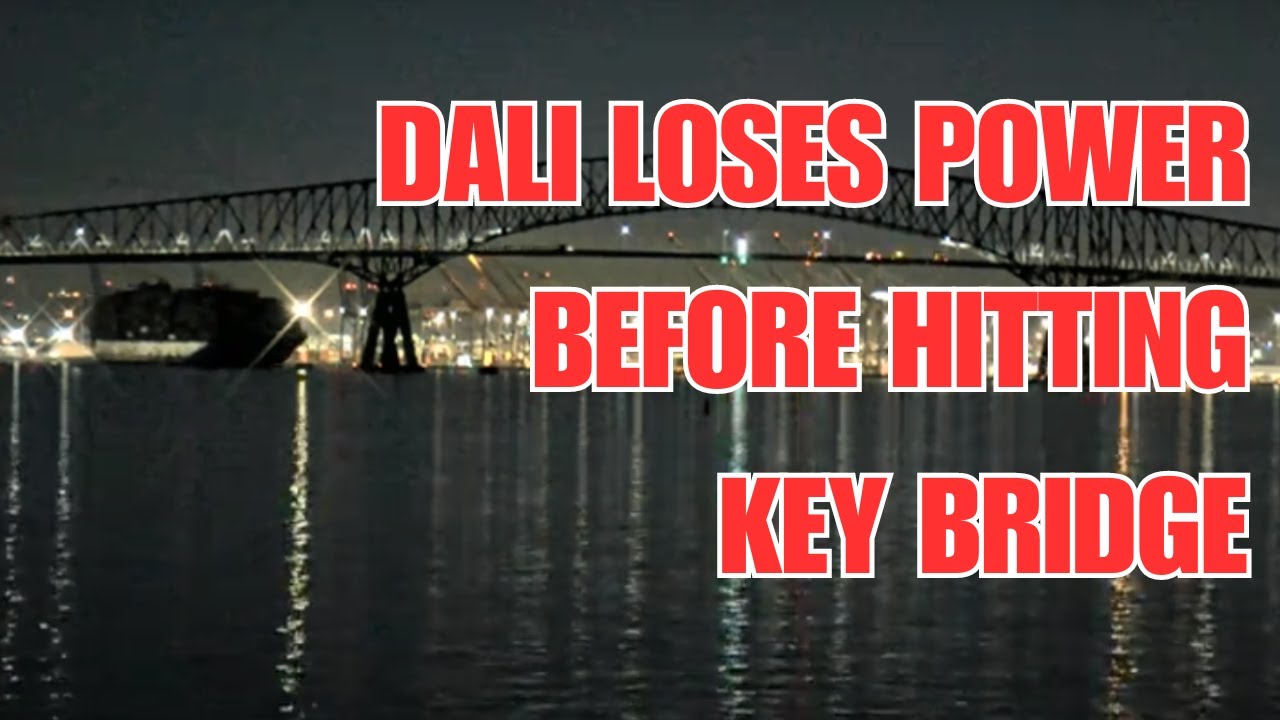
Initial expert from someone with actual expertise in maritime operations:
Stranger
Against my better judgment I briefly poked my head into a website run by a (very) well-known conspiracy theorists. He is calling it a “Black Swan Event,” whatever that means. 
The latest news reports on CNN are saying that the ship did indeed drop anchor to try to scrub off some speed.
According to the timeline, the first signs of trouble occurred at 1:24AM, and the ship hit the bridge just three minutes later. There’s also mention that someone on the container ship placed an “emergency call” that gave officials time to begin closing the bridge to vehicle traffic. If that’s all true, then I’m really surprised a response could be mustered so quickly. Even if the call was placed at the first sign of trouble, could officials even begin to shut down the bridge in less than three minutes?