I’m wondering if there are any parts of the bridge that can be used in the rebuilding, such as the ramps leading up to the span that appear intact (thought they might well have damage) and anchors for the pylons, or one of them at any rate.
My understanding was that federal will front the costs, rather than waiting for insurance monies to kick in. Federal funds would be immediate, insurance would take quite some time.
They said the ship lost power and it made me wonder why it steered into the bridge. It may have been a function of throwing it into reverse which then pulled the bow around to the right. Just a wag at this point.
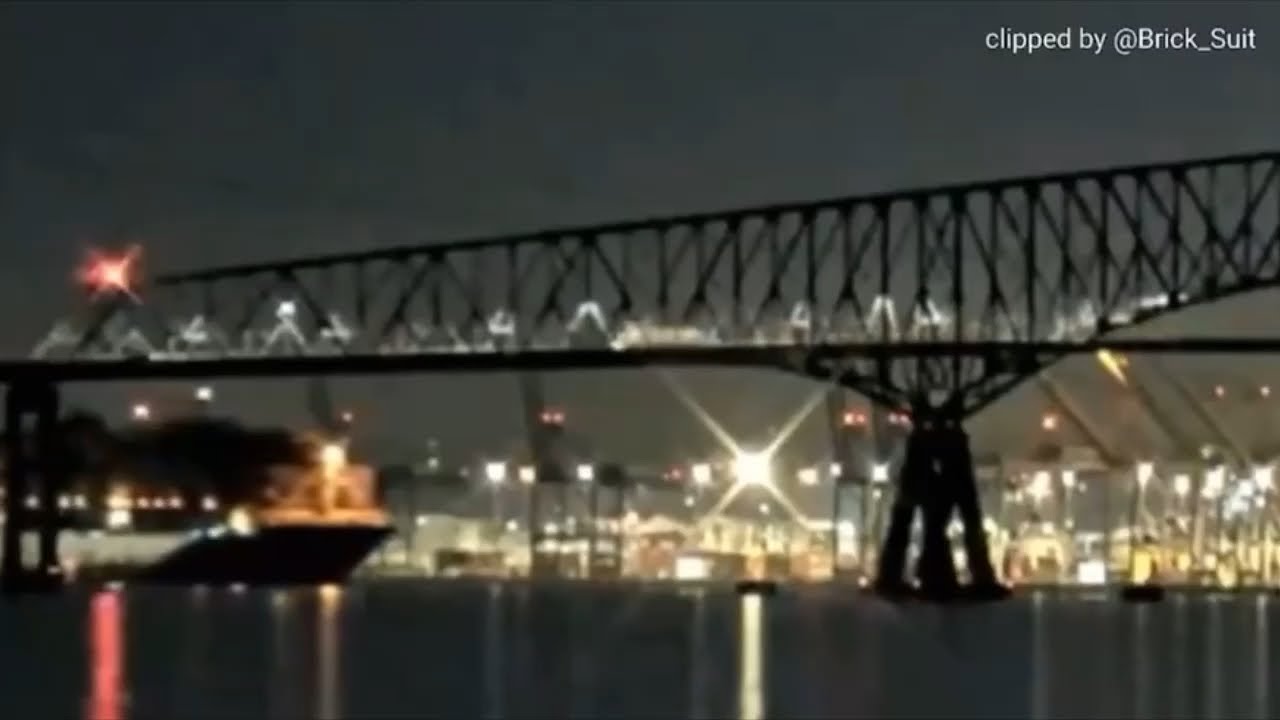
You can clearly see the ship lose power, regain power and lose power again in the video below. You also can see thick black smoke belching from the smokestack (engine restart? fire? I have no idea) before it hits the bridge.
I am guessing the ship just had a little momentum to starboard when it lost power and could not correct for it. As others have mentioned in this thread, these ships have a massive amount of momentum even when going slow.
Actually, a bit of a nitpick on the nitpick. The velocity of the ship has nothing to do with acceleration, of course. But it definitely comes into play in terms of the dynamics of the impact. There’s a negative acceleration that occurs during the impact, in which velocity goes very quickly from whatever few knots it was to zero. The time that takes is a measure of acceleration. That’s the basis of “crumple zones” to add protection in the case of vehicle crashes.
Well said. A lot of momentum and a lot of force needed to decelerate the ship from even 5 mph down to zero due to the large mass. The pier never had a chance. Not sure what the pier protection was but if it was pile clusters it would have snapped like a twig.
So I work at WUSA TV in Washington DC the CBS affiliate. Woke up a little early around 6am, looked at my phone and just drove to work. Got home a couple minutes ago.
There’s scanner audio of the MD Transportation Authority Police getting word of the ship having lost power, shutting down traffic about a minute before the collision but couldn’t get the construction crew off the bridge in time.
The officer who saw the bridge come down was heartbreaking on the radio.
It could have been the Golden Gate, or the Verrazano Narrows bridge. I’m thinking there should be a review of the piers and the protection to those piers on all major bridges spanning sea lanes.
If it’s ruddered to steer hard left and the props are reversed without changing the rudder that would turn the boat to the right. Did the loss of power affect rudder control?
But the ship was still moving forward. Will the propellers in reverse draw water backwards over the rudder and give you a reverse effect to steering or is it the ship direction that matters (forward or backward) that tells us how it would steer?
I honestly have no idea. This would be good for a Mythbusters episode (and I think it may be different from, say, a small boat with an outboard motor and a ship with a rudder).
Right, it was still doing about 7 knots forward through the water up until when it hit, so if the rudder was actually moving according to commands, so steering should not have been reversed. If they did put the prop in reverse and it worsened the turn, that may turn out to have been a mistake.
If we pretend the ship had no problems then it would have probably steered itself as it should under the bridge with no problem.
I can only assume steering was broken. The rudder did not move as commanded for whatever reason (I’m guessing that power outage). If the steering worked I’d think it would have steered clear.
I thought I’d heard it was in full reverse but I can’t verify it beyond speculation due to the amount of smoke coming from the stack. If the smoke is an indication of intense power production then it might be an indication of full reverse. Don’t know.
Thanks for letting me know that I’m correct. One of us has been working in shipping (marine casualties in particular) for 34 years.
However, it’s not really about “domains”. The European owners are operating worldwide, well outside of their “domains”. It’s not even really about Danish or European legally imposed standards - it’s substantially simply company culture. Maersk for example flags out much of its fleet but imposes high standards regardless because that’s the Maersk way. Then there are other European owned lines who flag out and whose ships are questionable.
You had your answer at “nuclear”.
Most vessels are a right hand screw which will walk the stern to port (causing a turn to starboard) when going astern. I’m a bit dubious about this being relevant though because from what I’ve seen of the track, the turn to starboard was early and definite, and the vessel then stayed almost straight, into the bridge pylon. If the starboard turn had been due to the vessel going hard astern, I wouldn’t expect it to have happened so early, and would have expected the vessel to make a gradual but continuous turn to starboard.
Dropping the port anchor would usually cause a turn to port, which is opposite to what happened.
Funny things can happen to steering as power is lost. I suspect that either the power loss caused the steering to go to starboard or the ship just happened to be making a slight correction to starboard at the moment the power loss occured.
Almost certainly not. Full frontal collisions are one of the least likely to result in loss of a vessel. The first bulkhead (wall) aft of the bow is called the “collision bulkhead” and is designed to keep the vessel’s watertight integrity even if the bow is compromised. The vessel will have ample reserve buoyancy over its length, even if the forwardmost areas have suffered flooding.
I get a daily emailed newsletter from Bloomberg and they sent out a special edition bridge collapse email talking about all the likely economic consequences. I’m not going to quote it since I’m sure it’s extensive and all copyrighted, but if you Google “Bloomberg bridge collapse analysis” you’ll get hits on several articles examining the knock-on effects.