Hah, it’s even more ridiculous than you think! The planner works for the council as far as I know. So it’s two different representatives of the same local government organisation squabbling with each other over what is permitted, each with the full backing of the law. This is seen as perfectly normal and acceptable because:
[ol]
[li]It’s property/architecture, where famously the number of opinions on whether something is beautiful/horrific is the number of people involved multiplied by an irrational number[/li][li]It’s England, where incoherence, contradiction and inefficiency are prized as part of the cultural heritage[/li][/ol]
More seriously, whether it is local/municipal government, the HOA, environmental regulators or whatever, in every developed country there are always groups with the ability to tell homeowners what they can or can’t do with their property. And in almost every country the locals will moan and grumble about the unfairness of it all while also scratching their heads over how on earth those crazy foreigners can put up with the far greater lunacy of their foreign systems.
As a case in point, some splenetic englander will now almost certainly make themselves heard to the effect that while the english system has shortcomings it is nothing on the Kafkaesque nightmare that is the French/Italian/Spanish/Belgian or whatever system.
The other thing that is worth bearing in mind is that catch-22s happen all the time when a sufficiently dense amount of rules have accumulated bit by bit, its not really all that uncommon. Just most people don’t venture into the crustier bureaucratic corners very often.
It may or may not be a significant difference in terminology, but we make a distinction between [professional] officials and [elected] * representatives*, so it isn’t so surprising if the latter don’t accept the officials’ recommendation. However, if that rejection is a clear breach of established policy or based on anything but planning considerations (not always easy to prove, I grant), then they may be liable to legal action.
The planners don’t “approve” - they advise applicants on what policy, best practice and so on would apply, and they make recommendations to the [elected] councillors. The legal power and responsibility is with the council as a whole, i.e., the councillors.
Diving in to clear this up - you’re right, in effect. The council is still ‘government’ at a local level. But we tend to separate out ‘Government’ and ‘Council’ to help us understand who’s who. So when a Brit talks about The Government, they’re talking about the PM and Cabinet of Ministers from the majority party (or in rare circumstances, coalition of parties) in the House of Commons who govern at a national level. Whereas ‘The Council’ is the local government.
We do talk about ‘local government’, which generally means, local council. But we wouldn’t just call that ‘the government’. That’s Boris and clan (or Nicola Sturgeon and clan in Scotland).
I remember a local town council in Canada having a big long debate about whether a person could have a circular driveway (2 curb entrances), and again whether a commercial building could have scrolling lights (remember the old movie theatre blinking lights?) The reason council could debate this stuff was because there were bylaws which did not permit it, and the owners were asking for a specific variance or exemption from the bylaw.
To my mind, that’s the issue. If you want to do something to your building, you apply to the planning department. They issue a permit. If they tell you “it’s contrary to the current bylaws in this regard” you can ask your friend on city council to initiate a bylaw variance procedure, a motion which must be approved by council. Once that exemption exists, you go back to Planning and ask for a permit for plans that now meet the new bylaw requirements.
Only 25% of United States housing falls under a Home Owners Association (the ones who make the rules about trash, lawn, holiday decorations). I for one would rather be homeless than live under such a bullshit system.
Does that sound like a lot? That sounds like a lot to me.
I live in a conservation area. It basically means I can’t get a multi-story extension on the front of my house. Ain’t no one telling me how often I should trim my front garden or how long I can keep my Christmas decks up.
I don’t see anyone disagreeing with the Brit concept of “listed” and the restrictions it entail, I’m certainly not, I think its great. It’s more the arbitrariness of how the rules are applied and the “Kafkaesque” Catch-22 nature in some cases. (Love that term Slaphead, thanks!)
With listed/conservation properties vs. a homeowners association, in each case you know that there are restrictions are in place when you buy BUT in a homeowners assoc. they’re clearly spelled out, don’t vary from home to home and not subject to capriciousness of administrators.
You don’t have someone telling you that you can only put up red and green Christmas lights or you’ll be fined and someone else telling you they don’t personally like red and green lights and you must put up blue or you’ll be fined.
A cousin lives in a private gated homeowners association development in Arizona and they love it. It’s a case where you know the rules going in and if you don’t like it then you simply don’t buy there. The rules are in black and white and consistently applied which they love.
I said the exact same thing, right up until I had shitty neighbours. The house across the street from us was sold and became a rental and went from a nice elderly couple with an immaculate property to zero yard maintenance, garbage cans left out blocking traffic, loud parties etc. (Yes, we contacted the city to complain but dealing with “homeowner squabbles” is Z on their priority list. When they finally investigate, there is a very long process of warnings that can last years, so nothing happens.) That one property brought down the value of every property on the street.
After that one experience I could 100% see the appeal of a regulated home owners association.
I can see where you’re coming from, but one thing I’d say is that there isn’t clear consensus of what ‘good conservation’ really means, when you’re dealing with individual properties. And those ideas change as well - what our parents might have regarded as good conservation might not be what we think.
Hence the debate. Each property has its own history and impact from the local environment. Plus, what do you preserve and what do you change? I used to work for a couple whose home was a 14th century farmhouse, with various outbuildings. They managed to get permission to reclad and renovate the barn using traditional local techniques. However they hit a stumbling block when they came to the grain store. At some point in the past 100-150 years, someone had reclad this 500 year old building in corrugated iron. The owners wanted to strip that off and clad it with black wood (which would have been traditional). The issue was a debate amongst the planners and the council, who couldn’t agree whether the corrugated iron should go, or whether it represented the historic life of the building and should be preserved. The issue is one of not disguising how a building has changed over a few hundred years. They don’t want to ‘disney-fy’ our history. And so a debate ensues.
It’s not as simple as keeping the grass cut once a week.
Speaking for myself- this is the part I have difficulty understanding. Not that there wouldn’t be disagreement and not that the standards couldn’t change over time - but that a public debate would have been between the planners ( who apparently work for the council ) and the council regarding an individual building, rather than between individual councillors at the point where the council was enacting/changing the rules, regulations, policies and so forth.
I mean , I could see if the rules/regulations/policies required that the corrugated iron remain, and that was the planners recommendation and the owners appealed to the council for a variance to allow the traditional black wood - but from my understanding of the discussion I've seen here, that isn't the case. The planner could recommend wood, the owners could want wood and a councilor could start a debate based on his or her own personal taste and preference to keep the iron to show the history of the building.
Here’s a quote from my city’s Landmark Preservation Commission website :
If the preservationist can’t approve the permit, the only suggestions made are alternatives that would allow a staff level permit. They may or may not make recommendations regarding proposals that go to a public hearing - but they wouldn’t make any such recommendations public and even if the recommendation somehow got out, they wouldn’t speculate whether the commission would agree with their recommendation or not*. So there wouldn’t be any owners or TV viewers mystified by the staff being unable to recommend A but the council being unwilling to approve anything other than A, as they would never know the staff was unable to recommend A
It’s a fairly standard rule in the state and local government agencies I know of that those who make recommendations to various boards/commissions/elected officials are not permitted to voice any speculation regarding the decision that will be made.
Strikes me that’s a feature/bug of democracy. We vote in officials who do have the power to override experts, and we’ve essentially given them permission to do so. I don’t see this is restricted to architecture - isn’t it true for anything? How politicians choose to interpret and apply scientific recommendations on how to handle the Covid pandemic, for example?
As to the corrugated iron example, how do you write policies for every individual situation? Some planners may say the iron was an inappropriate application in the first place, another might say it was a clear demonstrate of the effect of industrialisation on the Victorian farming industry and deserves preservation for historical record, or it may have been a random experiment by a famous architect so should be preserved for that reason. There’s going to be conflicting opinions, and ultimately it’s the elected officials’ authority to make the final decision. Times that by the 1000s of individual historic buildings with all their individual quirks, and you can see why it might be done on a case-by-case basis rather than a blanket ‘wood good/corrugated iron bad’ ruling.
I also think this idea that decisions are made at the whim of some politician’s personal taste is perhaps a little unfair. It’s not like they don’t take advice or listen to experts. Sure, some are idiots, but most are trying to do the right thing.
Hah! I’m pretty sure any US city or county would just say “Sovereign Immunity!” and give them the finger. And probably tell you that you can get blue tarps at the nearest Home Depot or Lowe’s.
There’s no mandate or requirement in general saying that whatever approving/certifying/permitting authorities have to get their act together in your time frame. At best, there may be some sort of statutory limit on time- i.e. “The permit must be approved/denied within X weeks of submission.”
So if you tried to sue them for damages, they’d first have to consent to be sued for it (how sovereign immunity works), and then prove that they did something out of the ordinary that caused you damages. Both of which would be a pretty unlikely occurrence.
I think that perhaps I’m not being clear - maybe you can’t write policies for every individual situation , and different planners certainly have different opinions and maybe you do want the elected officials to make the final decision in every individual case. I have no argument with that in itself. Something similar happens at my government job - I make a recommendation to a board which makes the decision and they have no obligation to follow my recommendation. But nothing similar to this
would never happen. I make my recommendation and the board decides and that’s it. I don’t make suggestions to the people involved regarding how they can gain my approval, and in fact, they aren’t even notified of what I recommended. They are only informed of the final decision. What is the point of the planner meeting with the people and suggesting changes to get his approval if his approval is neither binding nor necessary ? Why doesn’t the planner simply give his recommendation to the council and let them vote without meeting with the owners and making suggestions? It seems like this case in particular involved making people jump through unnecessary hoops, and if you tell me that this is unusual or only happened to create drama for a TV show , I’ll certainly believe it.
In a few instances buildings which were a recent pastiche of some style from the past have been suddenly listed, and then had to be de-listed again when the owner pointed out that it hadn’t been there five minutes.
Well what happened??? I can see both sides of this argument.
My money is on the black wood winning: based on my completely skewed and totally superficial knowledge gained from these shows and assorted Time Team episodes, (which qualifies me as a pseudo-expert:D), there seems to be a trend toward viewing the Victorian era renovations & alterations as a negative and trying to return things to the pre-Victorian looks. It seems the Victorians made lots of changes to re-make things their “idealized” view of architecture and style. Those Victorian alterations to older buildings seem to be frowned upon (or at least they were 10 years ago when these shows were filmed)?
@ bump
I don’t know enough about Sovereign Immunity to comment on that specifically and how and when it’s invoked. But meeting the stated planning requirements and still being rejected strikes me as being out of the ordinary.
Certainly in Canada, that’s what you’d make your legal argument based on. You may not get damages, but you’re really suing for them to allow permission.
Although as I’ve said, I literally can’t imagine this kind of thing happening in Canada or the USA. As long as you meet the planning requirements (no variances), that’s it: you get approval.
Sadly I don’t have a conclusion to the story! I haven’t seen them for years, and when I last did, the grain store still stood, dilapidated, waiting for a decision, corrugated iron still intact.
You’re right that the Victorians did some shocking things (you should see Cardiff Castle, basically rebuilt by a coal-wealthy Duke into some true Disney-esque affair that looks more German than British). But that disdain is mostly reserved for when they were trying to create a pastiche of what they thought was old. I don’t think the grain store fits that category.
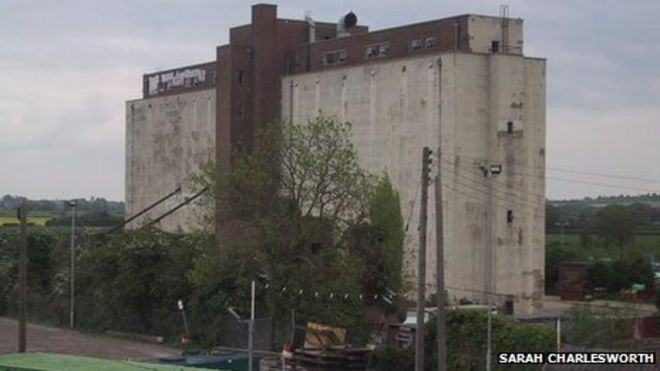
When this Ugly and long disused grain silo just outside Oxford was to be demolished, there was an attempt to have it listed. Fortunately, the attempt failed.
Okay, lets use this as an example - this is Water Eaton Grain Silo [also link and more on Google]. It was built as a strategic grain silo in WW2, so its already not bog-standard grain architecture, but its a prominent visual reminder of an important part of the recent history of Britain and that region.
The question of conservation rests on what is significant about it and what we lose by its demolition [in this case] or conversion so that it loses whatever attributes convey its heritage value, whether that is its fabric, form, historical associations or unique features.
We’ll never have any more authentic reminders of World War II than we have right now. Each building or structure that goes is gone for good. Do we manage that process by selecting what is left ‘for posterity’ while we have the luxury of choosing what to keep, so that we can select the best, most representative and storied examples, or do we wait until we realise ‘shit, they’re nearly all gone’ and desperately try to keep the last few examples that have survived by chance, whether they are appropriate or not? One approach is sensible, strategic and ultimately less costly. Can you guess which?
Keeping heritage and creating a layered landscape that shows depth and richness gives people greater psychological comfort than living in something shiny and new -it promotes a feeling of solidity and permanence that gives us assurance that we are in a stable environment. Built fabric shows why each place is different, otherwise why would we go to Paris if the oldest building was 20 years old and exactly the same as you would see in the nearest city?