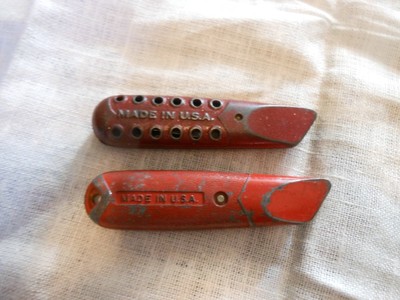
Perhaps it would help keep him in business.
I vaguely remember curled butter at a restaurant in some (Southern?) rural area in the 1960s.
Perhaps it would help keep him in business.
I vaguely remember curled butter at a restaurant in some (Southern?) rural area in the 1960s.
If you were holding a picket sign, and had made the handle out of a rough wooden stake or dowel, then a thing like that would be great to slip it into and hold it with. The curved edges could be clamped or hammered to fit the size of the available wood, and the holes would take a small nail or tack to keep it steady. Might be a nice handout to striking union workers or marching political supporters. . .
While I still maintain it would indeed produce wonderful lemon twists for a martini, I think butter curler/spreader makes a lot of sense. Clever really, it would sliver the hard butter AND be a handy spreader all in one.
Makes me wonder though, how firm would the butter really be, in the days before refrigeration?
(Now part of me wants it to be, ‘Here’s a handy butter curl/spreader ma’am!’, AND, ‘nudge, nudge, Handy for a cocktail too, right Bob?’)
������
Well, a magnet sticks to it and, assuming it was made in in the 1920s, it’s pretty much assured to be made from carbon steel. Although stainless steel was “officially” invented in 1913, it was not widely available and expensive. What this means is that nearly all kitchenware of the time was made from the same material. This includes things like knives, forks, egg beaters, apple corers, and a host of other items available at the time. And yes, they would rust. To prevent that people would keep them dry. If you look carefully at the photos, you will see some scratches in the paint; you can see the scratches because the steel underneath has rusted and is dark. Rust is not poisonous.
I guess it could be a butter curler, but I still feel as though it was something more likely to have been found in a tool box, than a kitchen drawer.
And just where, in the middle or rural Missouri, during the middle of prohibition, is someone going to get any decent Vermouth?
In case anyone’s interested, here’s the 1928 Missouri election page. Marion County (where Palmyra is) cast about 13,400 votes for governor.
Think of a useful household item that could be so cheaply produced that a small-town undertaker could afford to have hundreds, maybe even 1,000, made for him. Maybe there was gangster’s big money behind his campaign, but for Coroner in a rural county? Could it be that’s where the bodies were buried?
A cat’s claws fit through the holes for trimming or painting.
Why on earth would you make curved metal handles for picket signs? Would you make the sign out of embossed brass? How about an ivory stake? Maybe the picketers are sending their butlers out to walk the line for them.
You are a braver man than I.
I’m guessing a squash scraper given the geography it makes sense.
Here is a modern one:
That is a paper crafting tool.
That’s the first thing I thought of when I saw the photo. But then I wondered, how much paper crafting did voters do in the 1920s?
That looks like a butter curler to me. :dubious:
Great.
Now everything I see will look like a butter scraper.
Thanks.
You mean it’s for scraping butter out of your teeth?
Yup. Specifically, it’s for crafting corners. Schwartz was making a pun!
… except it is painted, which is unusual for a kitchen utensil and also possibly poisonous. I have a hard time believing this was anything that would come in contact with food although it may still be a kitchen tool.
The scratches and wear in the paint do not seem to indicate that the triangular holes or the round edge were used for any specific purpose, although the point looks like it may be sharp and have some wear.
The hole in the handle is for either to hang it up or to attach a string or rope.
Yes, looks to me whatever it was designed to cut or imprint, it was done by rotating the tool; push down at 45-degree angle then rotate the handle to vertical while pressing and whatever it is attacking is crimped or cut or formed or whatever. the fact it is somewhat blunt limits the material it could be used on… use it with dough or something similar that does not need a sharp edge.