That’s blood atonement. What did you think it meant, that you didn’t think it was based in that part of Genesis?
puzzlegal:
Yes, i assume that was a typo for “mobs”.
No, it was mods. The internet was a crazy mess back then. No computers, so you had to yell across the fence at your neighbor. If you caused too many problems, you got driven out of town.
Teaches me to not post on my phone with the stupid autocorrect, it should have been “mobs”.
puzzlegal:
And also, I’ve been told that the Mormon Church preached polygamy in part to increase the population of Mormons, and to make sure every woman was supported.
No. Not at all. That’s an apologetic argument created afterwards.
Not all plural wives were taken care of by their husbands, and some obtained divorces and then remarried, usually to men who were not polygamous.
There actually was a problem where polygamous wives needed to find husbands after their first husband died because the second and subsequent wives were often much younger than their first husband. A lot of men who couldn’t get married initially then were able to marry these women. The women would still be married in the afterlife to their first husband but married “for time” (this life) to their second husband.
There are a number of explanations about the beginning of the Smith’s embrace of polygamy, ranging from reluctant acquiescence to God’s commandment that all things must be restored to salacious theories that would violate my suggested guidelines for the thread.
Polygamy was first openly announced in 1852.
Sticking to the doctrine, there was considerable evolution in its development and early practice, and there are some practices which would raise eyebrows now.
As I said in my previous post, there was a teaching that people must be polygamous in order to achieve the highest degree of salvation and to become gods, etc..
In the 1860s, 70s and 80s, the Federal Government outlawed polygamy and passed various laws to stop the practice. The Mormon leaders felt strongly that they couldn’t discontinue
Finally, the Church was forced by the Federal Government by draculean measures to agree to abandon polygamy. Polygamous men were being sentenced to prison and the Federal Government had threatened to confiscate the temples.
Utah State Penitentiary , Polygamous Prisoners including George Q. Cannon
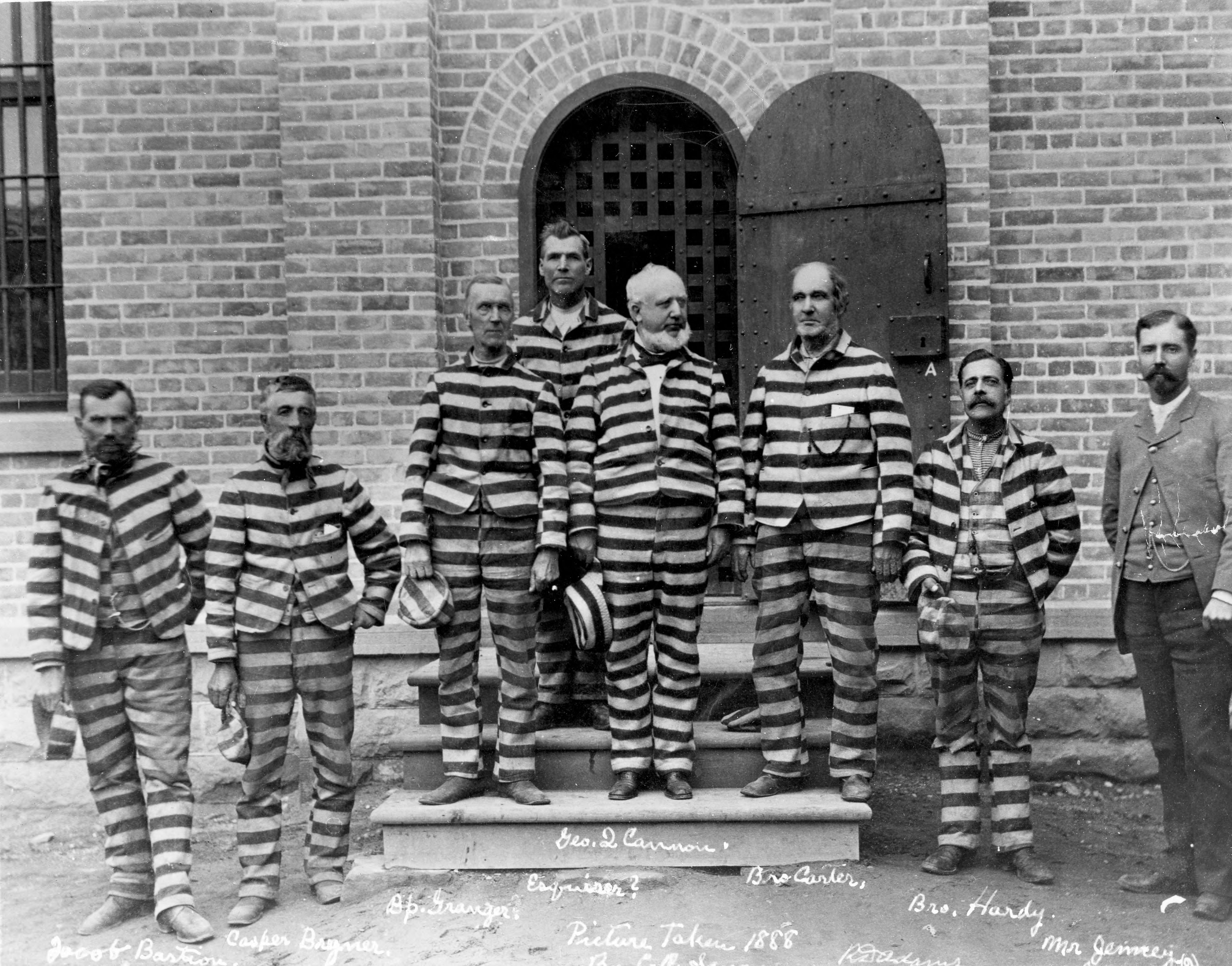
Faced with this quandary, President Wilford Woodruff issued a statement (later called the First Manifesto) in which he said polygamous marriages weren’t being carried out in Utah and he personally urged members to not enter new polygamous marriages.
However, new marriages were being conducted in Mexico, Canada and even secretly in the US.
There is evidence that Wilford Woodruff himself took a plural wife in 1897, post Manifesto.
Some of the leaders took new wives, and others were conducted for adult children, friends or relatives of the leaders in order to allow these people to be assured their place in heaven.
Polygamous marriages were generally not broken up, but new marriages were not openly carried out. Polygamous families remained living quietly until the mid 50s(ish?) as the members slowy died off.
There was a long period of this secret practice, and after additional pressure from the Federal Government, the next president of the Church issued a Second Manifesto in 1904 which finally threatened excommunication for anyone who officiated in new plural marriages.
Neither of these manifestos explicitly disavowed the doctrine of polygamy and this is where the fundamentalist movement started.
One of my cousins almost became a second wife. She was befriended by a woman in her ward and had met the husband as well. They told her they had received confirmation from the Spirit that they were to become polygaamous, and that she was to be the second wife. She prayed and felt that the Spirit had also confirmed it to her and was considering it when she consulted with her sisters who read her the riot act.
Yes. That came up in 1977 when Gary Gilmore was executed. This was a “quiet doctrine” so it was talked about by some members, but not publically preached in General Conferences or published.
I clearly remember my mother explaining it and I think we talked about it in Sunday School class or seminary, but I’m not 100% sure.
Yeah, this happened a lot.
I had heard about it from before Gary Gilmore, but it wasn’t in any of the official manuals, IIRC. I am 100% certain I didn’t hear about it when I was in Primary (for children up to age 12). 
Joseph Smith quietly taught the doctrine of blood atonement to some people. Once the Saints got to Utah and away from the World, they started to preach it openly, and it can be found in a set of sermons called the Journal of Discourses. (Which have been quiety removed from church libraries and not directly quoted in manuals or sermons.)
At any rate, Blood atonement was not a wide-spread practice, but there seems to be credible evidence that it happened “some”.
My bolding.
The background to this is that Smith was secretly practicing polygamy (or having affairs, YMMV), and his wife Emma was strongly opposed to it. Reportedly, Smith received revelations commanding the practice and Emma burned the revelations.
First, this section outlines the authorization of polygamy and points out that Abraham, Isaac, Jacob, David, Solomon and Moses had practiced polygamy and this was a restoration of the practice.
From D&C 132:
1 Verily, thus saith the Lord unto you my servant Joseph, that inasmuch as you have inquired of my hand to know and understand wherein I, the Lord, justified my servants Abraham, Isaac, and Jacob, as also Moses, David and Solomon, my servants, as touching the principle and doctrine of their having many wives and concubines—
2 Behold, and lo, I am the Lord thy God, and will answer thee as touching this matter.
3 Therefore, prepare thy heart to receive and obey the instructions which I am about to give unto you; for all those who have this law revealed unto them must obey the same.
4 For behold, I reveal unto you a new and an everlasting covenant; and if ye abide not that covenant, then are ye damned; for no one can reject this covenant and be permitted to enter into my glory.
So, it’s not the case that polygamy wasn’t discussed later in revelation. It was in Verse 1 and was the reason for the revelation. People who rejected polygamy were not allowed into God’s glory.
Later, the Church started teaching that the “new and everlasting covenant” of marriage was Celestial Marriage, and changed that to mean being married in the temple for “time and all eternity” and separated the concept from plural marriage, but that was not how contemporaries saw it.
From the Journal of Discourses when the apostle Orson Pratt revealed the secret practice of polygamy to the world:
He also gave the justification as saying that polygamy is to allow the elite to propogate and have numerous progeny, and reiterates it’s a requirement for exaltation (where people become gods and goddess).
What does the Lord intend to do with this people? He intends to make them a kingdom of Kings and Priests, a kingdom unto Himself, or in other words, a kingdom of Gods, if they will hearken to His law. There will be many who will not hearken; there will be the foolish among the wise, who will not receive the new and everlasting covenant in its fulness; and they never will attain to their exaltation; they never will be counted worthy to hold the scepter of power over a numerous progeny, that shall multiply themselves without end, like the sand upon the seashore.
As I’ve said before, religions evolve and the current teaching of the LDS church is that the “new and everlasting covenant” means eternal marriage without polygamy, but that was not what it meant at the time.
One of my Sunday School teachers was on the team of prosecutors working on getting Gilmore executed. One Sunday he gave us a retelling of how everything went down, including the “Taxpayer lawsuit” (the objection to the State using taxpayer funds to kill someone) that he anticipated and prepared a response for before it was even filed. But he also mentioned the idea of “blood atonement” in the lesson, as the reason behind Gilmore choosing the firing squad… probably the first time I’d heard of that doctrine. To me it’s one of those cultural undercurrents that isn’t overtly documented but survives anyway in the minds of the general membership.
One of the big differences between The Church of Jesus Christ of Latter-day Saints and the Reorganized Church of Jesus Christ of Latter Day Saints (now Community of Christ) is who gets to lead the church. For the LDS headquartered in Salt Lake City, the leader is the senior (longest-serving) Apostle. With President Nelson’s passing, there has been plenty of coverage of the leadership succession for the LDS so I won’t go into it further.
For the RLDS/CofC, the president had to be a lineal descendent of Joseph Smith, Jr. This was the requirement until 1996 when W. Grant McMurray became president. This apparently was part of the church’s move towards modernization and inclusiveness. Ordaining women to the priesthood begain in 1984, and finally this year the church now has a woman president.
Here is the Community of Christ Leadership currently. I’ll break it down below.
First Presidency
President of the Church: Stassi D. Cramm
Counselor to the President: Bunda C. Chibwe
Counselor to the President: Janné C. Grover
Presiding Bishopric
Presiding Bishop: Ronald D. Harmon, Jr.
Counselor to the Presiding Bishop: Carla K. Long
Counselor to the Presiding Bishop: Willem F. van Klinken
Council of Twelve Apostles
Richard C.N. James (President)
Arthur E. Smith (Secretary)
Matthew J. Frizzell
Kat Hnatyshyn
Lachlan E. Mackay
Catherine C. Mambwe
Shannon MacAdam
Carllos Enrique Mejia
Angela Alt. Ramirez de Hernandez
Adam Wade
Carrie Welch
Joey S. Williams
World Church Secretary
Susan K. Naylor
President of the High Priests Quorum
Jenn Killpack
Presiding Evangelist (CofC evangelist is equivalent to LDS patriarch; with ordination of women, CofC changed the terminology so as to not call a woman a patriarch and, evidently, nobody wanted to call a woman in this office matriarch.)
Mareva M. Arnaud Tchong
Director of Formation Ministries
Katie Harmon-McLaughlin
Senior President of Seventy
Karin F. Peter
Presidents of Seventy
John F. Glaser
Larry M. McGuire
Sylvester Ochieng
Leslie Pascua
Humberto Rosario del Rosario
Joelle Wight
I must say their top crew has a much more interesting set of names than my outfit’s top leadership does!
Over the years, I have paid attention to the ups and downs Community of Christ has experienced. Their story, like my own church’s, is fascinating. If you’re very interested in either group, you can, of course, check their web presence. The homepages are:
The Church of Jesus Christ of Latter-day Saints
&
Both churches have a publishing arm. Deseret Book is the LDS arm; Herald House is the CofC arm.
Thanks for that. I went to the CoC leadership page and was amazed at how much younger their presidency members and apostles are compared to the Brighamite branch of the church. Digging deeper got me this AI summary:
The Community of Christ has a history of having leaders serve until they choose to retire, with an average ordination age of around 50.5, a median of 48, and a median retirement/death age of 74. In contrast to some other faiths, the Community of Christ’s policy encourages retirement at a certain age, and the church is not run by a gerontocracy like the Latter Day Saints church, where leadership succession is based on seniority.
- Ordination: The average age for ordination is around 50.5, with a median of 48.
- Retirement: The average age for retirement is about 72.3, with a median of 74. The church encourages leaders to retire at a certain age.
- Succession: Unlike The Church of Jesus Christ of Latter-day Saints, the Community of Christ does not have a seniority-based succession system for leadership.
- Overall: The Community of Christ’s leadership is generally younger than the leadership of The Church of Jesus Christ of Latter-day Saints.
Their younger leadership seems like a much better system to me, and has probably been the key factor that has allowed them to work through all of the challenges (such as giving women the Priesthood, LGBTQ issues, and the shady parts of their history) that the CoJCoLDS has yet to deal with.
In contrast, here’s the summary of the LDS branch:
The average age of the top leaders of the Church of Jesus Christ of Latter-day Saints varies depending on the group, but recent data indicates a high average.
As of December 2023, the First Presidency had an average age of about 93 years and 9 months, while a 2015 report cited the average age of the 15 top leaders as 80 years. A more recent analysis from September 2025 indicates that the average age of the Quorum of the Twelve Apostles is around 80.
Gilmore getting the firing squad was huge news because he was the first person in America to be executed after a supreme court ruling that had commuted the death penalties of everyone in America.
As Mormons believed in blood atonement, getting the death penalty back was big. I was in high school and I remember talking about it with other members.
It’s interesting that you had one of the prosecutors as your Sunday School teacher. One of my teachers knew one of the attorneys handling the appeals for the state. He came to our class and talked about that, including his setting up a code word to use for verification when he called the prison to let them know that there were no last minute stays. The prison was getting calls from people claiming to be clerks of various courts saying there were stays. As it was school, he didn’t talk about blood atonement.
There were a number of such doctrines that everyone knew, but the Church wouldn’t say they were offical or not. They had a basis in teachings of the prophets and apostles, but the Church wasn’t clear if they were orthodox or not.
The Journal of Discourses had a bunch of wild teachings, and some had been disavowed, while others just weren’t discussed.
Bruce R. McConkie, who later became one of the more influential apostles, published a book Mormon Doctrine in 1958 which clearly laid out a lot of these questions and had an authorative tone. He based the book on Mormon scriptures and authorative leaders. However, he didn’t have permission from the Church and they stopped the reprint for a number of years and had him make a large number of changes before they allowed it to be published again.
The second edition of Mormon Doctrine, with its approved revisions, was published in 1966. Horne states, “The most obvious difference between the two editions is a more moderate tone.”[4] Many entries were removed, while others were added, and entire paragraphs were changed in other entries. Complete removals included entire entries which specifically labeled the Roman Catholic church as the Church of the Devil and the great and abominable church, including the sections titled “Catholicism” and “Roman Catholicism”.[8][9]: 19, 119 (snip)
Other notable changes in the second edition also include the removal of sentences stating that
“Suicide is murder, pure and simple, and murderers are damned”,[9]: 119
“No doubt psychiatry … has some benefit … but in many instances, it is in effect a form of apostate religion which keeps sinners from repenting…”,[9]: 103 and
that all those using condoms or other artificial contraception are “in rebellion against God and are guilty of gross wickedness.”[9]: 12
Additionally removed were references to evolution, including
one stating that the “official doctrine of the Church” asserted a “falsity of the theory of organic evolution”,[9]: 34 along with sentences stating
that “There were no pre-Adamites”,
that Adam was not the “end-product of evolution”, and
that there “was no death in the world, either for man or for any form of life until after the Fall of Adam.”[9]: 3 7
Left in the second edition, but later removed after Blacks were allowed the priesthood and the right to attend the temple:
Of the two-thirds who followed Christ, however, some were more valiant than others …Those who were less valiant in pre-existence and who thereby had certain spiritual restrictions imposed upon them during mortality are known to us as the negroes. Such spirits are sent to earth through the lineage of Cain, the mark put upon him for his rebellion against God and his murder of Abel being a black skin (Moses 5:16–41; 12:22). Noah’s son Ham married Egyptus, a descendant of Cain, thus preserving the negro lineage through the flood (Abraham 1:20–27). Negroes in this life are denied the priesthood; under no circumstances can they hold this delegation of authority from the Almighty. (Abra. 1:20–27.)
(shortened)
…The negroes are not equal with other races where the receipt of certain spiritual blessings are concerned, particularly the priesthood and the temple blessings that flow therefrom, but this inequality is not of man’s origin. It is the Lord’s doing.
The first edition was printed in 1958 and the second in 1966. I don’t remember which edition was the one in our house, but like most good Mormon families, we owned a copy.
So many of the teachings of the Church are like this, where Blacks were said to not be valiant in the pre-existence so they were cursed. This was taught by prophets and apostles, but later quietly ignored, and then finally the Church now says it never taught that. We knew that the Catholic church was the great and abominable church. That has changed as well.
My mother really loves Mormon doctrine and taught us a lot that many other parents didn’t. Back in the early 70s, we discussed that my father would have to have another wife in the afterlife and my mother said that feelings of jealousy would not be an issue in the Celestial Kingdom.
I see a difference between blood atonement and punishment by blood.
If I rob a bank and spend 10 years in jail, that is my punishment. I would expect that to remain on my record and I wouldn’t expect God to wipe out the sin because humans punished me.
I think the concept of blood atonement is that after you sacrifice your life, by the shedding of blood, then you are basically forgiven by God. At least that’s my understanding.
I never read the Journal of Discourses but had a chance to glance through them at a member’s house on my mission. I don’t remember who said it (one of the Orson’s, I think [Pratt or maybe Hyde]) but there was a long description at one point about the birth of Adam and Eve.
Basically, God brought one of his wives to the Garden of Eden and they conceived there. The key point was that she had to eat of the fruits of that world to grow bodies for the babies from that material, just like she ate spiritual fruits and vegetables from the plants in the Celestial Kingdom in order to grow spirit bodies for us born there. In other words, what you eat determines the kind of body that is made.
It was so cool to me to learn stuff like that as a missionary, and it’s such a contrast between how the early apostles gave answers for everything while the modern ones shrug and say “we don’t know” or “the Lord hasn’t revealed that”. I mean, didn’t they ever learn that the foundation scripture of the church was “if any of you lack wisdom, let him ask of God”?
And we had a copy as well. One of my things growing up was pulling out the copy and reading different sections. I believed in blacks not being valiant in the pre-existence and the Catholic church being the great and abominable church and the other similar things in the book.
Yeah, me too. In my case it was teenage me finding the entry for “Sexual Immorality” but mis-reading it as “Sexual Immortality” and going “woah!” 
That’s fascinating! I guess Genesis already has two stories of the creation of mankind, why not a third.
I bought Leo Rosen’s Religions of America back in 1975 when it was published. It didn’t cover all of the religions in America. The ones it covered are listed on the book’s front cover (I’ll change it from all caps):
I was a bit disappointed Islam and African Methodist Episcopal Zion Church, along with some others, were not included. But the book is still fascinating. Rosen sent a list of questions, tailored for each religion there, to the top leadership and published their answers. The entry for Mormon was quite interesting and definitely included the issue about Blacks being barred from the priesthood. I don’t recall if women being barred was discussed at all or as a question in its own right or even as part of the answer about the priesthood and Blacks. You’ll note Rosen’s book is just three years before Official Declaration 2.
Yeah, and the crazy thing is that’s not how they show it in the temple ceremony – that’s much more like the biblical account. Still, I remember 10th grade seminary and one day the lesson was on Adam and Eve… the teacher asked if we thought they had belly-buttons or not. Most of us said “no” but he told us that yes, they did… because they were actually born there. My fifteen-year-old mind was blown!
Yeah, this is the theoritical basis for blood atonement, but note that killing apostates was justified on the grounds that this was better for them in the afterlife.
From the Journal of Discourse Vol 4. The killing of apostates was laid out in a sermon by Brigham Young with the topics:
TO KNOW GOD IS ETERNAL LIFE—GOD THE FATHER OF OUR SPIRITS AND BODIES—THINGS CREATED SPIRITUALLY FIRST—ATONEMENT BY THE SHEDDING OF BLOOD
A Discourse by President Brigham Young, Delivered in the Tabernacle, Great Salt Lake City, February 8, 1857.
I have known a great many men who have left this Church for whom there is no chance whatever for exaltation, but if their blood had been spilled, it would have been better for them.
As @raspberry_hunter says, this isn’t taught in the current church, but it was doctrine then.
Yes, the Adam - God doctrine. (Or as the Mormon church calls it, the Adam - God theory) taught by Brigham Young and others.
That has been denounced by the Church. Pres. Spencer W. Kimball gave a General Conference talk in 1976 concerning this.
We hope that you who teach in the various organizations, whether on the campuses or in our chapels, will always teach the orthodox truth. We warn you against the dissemination of doctrines which are not according to the scriptures and which are alleged to have been taught by some of the General Authorities of past generations. Such, for instance, is the Adam-God theory. We denounce that theory and hope that everyone will be cautioned against this and other kinds of false doctrine.
(my bolding)
Did it discuss the reason being that Blacks were not valiant in the pre-existance or simply that they were barred from the priesthood?
Not calling you out here at all, but something that really bothers me is that the whole discussion is framed as Blacks being barred from the priesthood, but this only affect males, where the ban on Blacks from attending the temple affects both males and females.
Here is the homepage for the newest group of which I am aware in the Latter Day Saint movement. The name of it is The Church of Jesus Christ in Christian Fellowship. They have quite the volume of Scripture, and some unique approaches to what constitutes membership in Christ’s church. Somewhere online they have a very comprehensive conversion table for finding the book, chapter/section, and verse number for a particular verse or part of a verse throughout the Latter Day Saint movements particular Scriptures.
I don’t remember. It was quite some time ago, obviously. And I’m having issues as always in October with connecting to certain Internet sites while in China so sites such as archive.org are out for at least another two weeks. I’m pretty sure the book is on that site.
Right. A few years before I joined the church, I had heard about their view of Temple marriage and also about the priesthood ban. I immediately thought, “Ah, so it’s the combined Thomas Jefferson and Stolen Generations plan!” I really thought that only Black males were banned from the Temple because women obviously did not need to be ordained to the priesthood to enter the Temple. A knowledgeable acquaintance explained the actual policy to me. He wasn’t LDS nor was he anti-LDS, just someone rather interested in religions.
This is a huge cultural change in Mormonism. We were of the generation when the understanding still was that all will be revealed with the implicit understanding that it would be sooner than later.
I admire people who could make the transition and although I quit for other reasons, I liked the literalism.
Blacks being banned from the priesthood was well known at the time, and was starting to become a problem. Other schools were starting to boycott playing BTU.
I thought it was because BTU’s teams were too hot.
Of course you meant BYU. And don’t forget about the racial situation in Brazil and how a number of African countries would not permit the church to operate in those countries while the ban was in place.
My grandmother was a huge BYU fan. She had season tickets to their basketball and football games. The story is that she said she was going to go into her bedroom to listen to a BYU basketball game, and died during the game. The family said this was he perfect way for her to go.
When I was young she also got a season ticket for me. I would go to the home games and would listen to the road games on the radio. I remember the protests and I remember wondering why people were persecuting us for our beliefs (I was young). The one that stood out was a game at Colorado State University. I only have the memory of a young kid listening to it on the radio. I just looked it up and found this article.