Googling tells me this is 40 000 4K movies being watched simultaneously. Is that about right? How do other commsats compare?
As each minisat gets thinner and lower power, all we’ll see on the flat faces may be solar panels.
Aren’t LEDs capable of receiving light and solar panels capable of emitting light, depending on which way the electrons are shifting? They could use the solar panels to (power-inefficiently) send optical data. Is the tech that would enable constructive interference between optical emitters mature-ish?
Less than $30M for 20 tons of payload to LEO? If it keeps going like that, it’ll be possible to take space rides for 5 figures. You must have thought about it.
Half a million dollars for a satellite is probably the most important datum. There was a time when a computer would have cost about that much, accounting for inflation. Yet, today, pretty much everyone in developed countries and a growing number in developing countries have access to a computer. I’m not sure what the world will be like when nearly everyone can use a satellite for more than telecoms. Telecoms is important but phones used to be limited to telecoms and expanding their capabilities has been worth it.
HughesNet would be the closest competition, with their EchoStar XIX being the latest generation. They claim to have 200 Gbps capacity. But they only have one of those, and a few other smaller-capacity ones. Certainly less than 500 Gbps total.
Just an amusing factoid–note this line from the link above: Employing a multi-spot beam, bent-pipe Ka-band architecture, EchoStar XIX delivers more than 200 Gbps of capacity
“Bent-pipe” is satellite engineer speak for a satellite with no real on-board processing. It just takes the data coming from one source and bounces it to its destination without inspecting it at all. Like a golf ball whizzing through a pipe at a mini golf course.
I guess that’s where you were going with your LIDAR question. Phased-array optical frequency devices exist, but I don’t think it’s really production ready yet. The StarLink inter-satellite links will be a mechanical laser turret of some kind. Maybe one day it can be entirely solid state.
I doubt they’ll ever be able to combine with power generation, since the sun’s output is necessarily broadband, while the comms links would want to be at a narrow frequency band to reduce interference. Though maybe power beamed from the ground could use a monochromatic system. We could have really tiny satellites if they didn’t need onboard power.
That was just ballparking from me, though I expect it to be close to SpaceX’s marginal cost.
If it were safe enough, I’d spend low 6 figures today. And low 7 figures a couple decades from now. So yes, I’ve thought of it :).
I had Wildblue satellite internet at my trailer in the woods. Everyone in the “spot” covered shared the bandwidth. Bandwith would be limited if you exceeded a certain amount. I hit it downloading graphics. Watching movies would screw my bandwidth quickly. They were bought by Viasat, offeringpackages with “unlimited data”.
I didn’t know that’s where I was going but hearing about solar panels made me realize it. Making things solid state has been a boon in electronics. Once you make it solid state, possibilities open up as we saw with vacuum tubes vs transistors, CRTs vs LEDs, HDDs vs SDDs.
To avoid weather and coverage problems, you could have the equivalent of in-flight fuel tankers: satellites optimized to capture and store the sun’s broadband output then convert it to narrow freq band before sending it to tiny satellites with no onboard power on a need basis. Or you could use a small number of ground beams to power a few large power hubs in space which would then power tiny satellites. I have no idea if the beams would stay focused enough for it to make sense at these distances.
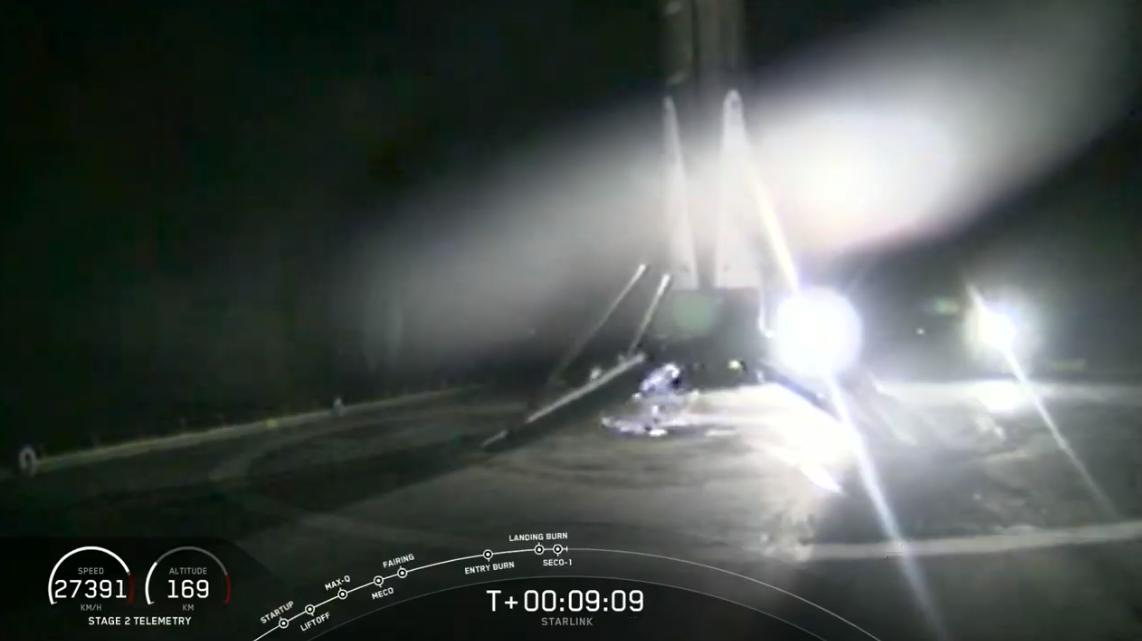
I didn’t expect the satellites to deploy the way they did. They kinda just released all at once. I was thinking the stage would spin more quickly, and release the satellites one by one so they kinda shoot out to the side. Instead, they just slowly drift apart, bumping a bit as they do.
They released this CG video. Pretty neat–the solar array is quite big, and there’s just one of them that extends “up”. The main piece is horizontal against the plane of Earth.
Here’s a nice closeup of the satellites. They look great! You can see the many layers of solar panels stacked up, and the white rounded squares with blue wires coming out the back are, I believe, patch antennas. Probably for low-speed maintenance comms–you want simple and reliable for that. The high speed phase array antenna probably takes up the entire bottom surface. I don’t know what the red-outline things are. Possibly something to do with the laser comms, but supposedly these units don’t have that feature yet. So I dunno.
The red outline things turn out to be star trackers for orientation. They have some kind of dust cover that is either a remove-before-flight thing or just pops off in space.
They have at least four reaction wheels–one picture shows four but there may be room for more, and they appear to be at angles suboptimal for just four. Hard to say for sure, though. In any case, three would generally be considered a minimum (though you can sometimes get away with two), so they must have decided that backups were warranted. I wonder if they manufactured them themselves–SpaceX usually isn’t one to use expensive off-the-shelf items, and they’re going to need a lot of these.
Thanks for the links. I’m a little too easily amused by rotating the globe and seeing the satellites orbit around it.
That could be huge. Helping to turn China from an authoritarian state to a liberal democratic one could be a bigger boon to humanity than anything that happens on Mars.
This is pretty cool. I count about 47 individual dots, although it’s pretty clear from the brightness that several of them are doubles or triples that can’t be resolved.
I’d love to be more optimistic here, but in all likelihood Starlink will simply follow local law. I doubt they want to rock too many political boats, let alone invite a physical or cyber attack on their network. Musk did comment on exactly this thing a while back:
Of course, if the US government wants to use the Starlink network as a kind of social weapon against our adversaries, they could conceivably give SpaceX some kind of dispensation and pay them for the additional risk.
An ordinary cell phone camera wouldn’t be enough for map-grade imagery, though it might be interesting for real-time weather tracking.
That said, fairly modest optics would enable that kind of thing–Planet Labs has some pretty impressive results from optics that fit in a 10x10x30 cm box. That’s still pretty small compared to a Starlink satellite, and high speed comms come for free, so it does seem like they could do something there if they wanted.
Haven’t heard anything about that lately. I’d suspect that they’re putting all their efforts into BFR at this point. It doesn’t seem like any second-stage recovery testing would really translate over with the current design, so it’s really not worth much even as an experiment.
Actually, at high resolution, the earth’s atmosphere is a significant problem. It takes considerable computing power to clean up the satellite images we all see. Not only the geometric distortion (remember the photo is of a sphere projected on a plane), but the atmosphere fogs up the image. There are very effective algorithms, but they are needed. Now for the current real-time satellites (Korean COMS is probably the best right now), they are all very high and have low enough resolution that the atmospheric distortion isn’t noticeable. Until you try to do science with the images-but the clean-up algorithms exist. Humidity ruins more than picnics and hair styles!
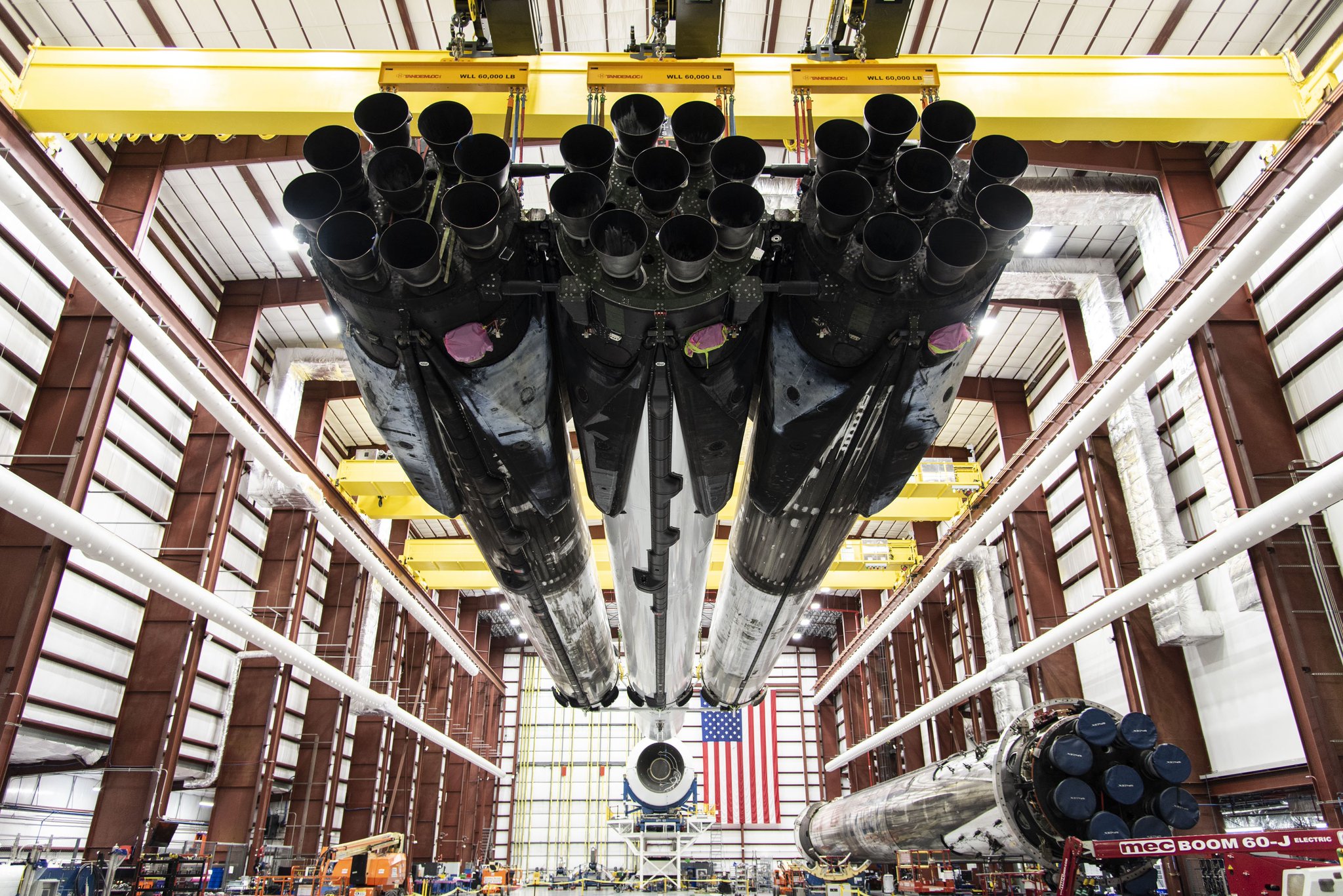
Just a reminder that a Falcon Heavy is planned to launch Monday, June 24 23:30 EDT (03:30 UTC)
One the coolest things carried aboard is The Planetary Society’s Lightsail 2 solar sailing experiment:
I love how they’re now mixing and matching cores. The side boosters are reused from the Arabsat mission; the center core is new. Once SpaceX has a few more FH missions under their belt, I have no doubt we’ll start seeing missions where all three cores have a different flight heritage.