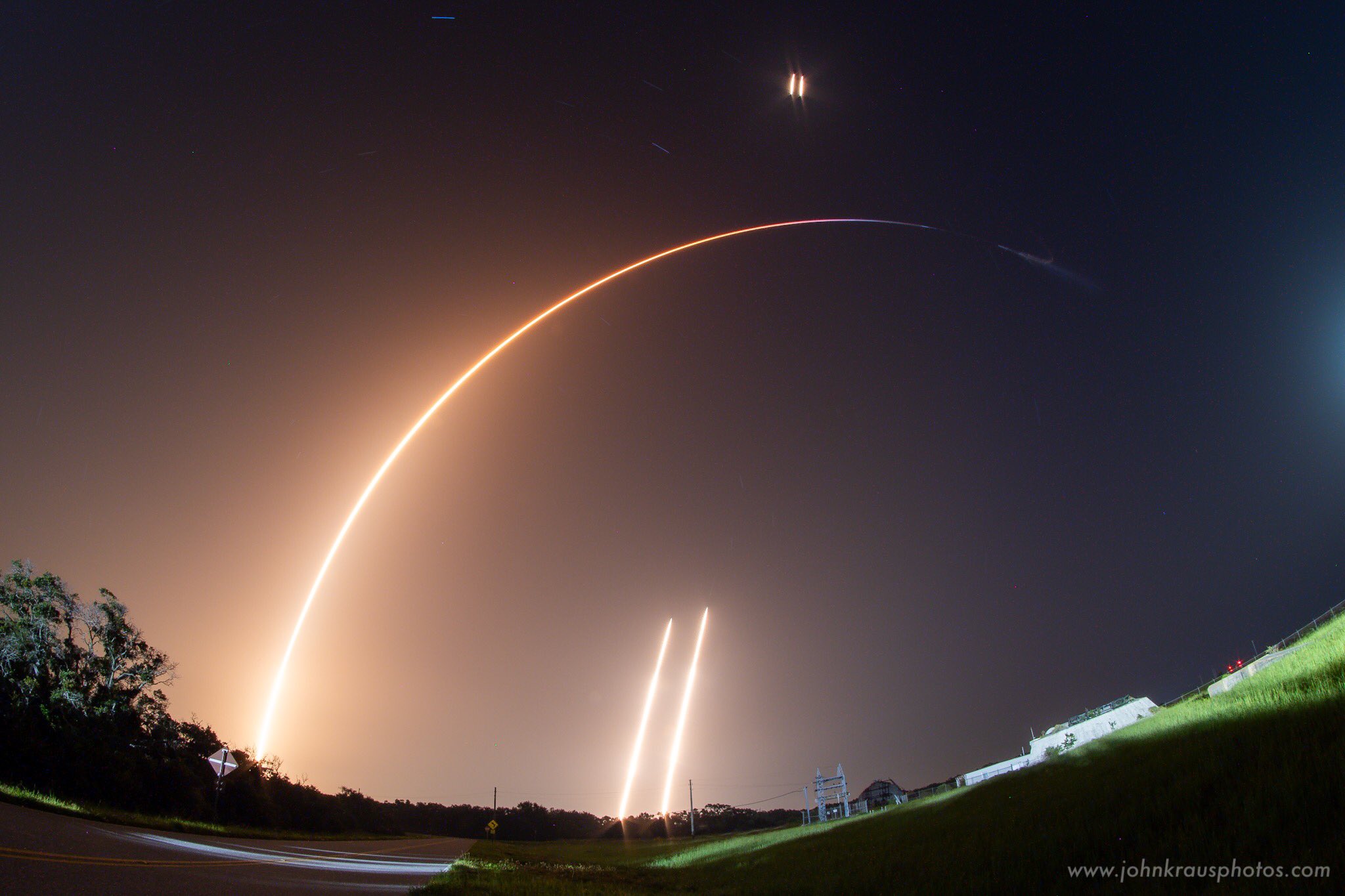
Launch went OK, side boosters landed. center core hydrobraked.
Brian
Launch went OK, side boosters landed. center core hydrobraked.
Brian
Considering the difficulty, two outta three ain’t bad. And we got a good view of the kaboom.
Some great IR imagery, I thought. I love the nebula look you get at night. I wonder if these were standard NASA cameras or if the Air Force loaned them some nicer units. Either way, the exhaust from the boostback of the side cores looked awesome.
It really took off like a bat out of hell from the pad. It was noticeably faster than usual off the pad, and I found out later (well, allegedly) that they hit Max-Q faster than any previous launch, at 41 s. Normally, it’s in the 60-80 s range. So they were really accelerating hard this time, which means lower gravity losses, which means more delta V for reaching orbit and changing orbits.
Oh, and they finally caught a fairing half in the net. The other one landed in the water. Fairing reuse feels imminent at this point.
I’m unable to fulfill your requirement so I’ll have to bow out of discussing this point with you.
That’s too bad, I thought you were going to use your considerable ability to solve this sort of problem to work out how much payload could reach 100km altitude if you used the lowest stage of Peacekeepers in something that would look like this: Imgur: The magic of the Internet
Not that I’d want you to take that as a challenge.
Does it need to, though? If you’re only carrying freight and have a clear area downrange, what’s so bad about a rocket blowing up? If going from 0.1% failure rate to 1% or even 10% failure rate decreases launch costs by an amount that makes up for the occasional Michael Bay theater, what does it really matter? Is the objective to increase access to space by lowering the average cost of putting a ton of payload into orbit or is it to have the fewest failures possible?
Given that, from what I understand, the extensive testing is a big part of why spaceflight costs so much, the lack of ground testing doesn’t seem like such a problem. It’s deeming any significant risk unacceptable that drives up costs.
Even if it’s carrying people, it wouldn’t be the first instance where a significant chance of people getting hurt would be deemed acceptable. Much like the solid prop factory video you linked to, black powder factories used to be scary places to work but that didn’t result in governments, companies and employees considering them unacceptable to have and work in. It took a few centuries for canons and grenades to stop randomly blowing up and killing their users. Yet they were still considered worthwhile to use. Sea voyages used to be dangerous to undertake yet they were still undertaken. Maybe space vehicles are like 15th century canons and space travel is like 16th century Atlantic crossing.
I’m not sure why we’d predict that pushing the boundaries of technology and humanity could be as comfortable or safe as sticking with the old ways we’re familiar with. We should use the same trade-off-based decision making as we do for soldiering, fishing, logging, roofing, flying and driving. Do you think there would be a dearth of candidates to go to space or Mars if it involved a 10% chance of dying?
Sam, I just remembered that tone can be difficult to get across in a text-only medium and that this could be read curtly even if that’s not the way I meant it. Thank you for your feedback.
Not that much less, as these things go. Note that the 65,000-motor design only makes it to space, not orbit. The orbital “design”, such as it is, uses quite a few more engines:
Note that I did not use any throttling in my design, so I could probably shave off a factor of 2 or so; perhaps more.
Another significant difference is that I included a 1 kg payload. The XKCD payload is just a single spent engine casing (i.e., paper tube).
No Worries. I hope my tone didn’t come across as condescending or anything. You are certainly right that there may be breakthroughs that change the game or that someone may come up with a clever solution that allows for different rocket designs. It’s just that without specifics, there’s really nothing to debate.
Elon reports that the hot reentry caused the center engine TVC to fail, and the rocket decided to land in the drink as opposed to trying to sink the droneship.
It’s always been pretty amazing that their engines can survive the brunt of reentry like that. Sure, the inside of the nozzles is built to deal with that (though they don’t get regenerative cooling on reentry), but the surrounding area just has whatever shielding they can stuff in without messing with vector control or weighing too much. This is the first I’ve heard of an engine failing due to reentry damage–though not surprising in this case due to the speed.
Hopefully they’ll figure out how to shield things better without adding a ton of mass. Fortunately, only the center core is likely to need the improvements.
I saw a comment somewhere, hopefully not here, that it’s a great day when you can watch a successful rocket landing AND a major explosion all in one mission!
That’s what the footage looked like. That thing pitched over really fast and flew itself into the ocean.
Indeed! If only other launcher companies would at least put a camera where the boosters were going to impact so that we could at least get a nice bang out of the spent stage.
The grace of the two side boosters coming down in synchrony is still quite stunning to me. The landings are amazing enough, but the two of them together lends it an unreal quality.
Frustrated and perhaps exasperated. I can see why: My education is in anthropology/philosophy/law and yours is, I presume, in science/engineering/programming.
To use a programming metaphor I hopefully won’t fuck up too much: I’m used to solving problems with scripting and you’re used to solving problems with assembly language. I can see how that would get frustrating.
Try and get to stable orbit with nothing but SRBs in KSP though, it’s fun. Nearly as much fun as trying to destroy the second base on Kerbin with a hypersonic boost-glide vehicle.
Some new info on the Crew Dragon anomaly:
UPDATE: IN-FLIGHT ABORT STATIC FIRE TEST ANOMALY INVESTIGATION
In short, the oxidizer system for the abort engines looks roughly like this:
compressed helium tank ->
main helium valve ->
titanium check valve ->
nitrogen tetroxide (NTO) tank ->
SuperDraco system (thruster, valves, etc.)
Some undisclosed leak during ground operations allowed NTO to go through the check valve and into the feed line after the main helium valve. The helium is under tremendous pressure, and so when the main valve was opened, this little blob of fluid was sent down the line at high speed. It impacted the check valve (which was not designed for this sort of thing), destroying it. Worse, it ignited it, leading to an explosion.
Why would an metal valve literally catch on fire if exposed to an impact like that from NTO? SpaceX did not expect that result:
That said, research in the 60s did note impact sensitivity between NTO and titanium:
COMPATIBILITY OF MATERIALS WITH ROCKET PROPELLANTS AND OXIDIZERS (page 9)
It’s not clear exactly what in the event was unexpected–the text above says that the ignitions do not spread beyond the impact areas, but in the SpaceX anomaly it sounds like the igniting material was more widespread. So perhaps they were aware of a possible ignition but not something that would cause destruction of this magnitude. Or perhaps they thought that the possible impact pressures were below the ignition threshold.
At any rate, the fix is simple, which is very good news: replace the leaky check valves with burst disks. Burst disks are essentially just a calibrated sheet of foil inline with the feed line. Below the threshold pressure, the disk is a perfect seal. Above the threshold, it bursts open and lets fluid flow. It doesn’t quite it in with SpaceX’s culture of avoid single-use items, but it makes perfect sense here since it’s in an abort system which isn’t intended to be used outside of emergencies.
Starhopper hopped! There’s a livestream here, though I can’t seem to link to the specific moment that it did its thing. It’s roughly 26 minutes from the current end of the stream.
Not much to see, unfortunately–its night and basically there’s just a big fireball. But there are a few glimpses of the vehicle a few tens of meters up, and once it lands you can see that it’s upright but in a different position. So it managed to do something without tipping over or exploding.
First use of a full-flow staged combustion engine on an actual vehicle (not just a test stand). Making good progress…
(Incidentally, they seemed to have set off quite the brush fire. Hopefully they can contain that soon.)
Fantastic!
Now that the livestream is over, I can link to the right spot.
This is better, though: an engine cam view. Those are some beautiful mach diamonds.
Also:
The rocket literally was put together by a water tower company. I have a feeling this is a first for them.
200 meter hop coming in a week or two. Hopefully daytime. SpaceX launches have gotten too routine lately–I miss the Grasshopper days! And while I don’t hope that they blow one up, I do hope they’re pushing hard enough that a kaboom is a real possibility. And I will enjoy watching if it does happen. The occasional reminder that space is hard is always a good thing.
How to catch a pallet with three million bucks falling from the sky
Well, not quite, but a fairing half is worth about $3M, and that’s a video of it landing gently on a net in the middle of the ocean. Pretty neat.
They seem to be getting the hang of the fairing landings, so I wonder if they’ll build another net boat. I think they’re still fishing the other half out of the water, but it had to be nicer without the immersion.
As for the launch, this was another AMOS mission, which you may remember from before as the one that exploded during ground testing. This one did not explode, but it was such a high-energy launch that they expended the first stage. Still, it was the third use of the booster, so it still had a decent life. I recall speculating earlier if they’d occasionally take older boosters and use them in expendable mode instead of continuing to refurbish them. It seems that may be the case.
In other SpaceX news, the attempt at a 200m hover and translation test for Starhopper is scheduled tentatively for tomorrow at 2100 UTC, or 4pm Central time. It should be a pretty good show!
Also, Musk’s presentation of the next rev of the Starship/Superheavy design, which was scheduled for August 24, has been postponed until after the next milestone for Starship, which will be a suborbital flight of one of the first two Starships with three Raptor engines. Apparently (and amazingly) this could happen as soon as mid-September. Musk says both new full-sized prototypes will be ready for initial flight tests in a month or so.
I find the speed of development of these things to be almost unbelievable. These rockets have all been under construction for less than a year. Apparently, progress on the two full-sized prototypes is going so fast that the Starhoppers may be obsolete by next month.
Musk is still holding to his claim that he believes Starship will be capable of Single-Stage-To-Orbit, without its booster. Again, that’s hard to believe, but if it’s true, it’s yet another vehicle configuration that could be very useful, and for anyone else just that would have been an amazing accomplishment that would revolutionize space travel. But for Musk it’s apparently just an interesting side benefit.
Assuming Starship flies, this will be Kelly Johnson-Skunkworks level development speed the likes of which we haven’t seen since the 1960’s. Tell NASA to build a giant 100 passenger reusable spaceship, and it would take them longer than this just to do the preliminary feasibility and decide which centers get the jobs if they ever built the thing. Then they’d offer a 10 year plan and cost it at $100 billion or something. Then it would struggle along without funding for a few years, then get cut by the next administration.