Back to musical rather than literary plagiarism, there is a rather astonishing tendency among many in this thread to opine that what Led Zeppelin did is no big deal.
Sorry, but it is. For a much more thorough going over of their many rip-offs, see these two YouTube videos:
I defy anyone here to watch these two videos in their entirety and then spout some namby-pamby stuff about "influence" or "Well, lots of others have done it too." NO ONE in the history of popular music has committed theft at this level...NO ONE. No one has taken composing credit and pocketed songwriting royalties for songs they had nothing to do with to this degree.
And by the way, the makers of these two videos never even got around to the “Taurus”/“Stairway to Heaven” bit or “When the Levee Breaks.”
Even if you aren’t too worried about ripping off old blues artists or alleged “traditional” folk songs (which really aren’t), there’s still Page’s most egregious theft of all — “Dazed and Confused” from Jake Holmes, a contemporary song written less than two years prior to the release of Led Zep’s thievery.
You may admire Page as a guitarist or the whole band for the sound they came up with — but it’s quite obvious that, in their earlier days at least, they couldn’t write their way out of a paper bag. They built their career on the backs of others and took money right out of their pockets dishonestly.
Well, my point is, its the collision of two fairly common ideas. That two people combined them and then added a fairly obvious addition (that the cursed person be fat, since having a skinny person loose weight is less dramatic) doesn’t seem that implausible to me. (also, in Thinner the protagonist doesn’t threaten the gypsy, he kills the gypsies daughter, and in Hugo Barge, it isn’t a curse, but a weight-loss potion that Hugo demands to be given despite the fact that the Gypsy warns him its possibly defective).
But there isn’t really any way to argue it other then vague appeals to plausibility, so I guess we’ll have to get someone to ask King.
DChord568, I usually agree with your contributions to the music threads. This time, I think that you’re probably going a bit far in your condemnation, and the links and arguments you provide are a little misleading today.
Zeppelin certainly did claim other’s work as their own, and profited handsomely from it. On the other hand, it appears that it’s been largely corrected. Here’s the songwriting credits from Led Zeppelin I’s wiki entry:
Side one
“Good Times Bad Times” John Bonham, John Paul Jones, Jimmy Page 2:44
“Babe I’m Gonna Leave You” Anne Bredon, Jimmy Page, Robert Plant 6:40
“You Shook Me” Willie Dixon, J. B. Lenoir 6:30
“Dazed and Confused” Jake Holmes, Jimmy Page, Chris Dreja 6:26
Side two
5. “Your Time Is Gonna Come” Jones, Page 4:34
6. “Black Mountain Side” Traditional, Arr. Bert Jansch / Page 2:13
7. “Communication Breakdown” Bonham, Jones, Page 2:29
8. “I Can’t Quit You Baby” Dixon 4:43
9. “How Many More Times” Bonham, Jones, Page 8:28
Their eventually correcting the situation may not absolve them of their sin, but it’s as close as they can come to making up for it.
Yes, they eventually came clean, but it’s not as if they really had a choice.
I have to wonder how much critical acclaim (and resultant success) their early records would have received if they’d been promoted a cover band who contributed a few originals.
Having slammed them as much as I have, it appears that their claim of having written “Babe I’m Gonna Leave You” was apparently an honest mistake. Anne Bredon’s wiki page claims that the Joan Baez record Page first heard listed the song as, “Trad. arr. Baez”.
Anyone can write anything on Wikipedia. The crucial question is, does what is shown on the Wiki entry match what is shown on the latest pressings of the actual CDs of the first Led Zeppelin album?
Just askin’.
This also doesn’t address the multiple thefts present in “How Many More Times.” And how about the tunes from LZ II, III and IV?
Nor, as you note, does it change the fact that the band built the bulk of its early repertoire on theft, and reaped millions of dollars in both composing and performance royalties because of this practice.
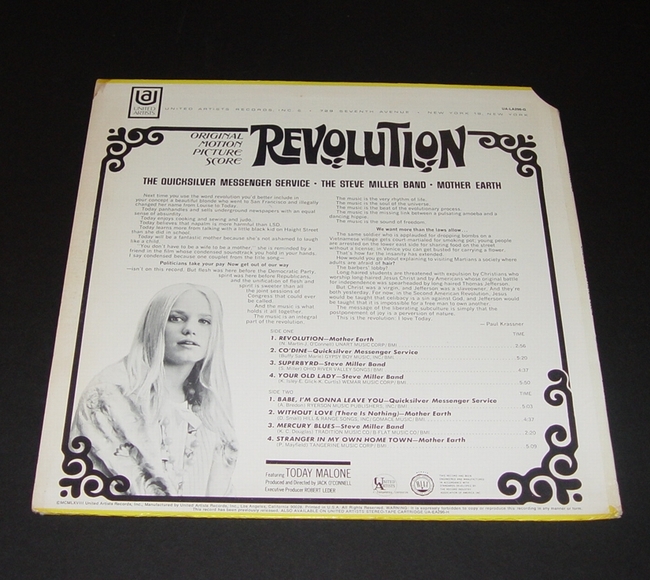
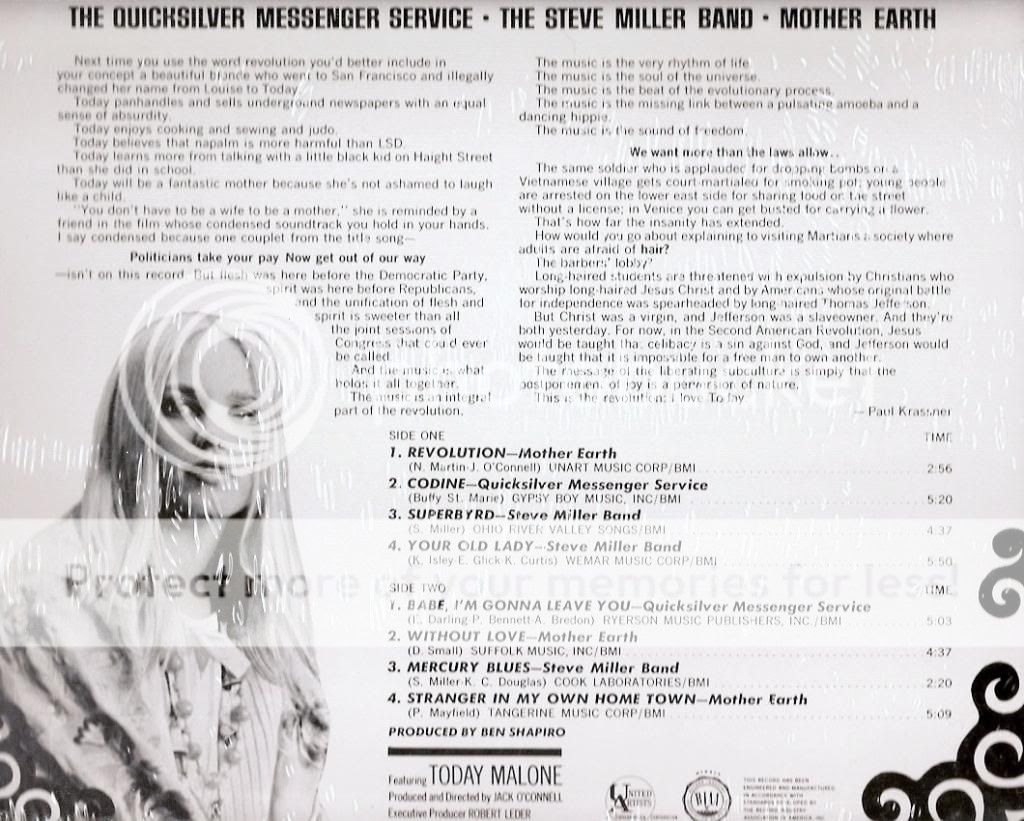
Though interestingly, Quicksilver Messenger Service managed to get it right with their earlier cover of “Babe I’m Gonna Leave You,” which appeared on the soundtrack album to the movie Revolution, released in 1968.
Google Images shows two different versions of the credits on the back of the album. On one, Anne Bredon is credited alone:
On the other, she is credited along with Erik Darling and Paul Bennett:
This is because Quicksilver incorporates part of Darling and Bennett’s song “St. John’s River” in their version.
I’ve seen those a gazillion times. Many I agree with. Some (like “Rock & Roll” and “Stairway to Heaven,” which appear not to be mentioned in those two videos, unless I glossed over them) I do not. Just because they have a history of reappropriating music doesn’t mean that I think every song by them that sounds similar to another song I have to believe is a wholesale rip-off.
Well, it purports to be the listing for the upcoming release. I suspect previous releases did not credit Jake Holmes, at the very least, since it was settled in 2010.
Yeah, I’m not really willing to defend their entire catalog. I was just aware that the worst problems were with their first record, and they’d largely been addressed.
Yes, I agree.
They’d never be promoted as a cover band. They were re-working the songs fairly heavily, and weren’t aiming to reproduce the originals. They would have been promoted like the Stones* and the Faces - bands who performed a mix of covers and originals, and received plenty of respect.
But, that’s the second worst part about making stupid decisions like they did. We’ll never know, and Zeppelin’s success will always be tainted by it.
*And, while they were good about crediting early in their career, they also pulled this type of shenanigan with “Love in Vain”.
Led Z used a very common chord progression. The defining lick in Stairway to Heaven is featured predominantly throughout the song. Its the hook that made the song a iconic hit.
Spirit’s song Taurus uses a similar lick but its not the focus of the song. It doesn’t define the song. Its really just a throw away lick in the song.
Why don’t we sue everybody that dares to play the G, Em,C, D7 progression? Theres only a few thousand songs written that way. (I don’t think Stairway is in this key).
Music is made up of 12 notes. 7 Naturals and 5 accidentals. Most pop/rock songs are in C,A,G,E,D keys. Heck nearly every bluegrass tune is played in G (they often use a Capo to adjust the key for their voice but still play the song using the G chord shapes).
In other words, theres nothing new or original in music. Bach and Mozart used the same freaking notes and formed the same chords.
It’s in A minor, but the actual chords/key aren’t really the important part. It’s the relationship between the notes. Stairway to Heaven can easily be transposed to G minor or E flat minor or whatever, but it’s still the same song.
I do have a good number of quibbles with the rest, though. The Western music scales are made up of 12 notes, but, even in pop music, there are more than just those 12 tones used. I can quibble with the accidentals and natural part, but, more importantly, is the last part. Composers through time have generally used the same notes, but they didn’t form the same chords. There are plenty of chords in Romantic era music and beyond that you would not have heard in Bach and Mozart’s time. I am not as musically familiar with Mozart vs Bach, but I’d be fairly confident that there were harmonic innovations in his music that you would not have heard in Bach’s time.
True, but (at least, these days) they have to admit it. That is, they have been legally required to do so all along (if the work was copyrighted) but it was rarely enforced.
I disagree. Not only are the first 4 chords, the same, the arpeggios are the same and the timing is the same. It’s the same lick, except that Page adds an upper voice and resolves it differently at the end. Both of these innovations are significant, but they don’t contradict the possibility of copying. If Page had been able to say he’d never heard the original, he’d have a leg to stand on, but it’s quite likely he did hear it.
That said, the award suitable for the small amount of likely copying going on here is debatable. That is, Stairway to Heaven was successful for quite a number of reasons, and the opening line (helping to define the theme for part of the first section) is just one of them. As a judge, I suspect I’d find for the plaintiffs, but set the reward to a small fraction of the proceeds.
I remember hearing Fogerty talk about it in a radio interview, explaining things like backbeat (and a few similar technical terms I don’t recall) and how those contribute to a person’s style, but which are not elements of a specific composition. He was remarkably erudite. I’m glad he won!
The first four chords are not the same, though. That fourth one, as I pointed out, is clearly different–it’s a D major chord in the Zep song, and an Am6/F# in the Spirit song. Tonality is completely different. The second chord is some type of augmented chord in the Zep song (with the B in there), while in the Spirit song, it’s just a plain Am/G#.
It’s an obvious chord progression. Like I said, I am inclined to believe Led Zeppelin was inspired by the Spirit song, but I don’t think something as simple and obvious as that should be copyrightable. Led Zeppelin made, in my opinion, significant changes. . Beethoven’s “Moonlight Sonata” has a similar idea, but descends diatonically rather than chromatically.
And where does Oasis’s Masterplan fit in on the Spirit Taurus ripoff scale? I can point you to at least a half dozen other songs that implement that minor descending part. Or try Bob Dylan’s “Ballad of a Thin Man,” also.
The voicing of a chord makes a song unique too. A open G Chord sounds different from a third fret G Barre. Theres moveable G chord shapes that can be played up/down the neck. The sound will be a little different. Sometimes it can be a hook for the song. Other times it doesn’t matter too much.
Completely different? They’re enharmonic. But I’ll grant that the 4th chord is different. What I’m not willing to grant is that Page didn’t get the idea from Spirit.
I agree it’s a pretty obvious chord progression, but he copied more than just the chord progression. He copied the form of the arpeggio, the pace, and a number of other elements.
I think it’s a reasonable claim, but a reasonable claim valid for only a fairly small amount of compensation. That’s my opinion, and that, and two cents, will get you … two cents.
Well, I don’t think we’re much in disagreement then, but it’s not something I think is worthy of compensation. Put it this way: if I played that chord progression for someone, and they turned it into a hit song with the changes Zep made (or even without), I wouldn’t think it’s worthy of a claim.
ETA: And that Oasis song, I’d argue, has a similar level of similarities. The first five chords do line up exactly (as opposed to Zep’s), also the same key, and even have the string texture which Zeppelin’s Stairway doesn’t. Now, Zep’s arpeggio pacing is closer, but they’re both pretty close to the Spirit song.
The reissue is due to hit stores on June 3rd. As said before, my $ is that this will be settled by then: undisclosed amount and a credit.
OTOH, I might have been partially wrong in my guess as to why this is happening now. While the reissue has been scheduled for a while, just this past Monday (2 days ago) the Supreme Court ruled outright that copyright claims don’t have a statute of limitations:
Ironic that a song the band hates playing is causing this much fuss. I guess this reissues shows dollars makes being associated with it more palatable.
 I guess this reissues shows dollars makes being associated with it more palatable.