# Do Toy Rockets Behave Differently When Launched From Higher Altitudes?
**URL:** https://boards.straightdope.com/t/do-toy-rockets-behave-differently-when-launched-from-higher-altitudes/993297
**Category:** Factual Questions
**Created:** [November 17, 2023, 5:58pm UTC](https://boards.straightdope.com/t/do-toy-rockets-behave-differently-when-launched-from-higher-altitudes/993297 "2023-11-17T17:58:05Z")
**Posts on this page:** 17
**Page:** 1
### Author:  [@HeyHomie](https://boards.straightdope.com/u/HeyHomie)
#### Post date: [November 17, 2023, 5:58pm UTC](https://boards.straightdope.com/t/do-toy-rockets-behave-differently-when-launched-from-higher-altitudes/993297/1 "2023-11-17T17:58:05Z")
In [this video](https://www.youtube.com/watch?v=4m75t4x1V2o&t=1218s&pp=ygUWcm9ja2V0cyBmcm9tIG1vdW50YWlucw%3D%3D), they discuss why we don’t launch rockets from the tops of mountains. I’m fuzzy on the science, but it seems that there is some benefit to launching from a high altitude, although the bad outweighs the good for a number of reasons.
But if we put aside rockets designed for space exploration and focus instead on those designed for backyard hobbyists, is there any appreciable difference? Would a toy rocket launched from, say, Denver (1600 meters) behave appreciably differently from one launched from, say, Miami?
---
### Author:  [@Andy\_L](https://boards.straightdope.com/u/Andy_L)
#### Post date: [November 17, 2023, 6:03pm UTC](https://boards.straightdope.com/t/do-toy-rockets-behave-differently-when-launched-from-higher-altitudes/993297/2 "2023-11-17T18:03:21Z")
The only notable difference is air pressure (gravity changes with height are negligible). Leas air pressure means less air resistance- but it may mean less effective rockets, since a model rocket is probably using atmospheric oxygen. No idea which factor is more important.
---
### Author:  [@Dorjan](https://boards.straightdope.com/u/Dorjan)
#### Post date: [November 17, 2023, 6:05pm UTC](https://boards.straightdope.com/t/do-toy-rockets-behave-differently-when-launched-from-higher-altitudes/993297/3 "2023-11-17T18:05:56Z")
For toy rockets, the only difference I can think of is perhaps some difference in the burn rate of the solid propellant that toy rockets use at 1 mile high vs seas level. At higher altitudes, with lower external pressure, the exhaust gases can expand more freely and the burn rate might be faster. This can lead to a slight increase in thrust, but it might also affect the stability of the burn. I doubt the effect is very noticeable in a toy rocket though.
---
### Author:  [@Stranger\_On\_A\_Train](https://boards.straightdope.com/u/Stranger_On_A_Train)
#### Post date: [November 17, 2023, 7:48pm UTC](https://boards.straightdope.com/t/do-toy-rockets-behave-differently-when-launched-from-higher-altitudes/993297/4 "2023-11-17T19:48:31Z")
Nitpick: the difference in ambient pressure won’t affect the interior ballistics of the motor; the burn rate is controlled by temperature, grain geometry, and propellant formulation (assuming that the chamber has choked flow). However, you are correct that with a diverging nozzle a lower ambient pressure will result in a slight increase in thrust and propellant mass efficiency (specific impulse) due to more effective expansion, provided that there is sufficient nozzle length and geometry to get full momentum transfer. However, ‘toy’ (model) rocket motors with an integrated nozzle that is really just a conical orifice and are not really optimized for performance at all, much less for high altitude performance, so I would expect the ballistic performance change to be negligible. The reduction in air density might be a slight improvement in terms of less drag, but also means that control surfaces will have less static control authority.
I didn’t watch the video but the benefits of launching from a high altitude are pretty small; despite being (slightly) closer to orbital height, it offers very little in terms of increased rotational momentum even if at the equator, and the logistical difficulty of trying to transport launch hardware, payloads, and propellants to Ecuador and up Chimborazo (the most far point from the Earth’s center of rotation and the tallest mountain close to the equator). The only material benefit of high altitude launch is having to push through less of the thickest part of atmosphere but most of the impulse that goes toward achieving orbit is in achieving orbital velocity and kinetic energy to ensure a stable orbit such that the payload falls above the horizon. To that end, virtually all space launch vehicles launch and fly upward first and then once they get above the most dense layer of the atmosphere will do a ‘gravity turn’ and fly more circumferentially to get orbital velocity. Nearly all launch facilities are actually close to sea level and typically adjacent to the ocean, primarily because this allows them to minimize hazard to people on the ground by flying into broad ocean area.
Stranger
---
### Author:  [@gnarator](https://boards.straightdope.com/u/gnarator)
#### Post date: [November 17, 2023, 8:01pm UTC](https://boards.straightdope.com/t/do-toy-rockets-behave-differently-when-launched-from-higher-altitudes/993297/5 "2023-11-17T20:01:47Z")
It will fly higher, but the results would not be dramatically different . Local winds and relative humidity have an effect as well.
Most hobby rockets are fairly small and stay under 1200’. Some high power clubs fly higher, but tracking a small rocket and recovering it can be difficult. Local winds and relative humidity have an effect on altitude as well.
Control surfaces would have less authority but most hobby rockets are designed to be overstable for safety reasons. At the heights reached I don’t think it’s a factor at all.
---
### Author:  [@Lumpy](https://boards.straightdope.com/u/Lumpy)
#### Post date: [November 17, 2023, 8:07pm UTC](https://boards.straightdope.com/t/do-toy-rockets-behave-differently-when-launched-from-higher-altitudes/993297/6 "2023-11-17T20:07:35Z")
There are a surprising number of proposals to launch rockets using a rocket sled ramp up the side of a mountain. Apparently the rocket equation is **so** tyrannical that even getting that first Mach 2 of velocity and ~2-3 km altitude via rocket sled ramp significantly reduces the overall size of the launched rocket.
---
### Author:  [@gnarator](https://boards.straightdope.com/u/gnarator)
#### Post date: [November 17, 2023, 8:30pm UTC](https://boards.straightdope.com/t/do-toy-rockets-behave-differently-when-launched-from-higher-altitudes/993297/7 "2023-11-17T20:30:07Z")
There were attempts to lift rockets to higher altitudes using balloons, then air launch to get more altitude. [Rockoon](https://en.wikipedia.org/wiki/Rockoon)
For altitude, the Tripoli Rocketry Association F motor single stage record is 10, 136 feet: [Adrian Adamson Sets new Single Stage F Record - Tripoli Rocketry Association](https://www.tripoli.org/content.aspx?page_id=5&club_id=795696&item_id=94219&)
The G motor single stage record is 10, 093 feet: [Records Search - Tripoli Rocketry Association](https://www.tripoli.org/content.aspx?page_id=1537&club_id=795696&item_id=493470)
You can buy an F or G motor from a hobby shop or on line, without any special licensing or certification. I have some rockets that fly on Fs and Gs, and 1500 feet is pretty typical.
---
### Author:  [@Telemark](https://boards.straightdope.com/u/Telemark)
#### Post date: [November 17, 2023, 8:31pm UTC](https://boards.straightdope.com/t/do-toy-rockets-behave-differently-when-launched-from-higher-altitudes/993297/8 "2023-11-17T20:31:04Z")
> [@Andy\_L](#):
>
> since a model rocket is probably using atmospheric oxygen.
Is this true? I thought all model rocket engines were self contained? The combustion happens in a place where little atmospheric oxygen could reach.
---
### Author:  [@Stranger\_On\_A\_Train](https://boards.straightdope.com/u/Stranger_On_A_Train)
#### Post date: [November 17, 2023, 8:35pm UTC](https://boards.straightdope.com/t/do-toy-rockets-behave-differently-when-launched-from-higher-altitudes/993297/9 "2023-11-17T20:35:04Z")
> [@Lumpy](#):
>
> Apparently the rocket equation is **so** tyrannical that even getting that first Mach 2 of velocity and ~2-3 km altitude via rocket sled ramp significantly reduces the overall size of the launched rocket.
That may be true, but most of the “overall size of the launched rocket” actually consists of propellants which typically represent less than one percent of the overall cost of a launch. Building and maintaining a kilometers-long track capable of supporting a car moving at thousands of kilometers per hour going up a mountain slope is an often overlooked challenge in these proposals that would actually rival the largest construction projects and push the envelope to or beyond the limits of conventional structural engineering and materials science. Ditto for ‘launch loops’, skyhooks, et cetera
> [@Telemark](#):
>
> > [@Andy\_L](#):
> >
> > since a model rocket is probably using atmospheric oxygen.
>
> Is this true? I thought all model rocket engines were self contained? The combustion happens in a place where little atmospheric oxygen could reach.
Solid rocket motors contain their own oxidizer and all primary combustion occurs within the chamber, which under operation is choked against any outside gas exchange.
Stranger
---
### Author:  [@Lumpy](https://boards.straightdope.com/u/Lumpy)
#### Post date: [November 17, 2023, 8:39pm UTC](https://boards.straightdope.com/t/do-toy-rockets-behave-differently-when-launched-from-higher-altitudes/993297/10 "2023-11-17T20:39:52Z")
That’s my criticism of laser launching too. Yes externally heating the propellent lets you achieve a marvelous Isp; but at the cost of a multi-billion dollar launch facility. We would have to see millions of people a year emigrating to the outer solar system to have the economy of scale that would make these mega-projects cost effective.
---
### Author:  [@Machine\_Elf](https://boards.straightdope.com/u/Machine_Elf)
#### Post date: [November 17, 2023, 9:02pm UTC](https://boards.straightdope.com/t/do-toy-rockets-behave-differently-when-launched-from-higher-altitudes/993297/11 "2023-11-17T21:02:44Z")
> [@Andy\_L](#):
>
> The only notable difference is air pressure (gravity changes with height are negligible). Leas air pressure means less air resistance- but it may mean less effective rockets, since a model rocket is probably using atmospheric oxygen. No idea which factor is more important.
The defining feature of a rocket engine is that it carries/uses its own oxidizer along with its fuel; there’s no reliance on atmospheric air to oxidize the fuel. Almost all “toy” rockets are propelled by solid rocket motors:
> **[Solid-propellant rocket | Hobby and amateur rocketry](https://en.wikipedia.org/wiki/Solid-propellant_rocket#Hobby_and_amateur_rocketry)**
>
> Solid propellant rocket motors can be bought for use in model rocketry; they are normally small cylinders of black powder fuel with an integral nozzle and optionally a small charge that is set off when the propellant is exhausted after a time delay. This charge can be used to trigger a camera, or deploy a parachute. Without this charge and delay, the motor may ignite a second stage (black powder only).
> In mid- and high-power rocketry, commercially made APCP motors are widely used. They can be de...
> [@Stranger\_On\_A\_Train](#):
>
> Nitpick: the difference in ambient pressure won’t affect the interior ballistics of the motor; the burn rate is controlled by temperature, grain geometry, and propellant formulation (assuming that the chamber has choked flow). However, you are correct that with a diverging nozzle a lower ambient pressure will result in a slight increase in thrust and propellant mass efficiency (specific impulse) due to more effective expansion, provided that there is sufficient nozzle length and geometry to get full momentum transfer. However, ‘toy’ (model) rocket motors with an integrated nozzle that is really just a conical orifice and are not really optimized for performance at all, much less for high altitude performance, so I would expect the ballistic performance change to be negligible. The reduction in air density might be a slight improvement in terms of less drag, but also means that control surfaces will have less static control authority.
I looked for **[a model rocket engine cross section image](https://www.google.com/search?q=estes+solid+rocket+engine+cross+section&tbm=isch&ved=2ahUKEwje8eaw7cuCAxXkz8kDHe_jDIoQ2-cCegQIABAA&oq=estes+solid+rocket+engine+cross+section&gs_lcp=CgNpbWcQAzIECCMQJ1AAWABg3QZoAHAAeACAAUeIAUeSAQExmAEAqgELZ3dzLXdpei1pbWfAAQE&sclient=img&ei=h8pXZZ6SHeSfp84P78ez0Ag&bih=1564&biw=1751&rlz=1C1GCEA_enUS930US931)**. I couldn’t find any, but there are plenty of drawings like this one:
[ ](https://qph.cf2.quoracdn.net/main-qimg-be2e071b33468429bc090454dd241784)
All of the drawings I saw show a nozzle throat-to-exit area ratio pretty close to unity, meaning the exhaust plume is probably **[underexpanded](https://aerospaceweb.org/question/propulsion/q0220.shtml)** even at sea level, so it won’t be any more efficient if launched at high altitude.
I suspect model rockets hit their drag-limited max velocity shortly after launch. Lower drag at high altitude would mean a higher max velocity. Ambient pressure (and density) in Denver is about 12 psi, about 4/5 of sea level. Aero drag is proportional to the air density multiplied by the square of velocity - so if density is 4/5 of seal level, then V2 can be 5/4, which means V could be SQRT(5/4) = about 12 percent higher. Kinetic energy goes as the square of velocity, so the Denver rocket at its peak velocity would have 25% more kinetic energy than the sea-level rocket - which means we might expect the Denver rocket to achieve an apogee (relative to the launch pad) that’s about 25% greater than that of the sea-level rocket.
> [@Dorjan](#):
>
> At higher altitudes, with lower external pressure, the exhaust gases can expand more freely and the burn rate might be faster.
One of the interesting things about **[flow through converging-diverging nozzles](https://en.wikipedia.org/wiki/De_Laval_nozzle)** is that when the upstream pressure is high enough, the flow at the narrowest point (the throat) is sonic, i.e. “choked” as @Stranger_On_A_Train says. Increases in upstream pressure will result in increased density of the flow at the throat, but they velocity at the throat will never exceed the local speed of sound (a function of the temperature in the throat). Relatedly, the fact that the flow at the throat is sonic means that any pressure disturbances downstream of there - say, a change in atmospheric pressure - can’t propagate upstream past that sonic flow at the throat. This means the combustion chamber is agnostic about atmospheric conditions, so as Stranger points out, the burn rate is entirely a function of fuel properties and geometry, temperature, and nozzle throat area (which factors into the backpressure that develops inside the combustion chamber).
---
### Author:  [@Andy\_L](https://boards.straightdope.com/u/Andy_L)
#### Post date: [November 17, 2023, 9:39pm UTC](https://boards.straightdope.com/t/do-toy-rockets-behave-differently-when-launched-from-higher-altitudes/993297/12 "2023-11-17T21:39:28Z")
Nope I was apparently completely wrong (thanks to all the correctors)
---
### Author:  [@gnarator](https://boards.straightdope.com/u/gnarator)
#### Post date: [November 17, 2023, 9:40pm UTC](https://boards.straightdope.com/t/do-toy-rockets-behave-differently-when-launched-from-higher-altitudes/993297/13 "2023-11-17T21:40:00Z")
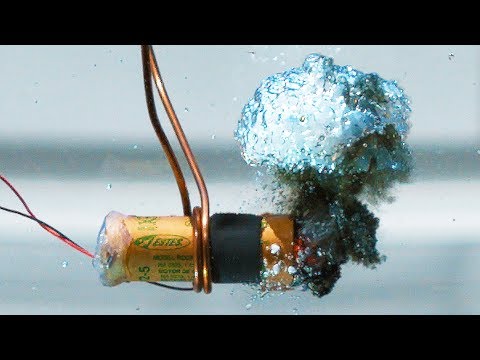
Estes Industries makes most of the hobby rockets sold in the United States, and they are primarily black powder motors. There are videos of people burning them underwater, so I don’t think they need atmospheric oxygen to burn.
[ ](https://www.youtube.com/watch?v=czwBWB5u6Hg)
[Aerotech](https://aerotech-rocketry.com/pages/history) and [Cesaroni Technology](http://www.pro38.com/products.php) make larger motors using composite material APCP (ammonium perchlorate), which is also used by NASA and the military in some of their rockets.
---
### Author:  [@eburacum45](https://boards.straightdope.com/u/eburacum45)
#### Post date: [November 17, 2023, 10:03pm UTC](https://boards.straightdope.com/t/do-toy-rockets-behave-differently-when-launched-from-higher-altitudes/993297/14 "2023-11-17T22:03:00Z")
Absolutely fascinating. Thanks!
---
### Author:  [@Francis\_Vaughan](https://boards.straightdope.com/u/Francis_Vaughan)
#### Post date: [November 18, 2023, 12:17am UTC](https://boards.straightdope.com/t/do-toy-rockets-behave-differently-when-launched-from-higher-altitudes/993297/15 "2023-11-18T00:17:10Z")
Some years ago there was a fairly amusing and quite complex hobby project to launch a rocket from a weather balloon at quite high altitude. This was reported on the UK tech news website The Register. (Very sadly, when a long way into the project, the leader died suddenly, and the project was abandoned.)
One of the interesting questions was - will the rocket motor light at altitude? And the answer was - without extra measures - no. They performed a set of tests in a cobbled up vacuum chamber, and found that a conventional model rocket motor igniter would not ignite the grain in the motor. The problem being that there wasn’t enough pressure to maintain combustion on the surface of the grain to get the combustion to the point of self sustaining. They worked out a temporary closure at the bottom of the motor that would hold gas pressure long enough to get the motor started and then get blown off. So not a huge problem, but could have resulted in disappointment.
The problem they found is explained in that rocket motors burn on the surface of the grain, and interestingly the rate of burn is roughly linear with pressure at the surface. When already ignited, the restriction in the throat balances the pressure and the burn rate is controlled and good. But before ignition could take hold there was a short time when combustion wasn’t fast enough to maintain pressure, and the rocket motor went out. At sea level it works.
This ties back into the flight termination system for solid rocket motors used for real rockets - at least the Shuttle SRBs. They blow the top of the motor off. This reduces internal pressure enough that it goes out.
---
### Author:  [@Stranger\_On\_A\_Train](https://boards.straightdope.com/u/Stranger_On_A_Train)
#### Post date: [November 18, 2023, 1:01am UTC](https://boards.straightdope.com/t/do-toy-rockets-behave-differently-when-launched-from-higher-altitudes/993297/16 "2023-11-18T01:01:43Z")
> [@Francis\_Vaughan](#):
>
> One of the interesting questions was - will the rocket motor light at altitude? And the answer was - without extra measures - no. They performed a set of tests in a cobbled up vacuum chamber, and found that a conventional model rocket motor igniter would not ignite the grain in the motor. The problem being that there wasn’t enough pressure to maintain combustion on the surface of the grain to get the combustion to the point of self sustaining. They worked out a temporary closure at the bottom of the motor that would hold gas pressure long enough to get the motor started and then get blown off. So not a huge problem, but could have resulted in disappointment.
>
> The problem they found is explained in that rocket motors burn on the surface of the grain, and interestingly the rate of burn is roughly linear with pressure at the surface. When already ignited, the restriction in the throat balances the pressure and the burn rate is controlled and good. But before ignition could take hold there was a short time when combustion wasn’t fast enough to maintain pressure, and the rocket motor went out. At sea level it works.
Ignition of solid propellant grains is a really complex phenomenon. There is actually a chain of progressively more energetic devices in the igniter that ultimately develops the pressure and heat flux condition to start combustion on some portion of the surface of the grain and sustains it long enough that the grain itself generates enough hot gas to fill the chamber and become self-sustaining. It is important that the motor ignition not only reaches the necessary combustion conditions but does so promptly and reliably so that there isn’t a long delay in ignition that can be detrimental in liftoff or separation. For ‘large’ motors the igniter is sufficiently oversized and generates enough products by itself that it can ignite the motor in vacuum and cold temperature conditions, but I suspect the igniters on Estes motors are just squibs which are adequate for normal hobbyist launch conditions but don’t work at very high altitudes.
> [@Francis\_Vaughan](#):
>
> This ties back into the flight termination system for solid rocket motors used for real rockets - at least the Shuttle SRBs. They blow the top of the motor off. This reduces internal pressure enough that it goes out.
Slight nitpick; the flight termination system (FTS) ordnance on the Shuttle Solid Rocket Booster (SRB) is actually a pair of redundant linear shaped charges (LSC) which run down the raceway of each motor [as shown in this diagram](https://i.stack.imgur.com/meNpn.jpg). When activated by the Range Safety Officer (RSO) would split open the case lengthwise, promptly extinguishing combustion and thrust. As far as I know, these were only activated in flight once (during the STS-51-L mission in which _Challenger_ broke up). Although some motors to have _thrust termination_ system which are intended to promptly neutralize thrust to achieve specific targeting or minimize tipoff, the SRBs are just allowed to extinguish naturally, and are pair matched to assure balanced thrust and action time.
The SRBs do have a set of auxiliary Separation Rocket Motors up in the frustum section just aft of the nose cone ([shown here](https://i.stack.imgur.com/GHmdF.jpg)) that push the motors away from the External Tank (ET) and Orbiter Vehicle (OV), and a shaped charge that cuts away a portion of the lower nozzle to minimize impact loads on the Thrust Vector Actuators (TVA) when it hits the ocean, but the motor remains intact for refurbishment, in which the individual case segments are retrued and propellant is poured into them.
Stranger
---
### Author:  [@gnarator](https://boards.straightdope.com/u/gnarator)
#### Post date: [November 18, 2023, 3:18am UTC](https://boards.straightdope.com/t/do-toy-rockets-behave-differently-when-launched-from-higher-altitudes/993297/17 "2023-11-18T03:18:11Z")
> [@Stranger\_On\_A\_Train](#):
>
> I suspect the igniters on Estes motors are just squibs which are adequate for normal hobbyist launch conditions but don’t work at very high altitudes.
[Estes ignitors](https://estesrockets.com/products/startech-starters) , or “starters,” are two thicker wires with a smaller bridge nichrome wire welded to the thicker leads. The bridge is coated with a small amount of pyrogen. Estes changed their ignitors a few years ago and they sucked, but they recently made a change and the newer ignitors are much better.
[Estes helpfully includes plastic plugs that hold the ignitor in place in the motor.](https://youtu.be/JVRsgMY4G-I?si=P38tVWHxDcGuExTp)
The motor on the project @Francis_Vaughan mentions no doubt was a higher-power motor that uses APCP. Those motors are harder to ignite and tend to burn from the inside out. The pyrogen used for hobbyists is not very aggressive, and “chuffs,” are not uncommon.
> **[How Composite Rocket Engines Work : Apogee Rockets, Model Rocketry Excitement...](https://www.apogeerockets.com/Tech/How_Composite_Rocket_Engines_Work)**
>
> Apogee Rockets : How Composite Rocket Engines Work - Model Rocket Kits Rocket Motors Launch Accessories Rocket Software Rocket Books & Videos Building Supplies Electronics & Payloads Wearables Gift Certificate Rocket Novelties and Gifts Garage Sale...
I imagine they had to get a more aggressive pyrogen, like copper thermite, in addition to the closure mentioned above.