Good catch!
This has a timeline for major trilobite groups, which had a pretty good run at 300 million years or so.
One reason why the sea-based exhibits may have passed you by is that a lot of it (as I recall) seems to be flat, wall-based presentations whereas the superstars on land are often shown as walk-round 3D constructions. Not sure why that is, I suspect that the nature of fossilisation on land may make it easier to do so, or that such as an icthyosaur and fishes don’t benefit as much from a fully 3D presentation. I don’t know.
Anyway, it is hard to avoid the impact of a triceratops in the middle of the room, easier to ignore an icthyosaur or similar on the wall.
The London Natural History Museum has quite a lot of the latter and many from the already-mentioned Mary Anning
Good. For some reason creatures with craploads of legs creep the hell out of me. Eight is my limit, then I start screaming.
It’s kind of a shame, because some of the sea fossils are truly impressive. At the Perot Museum here in Dallas, they have a locally found *Protostega *(Cretaceous sea turtle) that’s about 10 feet long, but they hung it in the air, so it’s not necessarily as visible or as impressive as if it was at ground level with the dinosaur skeletons.
They do have a Tylosaurus (Cretaceous mosasaur) skeleton that was found locally as well, and it IS at ground level, and quite impressive, although it is along the wall and behind glass.
Forgive me for a slight derailment (but still on the sea-land paleontology subject).
One aspect of prehistory that never seems to get much publicity is the gradual move from sea to land by plant-life. Certainly from a youth spent poring over dinosaur books I recall plenty of artists representations of lobe-finned fish, proto-amphibians etc. hauling themselves out of the primordial seas. I can’t recall seeing or reading much at all about how plant-life followed (or preceded it?). Surely an evolutionary step of equal or even greater importance but sadly I suspect less dynamically photogenic.
The Smithsonian Museum of Natural History in Washington DC currently has a special exhibition devoted to ancient sea life:
I can’t have been the only one who read the thread title as "Do we know much about sex life during the age of dinosaurs?
Trilobite imagery is tolerable, but I don’t want to think about brontosauruses getting it on.
Don’t look here, then (although I think these are Brachiosaurs):
Or in this book:
It’s more that marine reptiles have weaker skeletons than land-dwelling animals, since they had water to support their body weight in life. So they don’t lend themselves as well to static display, even as casts. That is particularly true of the thinnest bones such as ribs. For the most part, you will only see marine reptiles on static display as skulls (though there are exceptions).

The problem with displaying fish is that they don’t have calcium bones , so there is no skeleton to display. Fossilized fish are usually just impressions, except for sharks which leave jaws and teeth, or placoderms which had bony heads.
Also, don’t look in Volume I of Larry Gonick’s [B\Cartoon History of the Universe**
https://www.google.com/search?q=Larry+Gonick+Cartoon+History+of+the+Universe+dinosaurs&source=lnms&tbm=isch&sa=X&ved=0ahUKEwi5jaXqvoziAhXlnuAKHbchA1wQ_AUIECgD&biw=1440&bih=708#imgrc=4Wo9ZJOYL99hSM:&spf=1557337713676
(There’s actually a more explicit picture in the book, but I can’t find it online)
As you would expect, there is a wiki for that. As you also might expect, the first land plants were small, soft, and left little evidence. Here are two interesting (but possibly conflicting) articles I found just now.
And this is why you are no longer welcome in Maine and Louisiana.
One of the Jurassic movies had a giant sea monster lunge out of the water and grab a pterodactyl. What was that thing supposed to be? The size of it seemed comically exaggerated.
The mosasaurus in Jurassic World was about twice as big as an actual maximum-size mosasaurus was in the real world. They got to 60 feet or so and the one in the movie was around 120 feet.
Fish have bones largely made out of calcium, like other vertebrates. In fact, all of the fossils you showed in your link include fish skeletons. However, they also include impressions of the body.
The thing about fish is that if the body isn’t still intact when it fossilizes then the bones fall apart easily and disarticulate. Therefore the impression of the body is often included. But sometimes it’s just bones.
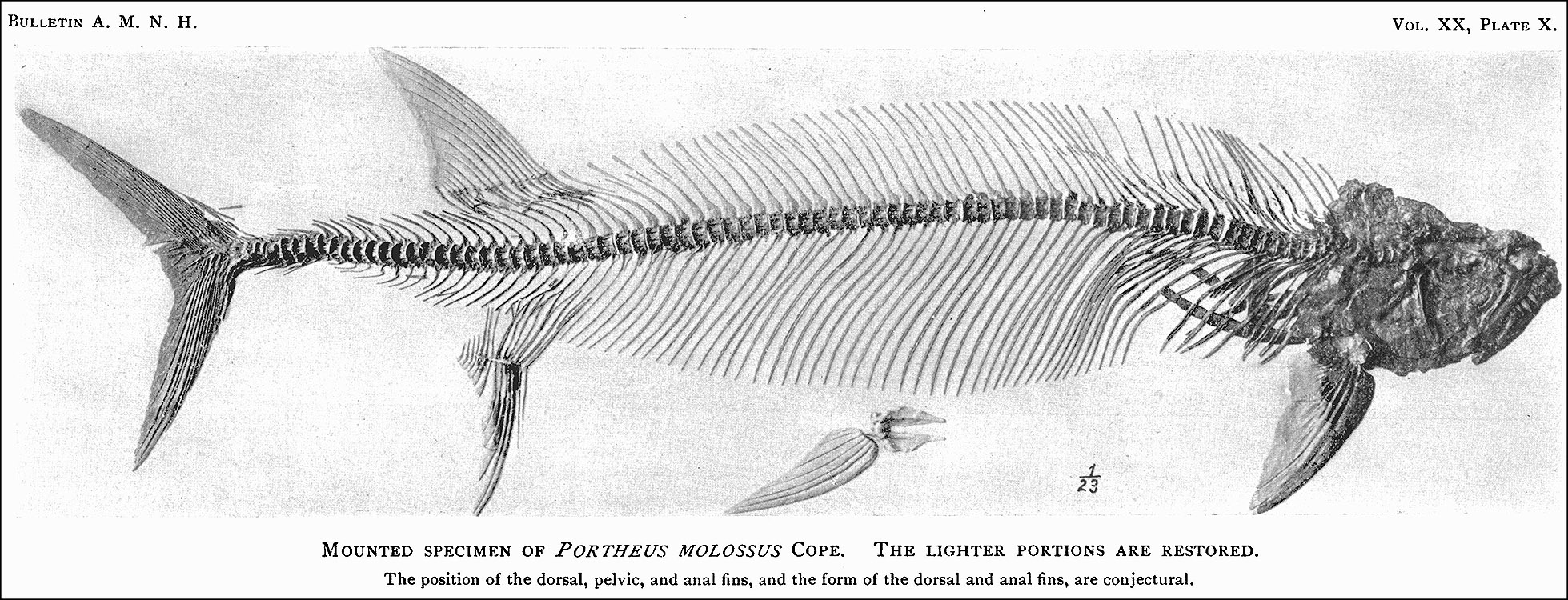
Check out this fossil plate!
Appreciate the correction.
I don’t know the answer to OP’s question but just noted a vaguely related story on the Yahoo News front page.
Based on DNA evidence, bedbugs are now believed to date to 100 million years ago, a big surprise to scientists who thought the first hosts of bedbugs were bats, 50 million years ago, since dinosaurs didn’t have … well, beds.
But surely some species of dinosaurs may likely have slept in nests, no?
Mammals were around long before that, and some would have made in nests in burrows. And plenty of dinosaurs of all sizes made nests for their eggs. And bed bugs sometimes feed on modern dinosaurs, that is, birds.