Why wouldn’t I just take the opaque box? Isn’t that an easy $1m? Why would ANYone take both of them?
Because once you enter the room, the boxes are fixed and your mindset previously doesn’t matter.
Unless you believe that you are uniquely special and unpredictable and capable of actions unconnected to your prior state, your mindset does matter.
Doesn’t that assumption come with the assumption that I cannot choose anything other than what has been predicted?
Is there anything more complex here than the statement “in a world where it is possible for a computer to know what you will do before you do it, you will in fact do what that computer predicts?”
I’ve now watched the Veritasium video and it underscored my status as a one boxer. It also revealed some things about me that I had not previously realized: My gut feeling is that free will is an illusion. This part blew me away: “If you don’t believe that free will exists, you still have to behave as if it does.”
Right. I haven’t watched the video, but @Thumper668 seems to confirm my hunch that this is really a stalking horse for an “Is there free will?” debate.
People presented with such a manipulative dilemma are prone to try to “flip the table”, and either break the rules or destroy the one responsible. Thus such things as a common solution to the infamous “trolley problem” being “kill the guy who set up the trolley problem”. The computer in the scenario is the “enemy”, or at least the proxy for one and so people are inclined to find some way to defeat or harm it.
People in such “game theory” dilemmas have been shown to often pick sub-optimal options knowingly out of sheer spite. It’s likely an instinct, since being spiteful like that reduces the likelihood of people actually trying such manipulative tactics.
Take the supercomputer. One that complex is probably worth a lot more than a million dollars.
Partly, but not entirely. It’s a paradox, so there is no “right” answer. But how you answer offers insight into how you think. What I think is very interesting is how most people are so confident in their solution that the other side is seen as irrational. From the start I could see logical arguments for both answers.
Have you tried to lift a supercomputer? 
Yes, but if there are no other players we have to make the computer into the opponent. Game theory doesn’t really apply here.
Nobody said I couldn’t bring a forklift.
By 1980s standards your phone is a supercomputer. And very easy to lift. And easy to drop too. 
That would have been pretty useful in the 1980s; why didn’t we think of that?
The rooms full of cabinets full of processor modules have their own intimidation factor, however.
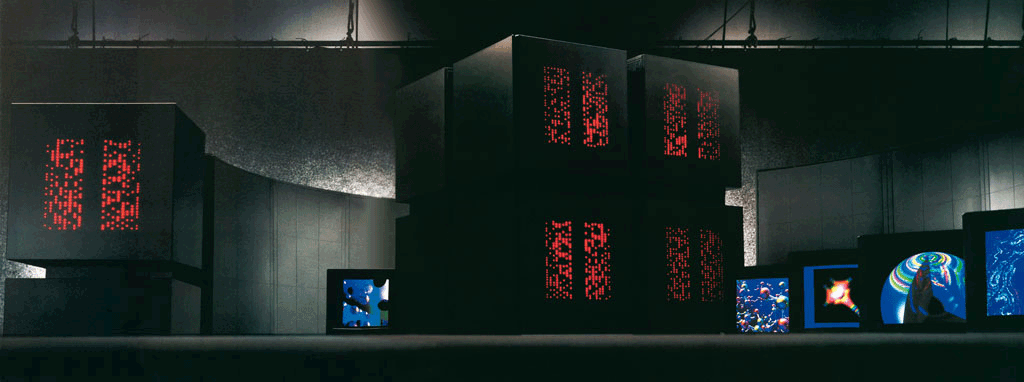
Pick a box, now!!
I think you’ve nailed it. It’s not nearly as interesting of a hypothetical as [the computer] thinks it is
Unless the computer really has supernatural powers or time travel ability or something like that, it made its move based on analysis of your previous history, not on what you do today. That history is done, you can’t change it. Deciding to take one box today is not going to affect what the computer did yesterday. (If you knew this game was going to occur, maybe you could change the computer’s move by having made different life choices over the past 30 years, but that is not an option.)
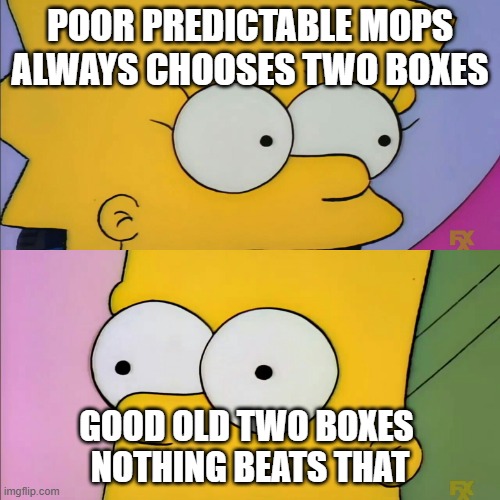
If you choose two boxes, you are Bart.
You always were Bart and you always will be Bart.
Wait, why am I walking into a room and stealing a box?
But anyway, empty boxes are useful. If I’m taking stuff, I might as well take both.
Are you saying I know in advance that I will be walking into this room and offered a box? I think there are a whole lot of unstated assumptions in this question. I think I need to know the rest of them to answer this. Because the real answer, in real life, is that I don’t take boxes of cash that are lying around, I assume they belong to someone else.
Yup.
A European or an African??
I’m going to pick a number between 1 and 10, then I’m going to multiply it by 5, divide by 2, add 27, multiply by 3 then take the square root. If the 3rd digit of the answer is odd, I take 1 box (the opaque one) if the 3rd digit is even, I take both boxes.
My number is 4
Hold on… the answer is 10.5345438, third digit is odd (5) so I’m taking just the one box.