I’ve asked you previously to estimate the chances that you think all those things happen to line up before, which would have been great to have an actual serious starting point to work from.
Here’s my rough guess at throwing numbers out there, for what it’s worth.
“Forgetting to plug in” : Maybe 5 days out of the year. (5/365)
“20+ miles of going out”: 3 days a week (3/7)
“commuting 50 miles” : top 20% of commuters (1/5)
“Visit a friend the next town over, stay overnight” : 1 day a week (1/7)
“During cold weather/EV battery degradation conditions” Half the year/lifetime of the vehicle, maybe (1/2)
If all of these items are independent events, you’d expect them to line up maybe once every 33 years. More than the lifetime of the vehicle.
And sure, this isn’t describing you in particular, since you commute this distance every day. And these may not be independent events, since this particular sequence of events may just be part of a weekly routine you do during winter, and maybe the 20+ miles of going out leaves you in a condition where forgetting to plug in is more likely to occur. And this is just one scenario, and there are many others like it.
But really what it boils down to is the chances to:
Have to drive a whole bunch of miles (~200) in one day.
Forget to plug in at home
Have to drive more than the remaining range (~50+ miles) the following day, and delays of an hour or more are not tolerable.
Have no convenient access to fast chargers, or other alternatives (trading car with a spouse for a day)
Sure, I’ve done #1 multiple times (weekend trips getting home on Sunday night). And I’ve done #2 multiple times. And I drive 50+ miles every day for work, so #3 would be pretty likely for me too. But #1, #2, and #3 combined would be an extremely rare event for me. I don’t live anywhere near a convenient supercharger, but I can trade cars, so it wouldn’t be an issue for me even if it happened. But that’s my situation, and I’m not going to claim its the same for everyone else.
If your round trip to work is 50 miles, you can manage two days of commuting AND about another 100 miles of miscellaneous travel (even in winter) over two days for nearly every EV on the market today.
So let’s get this straight – someone drives to work on day one, drives another 50 miles, and then drives back home, but forgets to plug in because he isn’t an automaton. Then on day two, he drives to work, drives another 50 miles, and drives home… and then forgets to plug in AGAIN because he is STILL not an automaton? And then on day three, he can’t get to work OH NOES! This is what you’re trying to convince us of?
The best part about this is he’s claiming that a person who knows they’re going to be driving 100 mile the next day won’t glance at their gas gauge the day before. As if the cars are all secret about the fact that their battery level is at 65% at the end of the day.
I expect that when shutting down the car, there may be a reminder to the owner that the battery is low, which should lead the owner to plug it in before going inside. I also suspect that most of these cars have smartphone apps, so if it’s sitting in the garage, with the battery at a low level and not plugged in, it might pop up a reminder on the phone to go out and plug it in.
Naw, they’re just all so expensive that the only people who own them have a butler who can be made responsible for ensuring that there’s a full charge on the car in the morning.
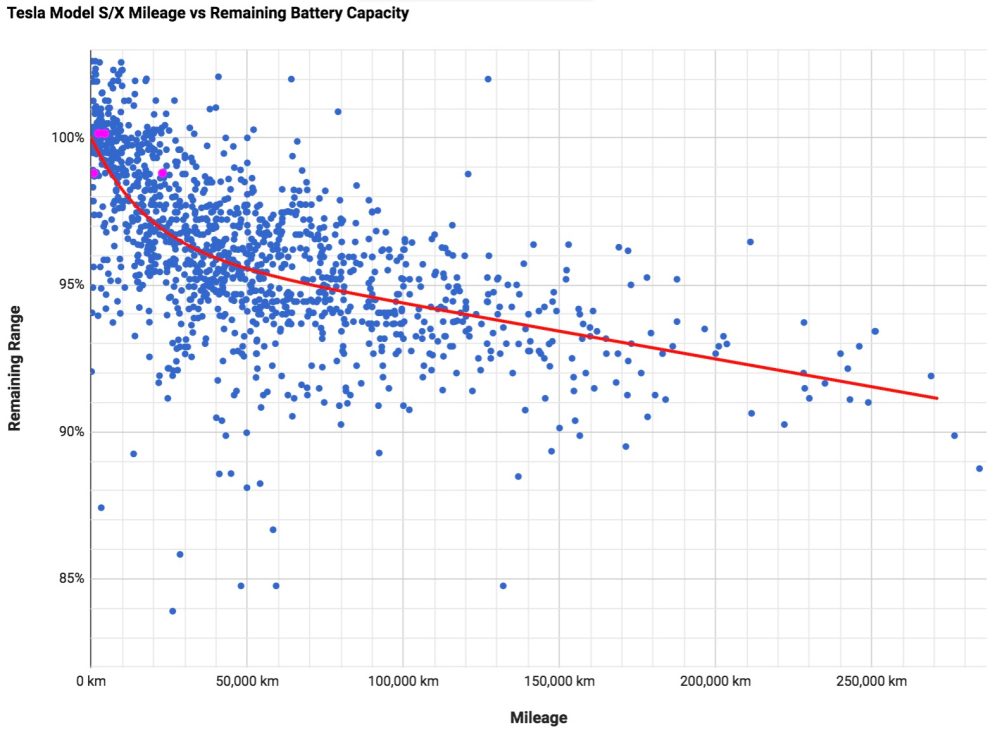
Here is a scatter chart of battery degradation on the Model S/X. None of the points are as low as 80%, and it certainly isn’t typical. Almost all the cars stay above 90%, even as far out as 250,000 km.
It’s too early to be sure, but the Model 3 is likely even better (expected, given their changes to the cell architecture). The first Model 3 to go 100,000 miles has only experienced ~2.5% degradation. The car may well reach a half million miles before degrading to 80% capacity.
This might just be a lucky outlier, since it’s just one data point. But even the older Model S, for which there is good data available, experiences far less degradation that your claims.
The first gen Nissan Leaf did experience significant degradation due to poor design and a small capacity. That should not be taken as at all representative.
I’ve setup automation so that if my car is below 30% of charge, I’m home, and it is not plugged in at 10pm, then send me a reminder. I guess if there is a chance I’m in the bathroom at 10pm, I could set it to run every 30 minutes. The conditions for the reminder to be sent have never once been met.
I’m sure it will happen to some people, though. Because even with gas stations on every corner and every freeway exit, people still manage to run out of gas.
It also needs to make them something I would want to buy. I like my vehicles to have at least a modicum of sportiness, aesthetically pleasing looks and practicality; properties the Focus EV, Leaf, and Bolt lack in large proportion. I did a hard look at the Volt and I still think it is one of the better choices out there, but I’ve had a hate on for GM and Chryco ever since they had to be bailed out. I won’t support a company that is still that badly mismanaged and clueless. JMO, of course.
I’m gagging on the idea of spending $65k CAD for a Model 3 as well. Maybe the ID3 is my next car.
This, to me, depends on whether you’re comparing based on $$$ or features.
Taking the LEAF as an example - the nearest in size and utility would be the Nissan Tiida - having spent a good amount of time in both…
The Leaf far outshines the Tiida in every respect except for range. From driving dynamics to acceleration to noise control etc.
Of course well it should given the price point… however, the lower running costs (if the range is suitable) offsets that
I found very much that when I was driving an EV my thinking changed to be more aware of charging.
Just as, when I lived in the country (far away from petrol station) I was far more aware of how much fuel I had left.
The above is from your OP. However, you’re doing the opposite side of the coin of what you’re bitching about in your OP. If they work for you, great! However, they don’t work for everyone.
They don’t work for people who don’t have dedicated (powered) parking spots at home &/or work, including city dwellers & many apartment residents.
They don’t work for people who need 4WD, like enipla because they don’t make a 4WD variant yet.
They don’t work for people who regularly drive long distances in remote areas like Kent Clark or myself. If/when the range/recharge infrastructure & vehicle type improves enough that my range/recharge issues go away I’d consider one for my next car; however, they’re nowhere near that today. I would have had issues two of the last three weekends with an EV - It’s not practical.
The irony is that, in the ICE world, the cheap econoboxes get the best MPG; sure, a Chevy Suburban may get more range but that’s only because it’s gas tank is 2x or 3x the size of that in the econobox. However, in the EV world, the best range & recharging options are in the more expensive available models; that’s adds affordability to the list of people who can’t get one.
In the same way that a SmartCar or a Miata doesn’t work for a family of four, EV’s don’t work for huge portions of the population; that doesn’t mean that we’re ‘critics’ of them. I’d love to have a Miata to go zipping around topless in the summer; however, the lack of seats/storage means it would need to be a second car as I couldn’t use it a lot of times. That’s why I don’t have one; same logic with an EV.
To be clear, the 4WDness is not the issue. The AWD system on a Tesla is excellent; far superior to most ICE AWD systems and probably comparable in practice to most 4WD systems.
It’s the ground clearance that’s the issue, and to some extent the form factor. There’s no equivalent to an EV Jeep yet. But on roads which are just snowy/icy/muddy, and aren’t covered with rocks or whatever, a Tesla is great.
I realize you’re probably using “4WD” a synonym for a high ground clearance, truck-like vehicle–I just wanted to clarify the difference here.
so basically you want a mainstream car company spend billions making a one-of-one vehicle which perfectly suits you. yeah, you’ll be waiting a while for that.
Please show me, using quotes if possible, where I have in any way implied that EV’s work for everyone, and I am “doing the opposite side of the coin”
I will repeat - EV’s do not work for everyone. There are many cases where they do not. I think I even said that a while back. Oh yes, I did - there it is:
If it were a literal reversal, with gas stations as far away as charging stations are today, it would be no problem, especially as you could carry a gas can to extend the range of a hybrid for a lot longer than the range of an electric vehicle today.
No problem? Suppose you live 50 miles from the nearest gas station, as one might today be 50 miles from the nearest fast charging station. Charging at home is sufficient for EV drivers as long as they stay within a certain radius. But there’s no home gas stations, so one would have to make extremely inconvenient trips just for daily usage.
This is why hydrogen fuel cells are a dead-end, IMO. Without home fueling, they require a public station density comparable to gas stations. And of course that doesn’t exist and probably never will.
If I had a garage that could fit a charging station, I’d be able to keep extra gas in it so I would only have to fill up every couple months. The hardest part would be the gas going bad.
Yup, I tend to think of AWD as cars that get power to all four wheels but where ‘offroad’ is not much more than a grass parking lot whereas 4WD tends to be higher ground clearance & knobby tires; something you can take on a trail - a Jeep, a pickup, etc.
Maybe there are options but standard road tires, which is what the Tesla comes with, are not nearly as good in crap conditions as off-road/knobby tires are; they can’t get the same traction/‘bite’ that an off-road tire can.
Post 587, which I quoted; where you called people who don’t have them 'EV critics" & ‘edge cases’; a third (or more) of the population isn’t an edge case.
 Half the year/lifetime of the vehicle, maybe (1/2)