Emergency response at air shows

They were supposed to be disarmed. They weren’t. I’ve never seen any kind of official accident report, but I’m certain someone was in a world of trouble after that one.

At the time, people were puzzled as to how it happened for a number of reasons. Beside the obvious screw-up of not having the rockets deactivated, according to the reports I remember from the time it should have been exceedingly difficult for the kid to accomplish this even on a fully active system. I seem to recall the reporting stating that the eject sequence wasn’t simply, “pull the yellow-and-black striped thingy,” but that there were a few things that were supposed to be done in sequence to successfully eject. In addition, it was reported that the force necessary to pull the ejection handles was larger than expected for a kid to exert. Either some or all of this was incorrect, or it was a true fluke aside from the improper prep of the aircraft.

Any aviation-minded Dopers know of a reputable source for more info on this accident? I’d be interested in the conclusions.

Disclaimer: I have not trained with ejection seats.

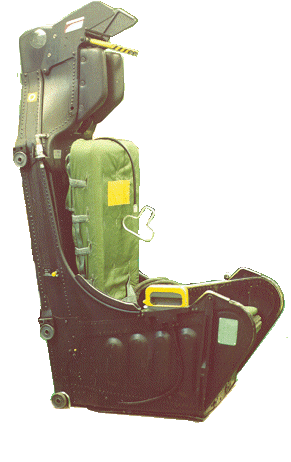
AFAIK there is a sequence of things a pilot must do to safely eject. (‘Safely’ implying a given value of ‘safe’.) But in the end, I think it does come down to ‘pull the yellow-and-black striped thingy’. I have a Douglas ESCAPAC ejection seat from an A-7E Corsair II. It seems identical to an A-4 Skyhawk ejection seat, only the A-4’s seat does not have canopy penetrators. I don’t know where my copy of the Pilots Operating Handbook for the A-4 is (it’s in a box somewhere), so I can’t look up the sequence. I imagine that one task would be to jettison the canopy. I don’t know if there is a safety interlock on the A-4 to prevent the seat from firing if the canopy hasn’t been jettisoned. The seats in the S-3 Viking do appear to have penetrators (although of a different design from the ones on my A-7E seat).

I’ve pulled the ejection handles on my seat. (Obviously I don’t have a rocket installed.) It’s a PITA because the canopy penetrators lock into the upward position. They have three wedges that are not retained in the unit by anything but the spring, and they have to be held in place while screwing the rods back in – and then secured so they don’t pop back up. (The penetrators shoot upward under spring pressure, and the wedges lock them in place.) Now that I know how to lower the penetrators, I have no desire to pull the handles again!

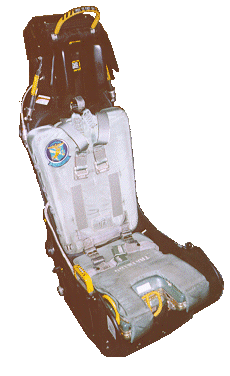
It’s hard to see the penetrators on this image, but you can see the two ejection handles – one over the head, and one between the legs. A person would have to deliberately pull the handle between the legs to activate the seat. But I can imagine a 12-year-old child reaching up and grabbing the top loop while climbing out of the cockpit. It doesn’t take that much force.

Incidentally, the top loop has a face curtain attached to it.

I never trained on an Escapac seat like the A-7 & S-3 have. But …

Launching any modern seat is a two step process:

  1. Assume the correct body position.
    2: Pull the handle.

If you’re willing to skip the first step then it’s just a single step process: pull the big yellow handle. As that poor kid discovered. Everything else happens automatically (& practically speaking, instantly) after you pull far enough on the handle.

The Martin-Baker & the Escapac generally had two ways to fire the seat. Both had the same outcome once you’d triggered the first step. The so-called face curtain above and behind the head and also the between-the-legs handle. The theory of the face curtain was that it put both hands in a good location, provided some protection from wind blast, and tended to ensure your head was fully back against the headrest at seat initiation.
The ACES II I flew on had a single handle between the legs. It was IIRC about a 20 lb. pull for about 1/2" to fire the seat. Not a hair trigger, but close. If the seat was armed and you climbed in or out clumsily, it would not be hard to snag a foot or a harness buckle in the launch handle & kill yourself.

Step one for pilots and maintainers upon approaching the cockpit was always to look in carefully at the arm/disarm lever & make sure the seat was safe. It was a major flail if somebody found an unsafe seat; finding the culprit for retraining was a big deal.
Ejecting was dirt simple because once it was needed it had to be done very quickly. Conversely, getting strapped in or unstrapping at the end of a flight was a PITA. As was quickly unstrapping if you needed to do what we called “ground egress”. i.e. climb quickly out of a damaged or burning jet & run like hell. All those other yellow & red handles you see along the side of the seat are related to that maneuver.

Thank you, Johnny and LSL, for your informative posts. I couldn’t tell from Johnny’s if either pull-handle would initiate ejection, but LSL cleared this up.

So, I think Johnny’s probably spot-on with this speculation:

“A person would have to deliberately pull the handle between the legs to activate the seat. But I can imagine a 12-year-old child reaching up and grabbing the top loop while climbing out of the cockpit. It doesn’t take that much force.”

(Nitpick: actually, it was a seven-year-old.)

How sad. And to think we have a Doper who was there.

Oh, I was thinking of the other kid-in-ejection-seat fatality!

No. Actually, I didn’t review the previous post that mentioned the age and ‘12’ was the number I had in my head, possibly from something/somewhere else.

That’s how old our fellow Doper was when he pretty much witnessed the incident in question.

Yeah, thanks Johnny L.A. and LSLGuy for some really informative posts. I’m just amazed that I had something of any substance to contribute to a thread like this, anecdotal though it may be.

I am not a seat mechanic but I was the 1st one on scene for this tradgedy. I was a Marine Sergeant - Support Equipment standing approximately 100 feet away from the aircraft.

The question of response time has surfaced again, with this crash at Travis AFB: http://www.sacbee.com/2014/05/04/6378124/fatal-air-show-crash-at-travis.html

Again we have to remember the caveat that people’s impression of response time can be wrong, and that even a couple minutes seems long when you’re excited/distraught and watching a plane burn.

But if the photographer quoted in that story is correct about the time stamps on his photos, it was 2.5 minutes for an individual to arrive with a fire extinguisher, and then another 2.5 minutes for the first crash truck to arrive. So that’s five minutes for what I would consider the real crash response.

A two-minute response time can be understood as acceptable or even laudatory, based on the earlier response in this thread, by the size of the airport, the need for a clear area of safety, and the practical restraints of dispatching trucks.

But five minutes? I’d hate to think that if a military plane crashed on the runway on a routine day, it would sit there for five minutes waiting on a fire truck. And that doesn’t meet the three-minute response requirement unless there was something about the ground conditions that would be considered not optimal.

The only thing I can think would explain the response time (and it’s only speculation) would be the problem cited in earlier posts about the crash trucks being on display for the open house or being impeded by the crowds. If so, that would seem like an issue for air show organizers to address.

Not that it ultimately made a difference in this case. I disagree with the quoted photographer about the pilot burning to death in his aircraft. That poor guy skidded along the runway upside down, in an open cockpit. I don’t see how he possibly could have survived the crash itself.

Five minutes is definitely too long to wait. Is there anyone other than the photographer who timed it at five minutes?

Although you may be right, if an open-cockpit plane crashed upside-down, I’d expect response time not to change the outcome. :frowning:

One of the reason the stunt flying at the Chicago Air and Water show takes place over the water is so that if there’s an airplane accident it goes into the water and not the crowd. It’s not a bug, it’s a feature. In which case the fire department and Coast Guard boats are the first to go in but really, making it a water crash doesn’t help the pilot’s chances.

That’s also the reason the traffic pattern at Meig’s Field (back before Dictator Daley back-hoed it in the middle of the night) was the reverse of the usual - so the aviation traffic was mostly over water and if something went wrong the crash would be in the lake and not on a beach full of people.

What happened, from your perspective?

Wonder if the pilot has passed out.

Reread my post above.

1.5 -2 minutes is typical for an average city engine company to roll out the doors. If they know they are going into a firefight, they will take an extra minute or so to get into protective gear before they roll. 5 minutes is FAST. Fresno fire last I heard has its response areas optimized to aim for maximum of 6 minutes from Rolling to on scene. So up to 2 minutes to drop what you are doing and get to the apparatus bay, 1 minute gearing up, and at least 2-3 minutes to crash scene. That’s actually going to be a textbook response. Fire apparatus are powerful, but not quick, think Clydesdale, not quarter horse. In the middle of a crisis situation, 2 minutes feels like an eternity, but it does not make it one.

Missed edit window. The only way you are going to consistently put guys on a crash site in 3 min would be to keep them sitting in station in their protective gear doing nothing else. During an airshow, this may be preferred, but as many crash teams have other “down time” duties that are probably magnified during something like an air show, may not be practical.

I was there the next day, but heard about this (buddy was in CAP which was involved with the crowd control at airshows so he was into the whole scene). The way I heard it was that they believed some prior person in the cockpit had removed the pins.

Sad stuff.

The next day when I was there, was a screwy show. They dropped a sheridan on a skid pallet and it slid off the runway. Then a large unit drop from 130 had one of the parachutists hurt himself (nothing major, looked like a leg injury, but took time to get him trundled off) and another smaller drop (Marine Recon from a helicopter) landed to heck and gone (one on top of hangar - huge BONG but he showed near the edge and waved he was okay. Another in that drop was blown on into the parking lot or beyond.

Then a guy flying a Hawker Hurricane look alike (forget what type it actually was, some trainer or civil job) ended his routine with a dead stick landing. He was so engrossed with this that he forgot to lower his gear. That grand and glorious feeling he must have had when he noticed they didn’t touch down. He managed to skid to a safe halt. The soldiers who had parachuted in minutes before ran out with others to bodily lift the plane and hold it until he lowered the gear and they could push it away.

It can happen - even to a highly experienced pilot.

Martin-Baker Aircraft Ltd will be in court in January 2018 under H&S legislation.

Ai shows are risky - fatality today in Italy. https://www.youtube.com/watch?v=1ZHsqsLCznk

Let’s look at this realistically.

A fire truck can either be sitting around at an airshow, or back in the city responding to fires & medical emergencies of city residents.

Fire trucks are paid for by city taxpayers.
Airports generally don’t pay any property taxes to the city.
There are fires (damaging taxable property) or medical emergencies (affecting taxpaying citizens) constantly, at least once per hour in a bigger city. Prompt arrival of a fire truck can make a big difference in these cases.
Most of the crash incidents at an air show are instantly fatal, and the arrival of a fire truck, either in 3 minutes or 3 hours, won’t affect the outcome.

So from the realistic viewpoint of the city elected officials, fire trucks responding to a crash at an airshow should be lower priority than their regular duties.

All US airports that serve scheduled passenger air carriers; i.e. airlines, are required by FAR Part 139 to have dedicated ARFF crews and equipment. All US airports with US military aviation presence have dedicated ARFF crews and equipment as well.

Despite this being a zombie, let me add some information as I have been a part of Emergency response at some airshows & part of the ‘talent’ at other ones.

The (military base) airshows I worked at had the crowd on the tarmac/ramp & show-center on the far side of the runway. There were two large objects to mark the two ends of show center, either shipping containers, or even better, big, yellow school buses. Nothing else of value was in the ‘danger path’ if an aircraft went into the ground. It was coordinated so that numerous various Guard/Reserve units had their ‘training’ this weekend. Some personnel were assigned (no offense) extremely simple tasks, like directing some of the tens of thousands of cars to the proper parking spots, trash pickup, etc., while others had more ‘professional’ tasks. There were additional ARFF trucks brougt in from other relatively local military institutions. I presume that they scheduled limited/no fight ops that weekend at those bases.
I was part of the EMS response. Even though there was a lot of advanced coordination, we had to be onsite stupid-early for day-of briefings, equipment handout, etc. We had a couple dozen ambuli on standby for this event, from multiple counties, all of whom were ‘extra crews’ (meaning the normally staffed one or two ambulances were still staffed at our home base.) Depending upon your squad’s equipment/county you were from, you were either given the unique frequencies dedicated to airshow EMS ops or you were physically given radios that had those frequencies so that all EMS personnel could communicate together on our assigned frequencies. There was also a mobile dispatch center brought on site, it was staffed by regular/full-time Fire/EMS dispatch staff; however, they were only working airshow calls; 911 calls for on-base incidents were routed to them, 911-calls for off-base incidents were not.

EMS units had three statuses
[ul]
[li]Off-duty - watch the show, walk around, eat lunch, enjoy yourself.[/li][li]Stand-by - could watch the show from the hangar; ambulance moved to the front row, no lawn chairs setup in front of the ambulance.[/li][li]Active stand-by - these ambulances would slowly drive thru the crowd, with lights on, to get to an assigned pre-positioned location, ie. North, Central, South on the ramp, a couple in the parking lots, etc. They were dedicated to treating any medical issues in the crowd: heat exhaustion/stroke, diabetic or cardiac emergencies, etc. The idea was if/when there was an emergency, an ambulance didn’t need to go racing from central staging thru the crowd, with sirens overstepping the announcer, to get to the person in need. There were also numerous two-man EMS bike teams that were on roving patrol. [/li][/ul]

Approx ½-hr before the grand finale (typically either the Blues or T-Birds) a significant portion of the ambuli were repositioned to designated staging areas off-base that put one ambulance roughly every x° circling the airbase. This was to ensure that once a couple hundred thousand people & tens of thousands of cars all left the base at the same time that EMS would not have to fight their way thru the gridlock to respond to any call. I can tell you, that if you weren’t going to be at show center, this could an AWESOME place to watch the show from as I was literally under the apex of their horizontal turns. I was much closer to the aircraft there than if I had still been on base.
While I don’t know as much about FD response, I do know they were also pre-positioned thruout the airbase. ARFF trucks were staged in the acitve aircraft parking ramp & on the non-crowd side of the fence line. There was also ‘regular’ fire apparatus staged around the base, expecially in the public parking areas.
I was also lucky enough to own part of a fire proximity suit It is literally aluminumized rubber. It is very hot & does not breathe. (But on a fall night, say, Oct 31st, it’s great! ;)) If the firefighters were sitting on the sunny, warm tarmac in their gear, they would literally bake like a potato so don’t forget they need a couple of seconds to gear up before the apparatus rolls.

In the event of a crash, we were not to take it upon ourselves to self-dispatch to the field. Only one ambulance was ‘lucky’ (morbid, I know) enough to be dispatched to the crash, one that was on active standby at the gate to the field. I presume FD worked the same way - if they see a crash, they gear up, get in & start the motor, but don’t go flying across the field until told to do such. After all, all of the ARFF personnel were professional military firefighters, not volunteers like your home FD might be. I would only expect the best of discipline from them.