At your workplace, that doubtless works. But if you specified your county here, most likely the vast majority of American dopers wouldn’t have any clue where it was. Even if you specified both your county and your state, only the state would carry any information to most of us.
For my case, I could truthfully say that I live in Cuyahoga County, which is (so far as I know) the only place in the world with that name, but most Americans wouldn’t have any clue where it was (though Ohioans might know). On the other hand, if I say that I live in Cleveland, most Americans (at least, the moderately-educated ones) would know where I am. And I would likely say so even though it’s not actually true (I’m in a suburb of Cleveland), and it would be understood by others that I might in fact be in a suburb. In fact, “Cleveland and its suburbs” is pretty much synonymous with “Cuyahoga county”.
Rural Americans are less likely to refer to their locations by cities, but in my experience, they still don’t usually go by county. State is more likely, or a part of a state: For instance, my family describes where we’re from as “western Pennsylvania” (or “Johnstown”, a (small) city, if more precision is needed).
Counties in America have a “County Seat”, that is, a city where the County offices are mostly located. Counties often contain a city having the same name, and that city is often (but not always) the County Seat.
Generally, if a county and one of its cities have the same name, and one simply names the place without specifying County or City, the city is assumed. Thus for example, any mention of Los Angeles or Fresno will be assumed to mean the city, not the county. If you mean the county, you need to say it.
Sonoma County (a “wine country” region adjacent to Napa Valley) contains a city named Sonoma which was once the county seat. But Santa Rosa grew to be a big city while Sonoma remained a smallish (now touristy) town, so Santa Rosa has been the Sonoma County seat for a long time now.
San Francisco has characteristics of both a city and a county. For example, it has a Police Department (something usually found in a city) and a Sheriff Department (something usually found in a county). I’m not sure why they do it that way. How are their duties and jurisdictions divided up?
Mentioning that counties can contain same-named cities suggests a metaphysical question. Can a county contain itself? Can a city contain itself? Does the county of all counties that do not contain themselves contain itself?
In a similar vein, the Las Vegas Metropolitan Police Department has jurisdiction over all of Clark County including four other incorporated cities. Its commander is a ‘sheriff’ not a ‘police chief.’
That’s what I was thinking too. Back in the rural day, the county was generally the lowest level government unit that people dealt with- there was a county fair, county courts, county judges, county sheriffs, county jails, and so on.
These days, most people live in larger towns and cities that have assumed a lot of these kinds of activities, so the county is much less prominent. Except in the pandemic, when at least around here, the county is the primary public health entity empowered by the State to deal with the pandemic. So the County Judge and the county’s health department have had a much larger role than usual in how things are conducted.
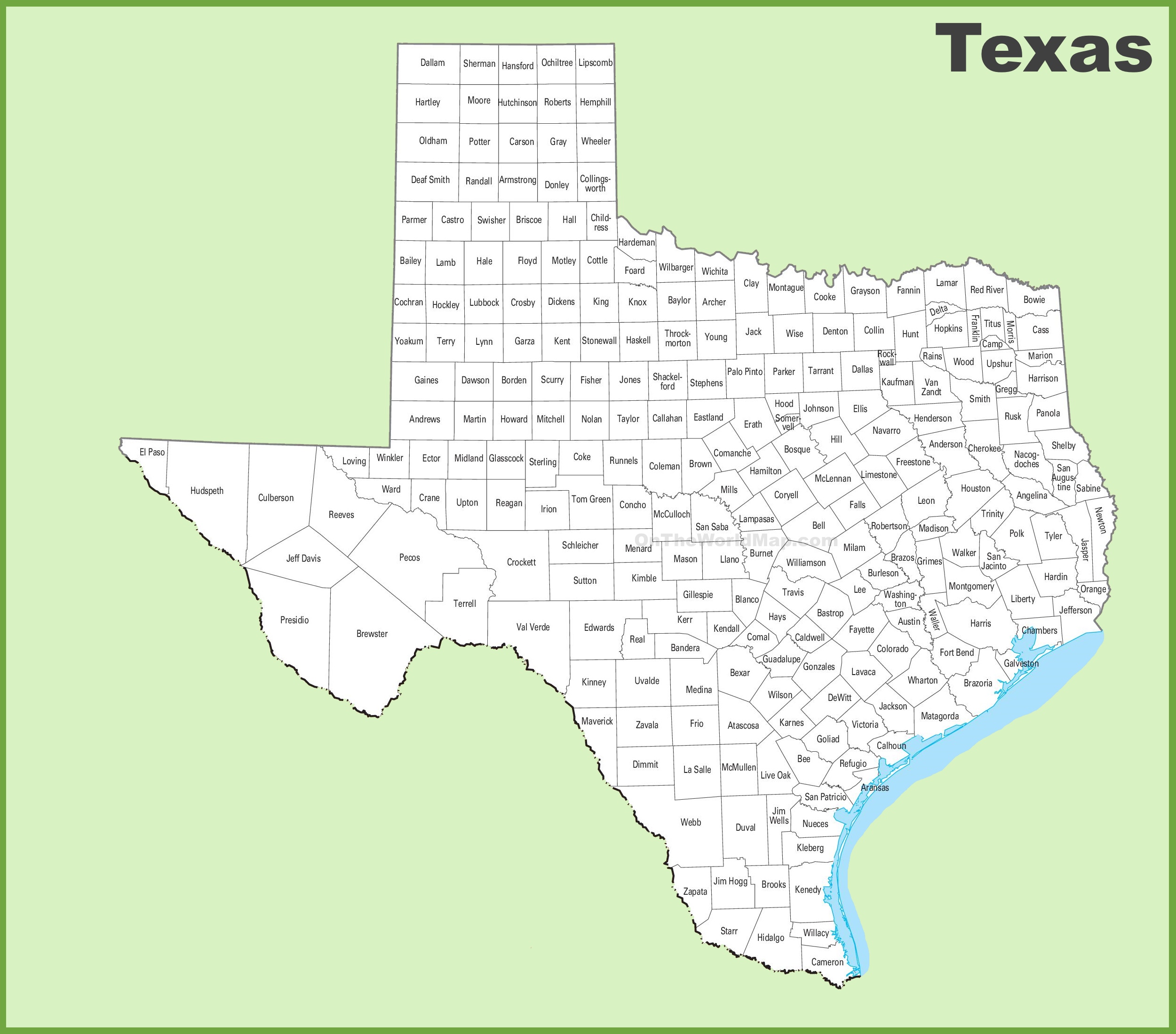
I hope someone will explain how UK counties determined their sizes. In the US, it was believed that democracy was served by them being only so large that their seat was one day travel from anywhere in them, as this map of Texas shows.
In the arid west that wasn’t practical. Originally all 113k sq miles of Arizona was divided into four counties. Later subdivisions we’re still massive, with Coconino County at 118k + sq miles.
Oddly, Coconino’s most famous law officer wasn’t a county sheriff, but a Policeman.
It depends. Here in the Bay Area, which is quite urban, the county identification is pretty strong. When I tell people from around here that I live in Alameda County (home of Oakland), they get a different picture than if I lived in Santa Clara County (home of San Jose).
I was pondering this and I do kind of feel like people in Holmes County (where the Amish are) would say they’re from Holmes County. Maybe because they’re so far from any major cities and also don’t want to give the impression they’re from Canton. Holmes County might just be well known enough as a tourist destination that it can be mentioned.
I do know that people like me who are from counties outside of Cuyahoga (Summit, Lake, Geauga, Medina, Lorain, etc) would say they’re from Cleveland.
Only some of them are analogous to U.S. counties, because most no longer exists as administrative units. Sussex is a historic county, but not an administrative county. Same with Yorkshire. Cornwall and Northumberland are both historic and administrative counties/units, but the borders of the administrative entities are different from the borders of the historic counties. For example, historic Cornwall included the Scilly Isles, but administrative Cornwall doesn’t.
The administrative counties have their own local authorities and limited self-government. However, as England is not a federal system, the national government in Westminster can withdraw any powers of local government by simple legislation.
The sizes of historical counties are mostly accidents of history, and the deciding factors differ across the country. In Wessex (modern South and Southwest England), shires were typically based on bishoprics.
The Local Government Act 1972 made major changes to the English and Welsh counties, abolishing many, creating new ones and merging others. The changes were highly unpopular at the time, and some of them were subsequently reversed.
The stadium is variously claimed to be (half) in England and Wales, where different Covid crowd rules apply.
As I understood, the assorted lands belonging to nobles in England got scattered, mixed and matched a lot due to marriages, and also by the desire by kings over history to split up the realms of their more prominent nobles, so they would not have a large central base of operations to potentially threaten the king. Plus freemen owned their own property, so the lord’s domains became less relevant with the demise of feudalism. (except in Scotland, where the lords - or rather, tribal chiefs - owned all the lands)
Once being a lord was a title that could be purchased, many rich industrialists did so, and as I gather, got to pick their lordly name. My father told me about one fellow years ago, who picked the name of the street in front of his factory, so people would think the street was named in his honour.
Another one who comes to mind is Conrad Black, who pretentiously renounced his Canadian citizenship to become a lord, so probably became the only British lord in his American prison.