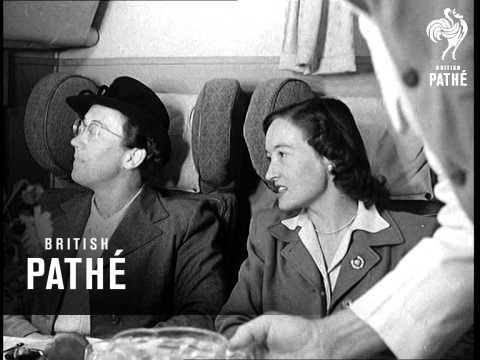
In the 1950s I was left in a boarding school when my father was posted to Calcutta and took my mother and sister (then 15) with him. My sister flew back to England unaccompanied twice and she tells me that there were children as young as five being looked after by the BOAC stewardesses.
The second flight was on the ill-fated de Havilland Comet, which was the world’s first commercial Jet powered airliner. (yes, another British 'first). She remembers it as being rather noisy.
My first flight was on my own in a Viscount to Paris in 1963, on a pen-pal family exchange visit. I’m not sure of a lot of the details, but I think in those days, in London, you still went to the airline terminal in central London, checked in there and were taken by bus out to Heathrow. All this was before train connections were made, either in London or Paris. But overall the inflight experience probably wasn’t very different from nowadays, on a short route like that, as my mother once said “They’ve barely got time to chuck a bun at you”.
As for earlier days, there are some videos on Youtube:
This one from the 30s takes 20 minutes or so (makes a change from today’s commercials!):
This one from the late 40s seems to have lost its commentary, but shows another sort of air travel:
Lots of airlines paint one to a handful of airplanes in their various vintage liveries. Here’s a quick Google search to get you started although a few of these are just now-old pictures of now-obsolete liveries that were current when taken.
I’m too young to have flown during the “early days of air transport”. My first flight was in 2003 when I was 23 years old, so I never even flew pre-9/11, although I do remember being able to go to the gate to meet people when they arrived. And when I was really young sometimes my dad would take us to the airport just to look at the planes.
But since we’re sharing, my first flight was on a BAe-146, that weird British regional jet with a high wing and four engines. Since we always drove when we went to visit my grandparents in Wisconsin when I was a kid – a trip that was always split over two days (stopping for the night somewhere in Indiana usually), it completely blew my mind that I had traveled to Chicago in about two hours.
Lame airliner joke: Q) Why does the 146 have four engines? A) Because eight wouldn’t fit under the wing.
My family wasn’t in a socioeconomic class that did much flying during the “golden age” but I do have an elaborate certificate given to my grandfather for crossing the Equator on a Pan Am flight from New York to Rio in 1950. Apparently this was issued routinely at the time, and included a letter from the airline’s head of the Latin America division, and a wallet card (no indication what flashing that might get one, except a good laugh).
My first flight was in the late '60s as an unaccompanied minor on then - Allegheny Airlines, from Johnstown, PA to Buffalo via Pittsburgh. The arrival in Pittsburgh was a bit late, and I arrived at the gate for the Buffalo flight to see the plane off in the distance, taxiiing out to the runway. The gate staff contacted the pilot and they actually brought the plane back to the gate so I could board. I still to wonder what the passengers may have thought, trying to figure out who the bigwig was holding up their flight, only to see some skinny kid climb aboard.
The first time I flew was in the 90s. I was a 10 yr old unaccompanied minor flying out to Hawai’i to visit my older brother in the Marines and his new wife. I charmed the flight attendants and was allowed to visit the cockpit and upgraded to First Class on one leg. The closest I’ve gotten to First Class since then was Premium Economy on a long haul flight home from the Philippines.
My great-aunt flew on the Hindenburg, but she wasn’t on the last flight. She returned from study abroad in Germany in 1936. Her only complaint was the aluminum piano, which apparently sounded terrible.
I suspect that in your own way you actually were a bigwig! If you weren’t on the flight on which grownups were expecting to meet you on arrival, the airline would have had some ‘splainin’ to do, and in the meantime would have had a responsibility on their hands that they didn’t want! Still, I very much doubt that they would do that today.
Yep, it needed all of them. It was originally designed as a twin but there wasn’t a suitable engine for it at the time so they added more. I think by the time it was actually put into production, engine tech had caught up, but it would’ve been impractical to go back and redesign it.
They’ve been described as “four oil leaks connected by an electrical fault”.
My first passenger flights were in old turbojet powered B737s. Not up to today’s standards, but not exactly “the early days”.
Unaccompanied minors are a big deal administratively. Somebody signs for the kid(s) at each step of the way, there are dedicated staff at the hubs who’re kid shuttlers, we have a daycare facility for all ages and staff to run it, etc. There are procedures (of course) for everything from kid misses connection to kids falls sick or injured, to airplane diverts to Bumfuck then breaks down stranding everyone.
And yes, all this is a lot easier now that everyone: staff, kids, and destination adults, are carrying phones.
I’d not be too surprised to hold or reverse push-out or taxi back and pick up a late kid if we were the last flight of the day to wherever. Otherwise they’d just be re-accomodated on the next flight out. Recognizing the window of opportunity between “they’ve closed the terminal-to-jetbridge door” and “we’re airborne” is usually pretty short.
My first flights were in 1972, as I was returning to New York from a summer at the University of Oregon when I was 20. (I had gotten to the west coast via a three day trip by train across Canada.)
My very first flight was in a two-seater with a friend of the grad student I had been working for, from Eugene to Mt. Shasta in northern California where the grad student was from. It was amazing to fly over the mountains of Oregon and California in such a tiny plane.
I took a bus down to San Francisco and went to the airport, being completely ignorant of how flights worked, with no reservation and no idea really of schedules. I just went up to the first airline counter I saw and asked for a flights to New York. I was told they only had international flights and didn’t fly in the US. (I suspect it might have been Pan Am, but am not sure.) So I went to the next counter and was able to get on the next flight. Back then before deregulation the price was the same regardless of airline or time or when you bought the ticket. I didn’t have a window seat but spent the flight looking out one of door windows entranced by the view from 30,000 feet.
On Mad Men characters are shown deciding to fly to Europe or elsewhere on the spur of the moment, just going to the airport without tickets or (IIRC) even passports.
I was born in 1966, so my experiences aren’t as early as others, but in elementary school in Connecticut in the 1970s, one of my classmate’s father was an airline pilot. I remember once she brought a big bag of airline freebies for everyone in class, including chewing gum, playing cards, crayons or colored pencils and so forth. At the time, everyone who flew got all kinds of free stuff. And then around 1980 I went with my parents to London and we flew standby, meaning we showed up at JFK without tickets or reservations and waited for seats to become available.
A fine people, the Brits, but they seem to have as many problems building decent airplanes as they do decent cars (Austin, Morris, Vauxhall, anything by British Leyland …).
Then there was the infamous de Havilland Comet jetliner. In all fairness, the early Comets were largely a casualty of being the first of a new breed of aircraft before the problems of metal fatigue were well understood, and paved the way for improved safety in the entire industry. Three Comets were lost in the first 12 months of service.
There’s a 1951 British movie called No Highway in the Sky about a new airplane design that suffered from premature metal fatigue failure that I thought was influenced by the Comet story, but it turns out that it predates them. It was, instead, a movie that turned out to be amazingly prescient.
That’s another thing that seems to have fallen by the wayside – low-fare standby tickets. Back in my youthful days, Air Canada (and probably many other airlines) had a “youth standby” fare system where you could fly anywhere for exactly half fare, as long as there was a seat available, provided you were under a certain age (I think maybe under 25). This was back in the days when fares were regulated and standardized. Today things are more or less as described by Dave Barry:
Q. Airline fares are very confusing. How, exactly, does the airline determine the price of my ticket?
A. Many cost factors are involved in flying an airplane from Point A to Point B, including distance, passenger load, whether each pilot will get his own pilot hat or they’re going to share, and whether Point B has a runway.
Q. So the airlines use these cost factors to calculate a rational price for my ticket?
A. No. That is determined by Rudy the Fare Chicken, who decides the price of each ticket individually by pecking on a computer keyboard sprinkled with corn. If an airline agent tells you that they’re having "computer problems, " this means that Rudy is sick, and technicians are trying to activate the backup system, Conrad the Fare Hamster.
They’re all low-fare standby tickets now. Except the “standby” part has been waived and you get a reserved seat for the low fare.
A little less cynically / more seriously, what used to be “standby” is now “last minute internet sale”. And typically is about half of what “low fare standby” cost back in the day once corrected for inflation.
Are you sure about that? From what Wikipedia says the design work on the 146 started in the early 1970s, by which point there were plenty of twins like the Caravelle, BAC-111, and DC-9 that were larger than the BAe-146. My understanding was that it had four engines because it was intended to serve airports with short runways like LCY (London City). Or did you mean it needed all of them in order to get the short field performance they were going for?
Nevil Shute had worked in the aviation industry and understood the subject well.
Once the problems with the Comet had been worked out it went on to become a successful airliner with no more problems than any other, but it had missed the boat and Boeing scooped up the business with the 707. Privately the other aircraft firms admitted it would probably have happened to them if they had been first.
You’re not wrong, and you certainly know much more about this than I do, but what I will say is that I think this is much more true in the US than in Canada, because there’s much more competition in the US. I remember around circa 1970 (or later, but definitely not earlier) flights between Montreal and Toronto were $35, equivalent to $236.90 today. On one hand, looking up Air Canada, the basic fare without conditions today seems to be around $445, with business class clocking in at an astounding $693. Discounted seats are listed at around $375. Which seems to indicate that fares have gone up in real terms by quite a lot. On the other hand, a third-party airfare history chart for 2020 across all carriers shows a lowest discounted price of $71 and an average of $185, which means fares have indeed gone down.
My conclusion from this is that discounts are definitely to be found that prove you right, but you have to find them! If you just walk up to an airport counter at a major airline in Toronto and say “Gimme a ticket to Montreal”, you’re gonna get screwed bigly! They’re gonna take your entire wallet and then hold you upside down and shake you to see if anything more falls out.