[QUOTE=alphaboi867]
Chinese fortune cookies.
[/QUOTE]
because they are actually Japanese 
[QUOTE=alphaboi867]
Chinese fortune cookies.
[/QUOTE]
because they are actually Japanese
[QUOTE=jovan]
Beni Hana-style steakhouses, where the cooks entertain guests by putting on flashy shows, are unknown in Japan. Many types of sushi popular in America, such as rolls with tempura in them, or inside-out rolls, are either uncommon or inexistant in Japan also.
There’s a lamb dish in Japan called “Genghis Khan” that most people believe to be Mongolian but was invented in Japan. Similarly, ebi-chiri (chili shrimps) is often served in Chinese restaurants here, and was also invented in Japan.
[/QUOTE]
??tenmusu not found in Japan??
[QUOTE=Darryl Lict]
Scotch tape is not of Scottish origin.
Chinese Checkers was in invented in Germany and German Chocolate Cake was invented in the USA. I think the closest thing to a Spanish omelette in Spain is a tortilla española which is thinly sliced potatoes, onions and eggs, thus being quite a bit different than that in the USA.
[/QUOTE]
German Chocolate was named after a guy man German. 
[QUOTE=WonJohnSoup]
Jose Cuervo is apparently a low-end beer in Mexico and the export shipments to the US are of a higher quality brew.
[/QUOTE]
Nachos are of American origin.
[QUOTE=ouryL]
because they are actually Japanese
[/QUOTE]
Just so that no one think they exist in Japan: they were invented in San Francisco by a Japanese man. They’re entirely American.
Tenmusu is a form of onigiri, and yes, it is found in Japan, but it’s not sushi. I’m thinking of stuff like this:
http://www.origamirestaurant.com/sushi/sushi_crunchy_roll.html
Or a few items from this place:
Or this other place:
[QUOTE=WonJohnSoup]
Jose Cuervo is apparently a low-end beer in Mexico and the export shipments to the US are of a higher quality brew.
[/QUOTE]
 José Cuervo makes tequila, not beer (and AFAIK there’s essentially the same product line available in Mexico and in the USA).
Then there is the case of foreign branding, in which products made in one country are marketed to imply that they’re from abroad: an example would be Häagen-Dazs with its faux-Scandinavian name and (originally) map of Denmark on the label, despite being made in the Bronx, NY. Its erstwhile competitor, Frusen Glädjé, used similar marketing techniques.
[QUOTE=GorillaMan]
Most ‘Indian’ restaurants in Britain are actually Bangladeshi.
[/QUOTE]
And curry itself was invented in Britain - with dishes like chicken tikka masala having precious little to do with anything found on the sub-continent
(though, apparently, the global popularity of curry dishes is such that CTM is even starting to be found in India and other Asian countries)
[QUOTE=Capt B. Phart]
And curry itself was invented in Britain - with dishes like chicken tikka masala having precious little to do with anything found on the sub-continent
[/QUOTE]
Not true at all. Tikka masala certainly has an obscure origin, but it’s ridiculous to say that ‘curry was invented in Britain’. Look at the other popular dishes in Britain - pasanda, jalfrezi, madras, even vindaloo all have origins in the subcontinent. Of course, they’ve been modified to suit local tastes, but this is no different to dishes of Indian origin in Africa, Fiji, Japan, or anywhere else.
Fosters Beer is not widely drunk in Australia- I’ve never seen it on tap in any pub, club, bar, tavern, or hotel in Australia (or New Zealand, for that matter).
Royal Crown Premium Draft Cola is brewed by the Bundaberg Brewing Company here in Australia, and is widely availably in New Zealand, but not in Australia. Similarly, Pixie Caramel chocolate bars (widely popular in New Zealand) are made in Australia, but not sold here (the only ones I’ve seen for sale have been re-imported by Foreign Confectionery stores).
[QUOTE=Antonius Block]
José Cuervo makes tequila, not beer (and AFAIK there’s essentially the same product line available in Mexico and in the USA).
[/QUOTE]
Maybe he was thinking of Corona, which is a low-end beer in Mexico. But you can still easily buy it in Mexico, so it doesn’t really fit the question.
[QUOTE=Scribble]
Vinyl Turnip–What brands of Brazilian beer do you have in mind? I checked out the Wikipedia page on Brazilian beer, and I think that most–if not all–the brands of beer listed there are available in Brazil.
[/QUOTE]
I looked at that list— “Xingu” is the only Brazilian beer on it that I’ve seen for sale around where I live. It’s quite possible that it is sold in Brazil, but I never saw it there and my Brazilian wife has never heard of it. I’ve bought a couple of other brands of Brazilian beer here that I don’t think are on that list (and I can’t remember the names of), which also weren’t familiar to my wife. (Who, granted, isn’t the biggest beer connoisseur in the world.)
On the other hand, the most popular beers there, like Skol, Brahma, Antarctica, etc., I’ve never seen for sale here… it could just be my city, though.
Americaners are not available in America. They are in Hamburg.
Quarterbackers, the American Snack were, ca 1990, available in the UK in hamburger and pickle, and also cheeseburger flavor. But not here.
good pizza is not made in italy-whta passes for pizza there consists of a flat crust, with thin tomato sauce and cheese 9with some basil0. Pizza in its N. American varieties (NYC, Chicago, etc.) is not made in Italy.
Mangetout writes:
> Even so, I think American ‘English muffins’ are a little different to muffins as
> found here in England - I think ours are more substantial and doughy. Could
> any dopers who have tried them both sides of the pond weigh in on this?
What are called “English muffins” in the U.S. are closer to the things called “crumpets” than to the things called “muffins” in the U.K. The things called just “muffins” in the U.S. are quite different.
Veal parmagiana and fettucine alfredo were both invented in the USA, IIRC.
David Letterman once, while visiting San Francisco, went with a camera crew to various fine restaurants asking for Rice-a-Roni. Oddly enough, not one of them offered “the San Francisco Treat”! :dubious:
[QUOTE=Wendell Wagner]
What are called “English muffins” in the U.S. are closer to the things called “crumpets” than to the things called “muffins” in the U.K. The things called just “muffins” in the U.S. are quite different.
[/QUOTE]
This is getting complicated.
What I would call an “English muffin” is a sort of bun - if you go to McDonalds and get a McMuffin, the bread part is an English muffin. Just a “muffin” would be a cake-type thing. Which are muffins (if either) over there?
French Fries
French Toast
Canadian Bacon
Italian Hoagies/Subs
[QUOTE=Revenant Threshold]
This is getting complicated.
What I would call an “English muffin” is a sort of bun - if you go to McDonalds and get a McMuffin, the bread part is an English muffin. Just a “muffin” would be a cake-type thing. Which are muffins (if either) over there?
[/QUOTE]
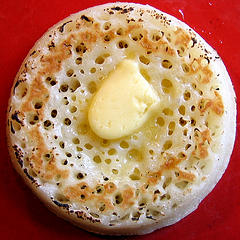
the front sandwich is on an English muffin
English muffins as bought at the store
(and while I’m at it: the very similar in appearance crumpet )
I am wondering if the McDonald’s Egg McMuffin is what brought the “English muffin” to England? This is the first time that I’ve ever heard of someone in England saying they’ve actually seen the things in England.
[QUOTE=Revenant Threshold]
This is getting complicated.
What I would call an “English muffin” is a sort of bun - if you go to McDonalds and get a McMuffin, the bread part is an English muffin. Just a “muffin” would be a cake-type thing. Which are muffins (if either) over there?
[/QUOTE]
There’s a US-style blueberry muffin right up at the top. Yum, yum!
[QUOTE=ralph124c]
good pizza is not made in italy-whta passes for pizza there consists of a flat crust, with thin tomato sauce and cheese 9with some basil0. Pizza in its N. American varieties (NYC, Chicago, etc.) is not made in Italy.
[/QUOTE]
In the mid-'60s my family lived in Brindisi, southern Italy. (My Dad was in the Air Force.) My Mom said every apartment had a string of sun-dried (or sun-drying) tomatoes hanging outside the kitchen window. When a housewife wanted to make “pizza,” she would pluck four tomatoes off the string, pound them flat into a deep-dish crust, and sprinkle some olive oil on the whole thing. No cheese.