I think it was worth bringing up as slightly more than a nitpick, simply because transgenerational epigenetic inheritance tends to be wildly exaggerated in the media, and people are quite likely to come across stories with headlines about neo-Lamarckism, that “Darwin was wrong” etc. - and might question how that fits into the picture you described.
To summarize: there are some studies in rodents showing limited cases of transgenerational inheritance of epigenetic marks that are initiated as gene regulation induced by environmental stressors. But there is no evidence that this is a significant or widespread phenomenon, and (as noted by Colibri) no evidence that it can last more than a few generations - meaning that it is not a factor in evolution. A few studies claim to “suggest” similar effects in humans, but there are confounding factors that are poorly controlled in these studies. The data so far indicate that it is, at most, a minor sideshow. In my opinion, the Wikipedia article does not present a balanced (skeptical) description of these studies.
And to circle back to Exapno’s point - there is in any case no relevance to mutilation, of course. A knife chopping off your finger is a rather different proposition to epigenetic gene regulation, even though both may fall under the heading of environmental effects in the broadest sense.
Actually some has been found, but no, not at that level.
*Transmissions of information across generations which does not involve traditional inheritance of DNA-sequence alleles is often referred to as soft inheritance [112] or “Lamarckian inheritance.”[113]…n their book An Introduction to Zoology (2013), Joseph Springer and Dennis Holley wrote:
Lamarck and his ideas were ridiculed and discredited. In a strange twist of fate, Lamarck may have the last laugh. Epigenetics, an emerging field of genetics, has shown that Lamarck may have been at least partially correct all along. It seems that reversible and heritable changes can occur without a change in DNA sequence (genotype) and that such changes may be induced spontaneously or in response to environmental factors—Lamarck’s “acquired traits.” Determining which observed phenotypes are genetically inherited and which are environmentally induced remains an important and ongoing part of the study of genetics, developmental biology, and medicine.[123]*
I did say 'some" and “*but not at that level” *.
Epigenetics is indeed interesting, but it has nothing at all to do with a accidentally cut off finger.
Yes, I meant no criticism of your posting this per se, it’s quite relevant. I was just pointing out the typical exaggeration that you find in popular descriptions of these studies - encouraged, of course, by researchers with a vested interest in a “hot” field that has failed to yield much of significance (by which I don’t mean epigenetics in the broader sense, just the transgenerational inheritance part).
The last sentence of the extract that you quoted is also laughable:
When has this not been an important and ongoing part of the study of genetics, developmental biology, and medicine? And 99.99% of the study of genetic vs environmental factors has nothing to do with studying proposed Lamarckian effects, which have not even been demonstrated convincingly in humans.
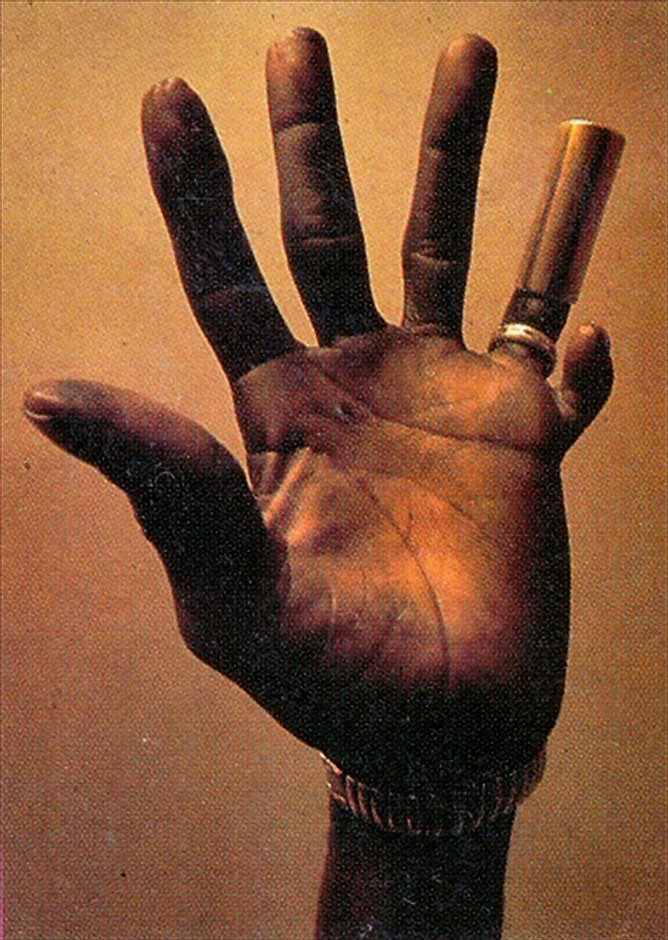
There is something missing in this thread. Perhaps Hound Dog Taylor can compensate for it:
“He was famous among guitar players for having six fingers on both hands, a condition called polydactyly.[5] As is usual with the condition, the extra digits were rudimentary nubbins and could not be moved. One night, while drunk, he cut off the extra digit on his right hand using a straight razor.”
Actually, not quite. Lamarkism is often misunderstood, such as that bogus "experiment’ where Weismann (not imho a “scientist”) cut of the tails of mice for generations, to yield no short tailed mice. That is not Lamarkism, and that “experiment” disproved nothing.
The idea behind Lamarkism, and why it isnt so crazy, if that characteristics that creatures strive to have- like a longer neck for giraffes- can be passed on.
"First Law [Use and Disuse]: In every animal which has not passed the limit of its development, a more frequent and continuous use of any organ gradually strengthens, develops and enlarges that organ, and gives it a power proportional to the length of time it has been so used; while the permanent disuse of any organ imperceptibly weakens and deteriorates it, and progressively diminishes its functional capacity, until it finally disappears.
Second Law [Soft Inheritance]: All the acquisitions or losses wrought by nature on individuals, through the influence of the environment in which their race has long been placed, and hence through the influence of the predominant use or permanent disuse of any organ; all these are preserved by reproduction to the new individuals which arise, provided that the acquired modifications are common to both sexes, or at least to the individuals which produce the young.[23]
In essence, a change in the environment brings about change in “needs” (besoins), resulting in change in behavior, bringing change in organ usage and development, bringing change in form over time—and thus the gradual transmutation of the species. "
Note that true Lamarkism, if read carefully, actually sounds quite a bit like Darwinism, and indeed Darwin himself had a semi-lamarkism idea called " pangenesis".
Mind you, it is still wrong, but Larmark was closer than most folk give him credit.
That what people refer to today as Lamarckism wasn’t exactly what Lamarck originally said is of as little import as what people refer to today as Marxism wasn’t what Marx originally said. Words change meaning all the time.
The modern definition of Lamarckism depends upon inheritance of acquired characteristics. As it says in exactly that Wikipedia page you quoted without giving a reference. It’s the use of it any other way that must be carefully qualified to allow the reader to understand that it is a technical and non-standard usage.
You have to understand that while Darwin correctly described the process of natural selection, he had no idea what the actual mechanics of it were. While Mendel published his work in 1865, it was not widely known. So Darwin could only speculate on what caused the incremental inheritable changes that evolution was based on.
That’s what some people say about every change in language. But there was never a Golden Age when language was pure and every usage crystal clear in direct succession from its origination.
Yes, but I didn’t memorize it. I had to go look up the quote to see where it came from in context. It’s helpful for everybody to always give a link to quoted material or at least give a reference back to an earlier cite that reveals the origin. It bugs me whenever somebody doesn’t do this, and I think for good reason.
Lamark’s reputation as a scientist has taken a bad rap. Although the hypothesis identified with his name has been proven wrong, given the state of available information at the time it was not ridiculous. As noted, Darwin’s ideas on the actual mechanism of inheritance were also wrong.
Agreed. When Lamarck put forth his theory in the early nineteenth century, it was as sensible as any other idea based on what was known at the time. (Although there was counter-evidence like the foreskin example.)
But in the early twentieth century, when Lysenko put forth similar ideas, it should have been dismissed as nonsense. Between the time of the two men, Mendel’s work had shown how genes worked and disproven the theory of acquired inheritable traits.