I wonder if the Wermacht and Red Army bestowed any medals on each other, and if that might qualify. Were any medals en-route when Operation Barbarossa commenced?
~Max
I wonder if the Wermacht and Red Army bestowed any medals on each other, and if that might qualify. Were any medals en-route when Operation Barbarossa commenced?
~Max
Crown Prince Jean Bernadotte (future Charles XIV John, King of Sweden and Norway) apparently received an 1813 Grand Cross of the Iron Cross from Prussia, on account of his role in the Sixth Coalition. This is despite his previous service as one of the Marshals of the French Empire, including a campaign against Prussia in 1806.
~Max
And the British have honored at least one traitor to Great Britain.
Not quite a medal but the leader of the Turkish defenders at Gallipoli in the Great War was Mustafa Kemal Ataturk, who became leader of the post-Ottoman state.
His enemies erected a memorial to him on Anzac Parade in Canberra, which is otherwise lined with Australian military memorials.
Again, not a medal, but a story that might be of interest in this context is that of SMS Emden. It was a German light cruiser which, during the early months of WWI, was operating single-handedly in East Asia and captured or destroyed a number of Allied merchant and warships there. It was finally defeated by an Australian ship and its crew taken prisoners of war, following the British press published glowing eulogies in praise of the captain commanding the Emden, Karl von Müller, for his gallantry.
That’s a fascinating story and a well researched article, but I have one nitpick: the river near Aachen which saw the battle in the Hürtgen forest is not the river Ruhr, but the smaller river Rur. It’s an understandable error, as the river Ruhr is one of the most important rivers in Germany, and the industrial center region Ruhrgebiet (Ruhr area) is named after it, while the Rur is a smaller, rather unimportant river that’s mostly only known because of that bitter battle in WWII.
Along very similar lines, there was also Juan Pujol García.
García first offered to spy for the British, who were basically like “uh, thanks, but no thanks.” Undeterred, García then approached the Germans, with the intention of feeding them as much misinformation as possible. Eventually the British caught wind of what he was doing, and began to work with him so that his intentional misinformation wouldn’t accidentally lead the Germans to real targets. García created numerous fake sub-agents, all of whom were on Germany’s payroll.
At the end of the war, Britain awarded García was made a Member of the Order of the British Empire, and was also awarded the Iron Cross by Germany. Germany even gave him a pension, which he collected for a few years. In 1949, he faked his own death, fearing that the Germans might eventually learn that they were deceived, and might hunt him down and kill him.
Thanks for the answers everyone, some very interesting information!
Closest you’ll probably find is the Battle of Camaron during the French occupation of Mexico where a greatly outnumbered group of French Foreign Legion soldiers fought so hard they were honored after the battle and to this day during ceremonies about the battle in Mexico, Mexican soldiers are required to salute a French Foreign Legion soldier as a mark of respect.
Those remnants were originally established by local governments and states, not “the US”.
A better example is military facilities named for onetime Confederates.
The Vichy government was well out of power when the Americans foiled the terrorists on the train in 2015.
yeah but its still an obvious answer to the OP though. Its a good bet that some of thousands of American or British troops who were given medals by France, were actually enemy combatants, having fought against France in somewhere like Morocco, Lebanon or Madagascar.
That’s assuming the Vichy government was the legitimate government of France, and not a usurper of the 3rd Republic, as de Gaulle argued. He would probably say that British and Americans who fought against Vichy were on the side of the legitimate government of France, the Free French of the 3rd Republic.
A European colleague said today that I should be more animated by the death of Elizabeth R because my parents were born in British India, subjects of the Queen’s father.
I asked if he was similarly attached to the current Russian or German governments, whose predecessors controlled the countries his parents were born in at the time (during WWII).
I mean he would claim that but it doesn’t make it so. Unlike some other occupied countries, the overwhelming majority of the French civilian and military leadership stayed in France. De Gaulle himself was a minor figure prior to the battle of France.
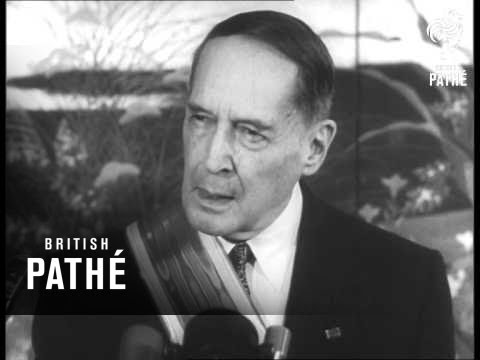
Douglas MacArthur was awarded Japan’s Order of the Rising Sun.
Granted, it was after the war ended. Still, it is because of the war - and the subsequent occupation - that he received it, so it’s likely as close as any we’re gonna find.
In a similar vein, Israel bestowed the honour of Righteous Among the Nations to Anton Schmid, a Viennese soldier in the Nazi German army who saved hundreds of Jews. The title was also given to several German officers who served in World War II (Heinz Drossel, Karl Plagge, Albert Battel, and Wilhelm Hosenfeld).
Not universally and not after the German occupation of the Vichy zone.
Awards from de Gaulle’s Provisional Government could hardly have been considered as coming from the Vichy regime.
Not Enemy Combatants per se, but there are many benevolent westerners, that joined India in their fight against the British for independence. Some of the prominent ones are :
Annie Besant - A remarkable atheist English lady whose contributions to India are many and India remains grateful to her. Annie Besant - Wikipedia
Samuel Evans Stokes : A quaker from Phili, came to India - taught Indians how to grow apples (He was the Johnny Appleseed of India), worked with the poor folks and helped India in its independence movement. How a Quaker missionary from Philly became India's Johnny Appleseed - CSMonitor.com
Benjamin Guy Horniman : An Englishman that also played a great part in India’s freedom struggle. B. G. Horniman - Wikipedia
Another peripheral example: In 1938 Charles Lindbergh was awarded the Service Order of the German Eagle by Goering, undoubtedly in recognition of Lindbergh’s stance in favor of isolationism and effusive praise of Germany’s war machine.
Lindbergh was subsequently urged to return the medal but to my knowledge never did, even after the U.S. entered WWII.*
*as a counterexample, air personnel preparing bombs for the Doolittle Raid on Japan attached medals awarded by Japan before the war to members of the American military, along with helpful comments like “You’ll get a BANG out of this”.