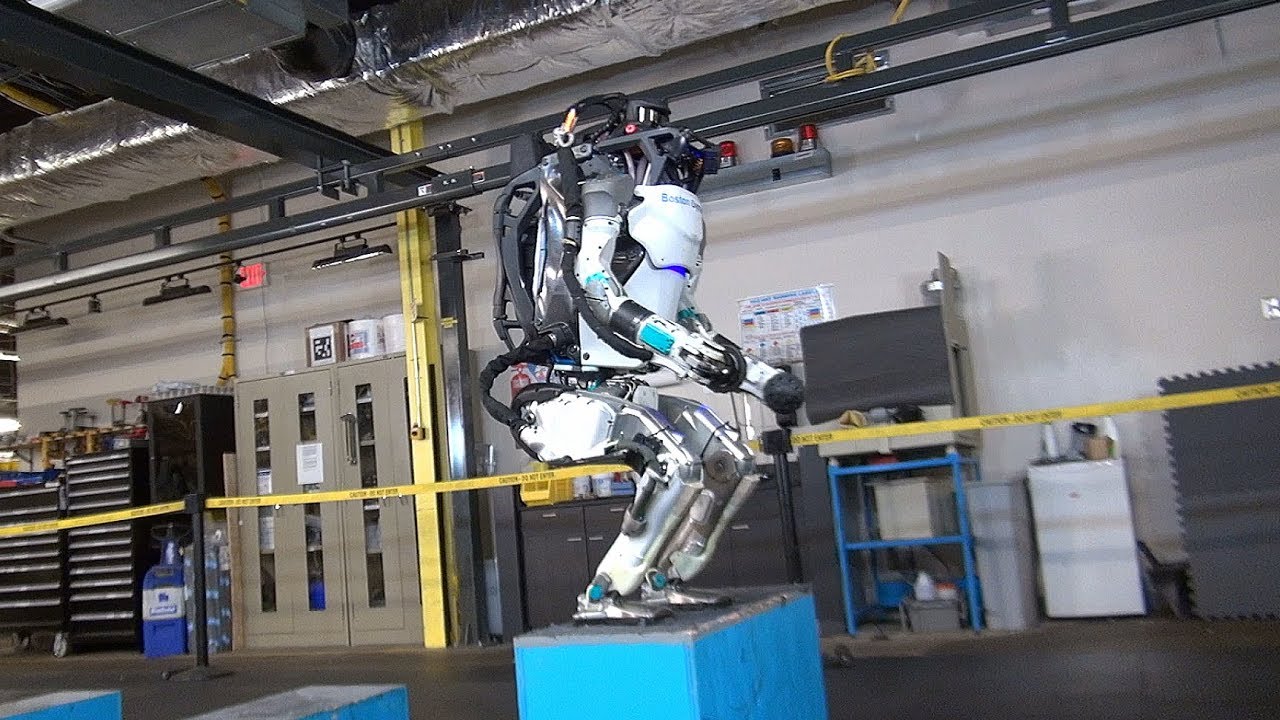
I’m a Computer Science person so I’ve seen incredible progress in Computing for several decades. Just mind blowing stuff.
E.g., I remember being the outside member on PhD student’s AI dissertation proposals where they were basically saying they were going to solve Natural Language. They all went nowhere, of course. That went on for a long time. It looked like a dead end.
But in the last few years there’s all these talking/listening gizmos around that are basically spectacular. And getting better all the time.
What’s going to happen in AI in the next 20 years will be astonishing beyond belief.
So, nowhere close to hitting a wall in terms of Computing.
I’m more worried about the wall hitting us. With climate change being the biggest, baddest, nastiest wall coming our way.
Hell, consider how they brought Peter Cushing as Tarkin back from the dead for his appearances. Sure, it was a brief cameo, but that’s just because it was literally resurrecting the man. I think we might be seeing either the last, or the next-to-last generation of actual human actors, because it won’t take too long before it’s cheaper to CGI up an actor. Plus, they never quit, they never die, they never go on strike or don’t do what they’re told, and they don’t negotiate for bigger paychecks.
I have actually been wondering if the contracts for actors in a lot of recent movies are including clauses where the producers are explicitly authorized to use CGI to make them reappear in future sequels, in case something causes them to become unavailable.
Prices have declined dramatically too, but they’re still higher than animal meat. It was ~$350,000 (I’ve seen figured from 300-375k) for a lab grown burger in 2013 but some companies are hoping to have the price down to $2-5 or so by 2021.
Depends on which wall you are talking about? For AI, there has been hundreds of thousands of times worth of speedup in the last 7 years. This won’t last now that specialized TPUs are starting to be made with the best available semiconductor processes, but AI is a distributed computing problem. Neural networks can be evaluated using massively parallel systems, most algorithms used in present day AI research are of the “embarrassingly parallel” class.
Due to this, through parallelism, and probably multi-layered chips, we can keep scaling the hardware up to as far as it needs to go. Probably an integrated artificial brain that is functionally as capable as a human being in almost all areas, even if the implementation of the cognitive algorithms is different is achievable, albeit it will take years, maybe decades to build one.
Well, wrt cancer, in 2011 my wife was cured of a cancer she discovered several months earlier; in the 1980s (which isn’t that long ago to this 60 year old) it would’ve been terminal.
And wrt space travel, I think the moon landings were a spectacular anomoly that resulted from the cold war. I believe that moon landings would have occurred eventually, but not necessarily in any sort of rush; ditto Mars.
The last decade has seen giant strides in identifying and solving human (and animal) problems via looking at DNA, I am participating in one such study looking at epilepsy for instance. The day is coming where a blood test will both diagnose the specific condition and suggest the best treatment. There are downsides of course, but hopefully employers/insurance companies will never be allowed to routinely screen everyone and discriminate on the basis of the results.
Many people in the 20th century lived their entire life using the same basic telephone.
I can remember watching the original Star Trek thinking it was way beyond our technology to have a computer device I could talk to and it would give me an answer. Imagine an encyclopedia I could talk to that continuously grew it’s knowledge base and could actually talk to me. It’s a barking mad idea. It would be a massive devise.
I carry that in my pocket now. I can navigate anywhere in the world using my “phone”. it provides me a continuously updated mapping system that can tell me if there are traffic issues ahead in real time.
I can place the same device in an airplane where it will replicate all the gauges with precision because it has GPS and accelerometers in it. It will navigate me to within a few feet of every runway on the planet. It can show me the current weather downloaded from satellites and overlay it on a moving map of my route. It can show me where all the other airplanes are on the same map. It can file and activate a flight plan. It provides all the airport data of every airport as well as approach plates and an active taxi display of those airports.
It would be pointless to describe a device that has infinite uses but I gave one example in aviation. My phone can replicate hundreds of thousands of dollars of equipment found in a commercial airliners.
Another example, positron emission tomography (PET) scans helped revolutionize therapy for trauma victims. Psychology really didn’t understand the physical changes in a brain which were the result of trauma in childhood, and consequently the therapies often were not effective.
A number of pioneers in the field developed better changes, but they have only recently become more mainstream. One of the reasons is that the PET scans can actually demonstrate the changes which have occurred.
Which, if true — okay, fine, 94% versus 85%, that’s just great. Like, if this were a story about a schoolteacher who, hey, attention to detail, majored in literature, terrific at reflexively analyzing noun-and-verb rules — if she outscored a bunch of experienced attorneys in that contest, then we’d nod appreciatively and make a couple of quips about paychecks and have a good chuckle, right?
While there is no cure for HIV yet, current anti-retroviral medicines are about as close as you can get to a cure. HIV-positive people on modern meds can not only live a more or less normal life, but once their viral load reaches undetectable levels, they can’t pass HIV on to anyone else. Besides that, we have PEP (taken within 72 hours of possible exposure to HIV, it prevents the virus from taking hold, kind of like the morning after pill) and even PrEP (the closest thing to a vaccine but in pill-form, take it regularly while HIV negative and it prevents you from contracting HIV if you were to become exposed to it). That’s a far cry from the highly contagious death sentence that HIV used to be!
in 2003 at a cost of 3 billion dollars the human genome was sequenced for the very first time. At that point in 2003 we have the complete text of the human dictionary written in a language we didn’t understand but are now beginning to translate. Now 16 years later, anyone can get a pretty good idea of their ancestry and genomic landscape for a couple of hundred bucks, and a complete sequencing for a few thousand. Starting from scratch a new species can be sequenced for about $30,000.
Then in 2015 CAS5 CRSPR technology was discovered. Now not only can we read the dictionary we can edit it as well. Genetically modified products are all over the supermarket. And the first genetically altered human babies have been born.
The industrial revolution has run its course and the silicon revolution may be slowing down, but we are just on the eve of the biological revolution.
Bump for a news item out this week: a bank has “been testing and using Watson for a year, but is only going public about it on Thursday … a virtual banker it calls Reggie. It speaks directly with customers about simple matters, such as updating an address or ordering a new card … Twenty-two percent of the time, calls are completely handled (or “fully contained” in the industry parlance) by Reggie.”
How long before it’s handling conversations like that maybe 50 percent of the time? And then 90 percent? And then — what?
I’m with those who have claimed that AI is on the verge of a massive breakthrough. On the other hand, artificial intelligence has to be counter-balanced with growing natural stupidity. I refer to the growing anti-vax and anti-GMO movements.
It would not surprise me if there were a cure for AIDS in the next 5-10 years.
Self-driving cars will be big (and new AI learning algorithms will play a big part).
On the other hand, I foresee a hiatus in space exploration. The radiation problem in space appears insuperable. And interstellar travel simply comes up against physical reality.