Yes, I’m not an athlete in any sense of the word. I want to burn calories and improve cardiovascular health. My instinct is to go hard for 20-30 minutes. I have no idea why I think that. Perhaps I’d be better off with moderate effort (zone 3) for 45 minutes? I’ll try that today.
My take, FWIW, is that hard effort, often short, is good, but no closer than every other day, maybe even less. The rest of the time, more of the volume, shouldn’t feel like we are in a race but be relaxed.
Every day pushing it backfires.
This came up in the weightlifting thread: strength training under an hour a week appears to maximize the benefits for longevity. Get to two and, according to a recent meta analysis anyway, you may as well have done none. More may even go negative. Recovery time really is important.
Keeping alternate days disciplined as easy allows for hard days to be effective. Easy psychologically feels like it will do less, harder more should be better, but it really seems otherwise.
Bumping this thread as my trusty old Citizen eco solar watch (tells the time and does it well) is potentially finally crapping out on me after many years of reliable service. (It still works but changing time zone or leaping forward springing forward is dodgy now.) Same time my heart rate monitor is not always turning on right. So now may be a time to get a smartwatch that serves a heart rate monitor function.
Fitness focus watches, Apple, and many other brands now pretty much all do heart rate, distance, pace, and so much more.
Users of these devices: how useful do you find the various so much more options?
I appreciate the health importance of heart rate variability for example but is the way it is used by some of these watches to inform you of your energy and stress level helpful to you? Or do you pretty much already know that you’re stressed and/or tired? I’m doing a marathon in seven weeks but my triathlon days are long past. Even then I never bothered with worrying about cycle power zones and was only concerned about not drowning during the swim … I don’t think I need a pulse ox reading or the ability to do a two lead EKG. Nice to have GPS and plenty of music without taking my phone and of course to see my current pace and HR on my wrist. I could see the convenience of my texts showing on my wrist. -
So how do you all use all the available metrics or do you mostly ignore it? What features have surprised you as useful? Besides pace distance and heart rate what do you now consider must have or at least highly valued features?
I’m thinking of getting a Garmin Forerunner 165 Music. Any advice or feedback?
I don’t have a smart watch. For many years I’ve used a Polar HR strap monitor. I’m on my second as the first did crap out after many years. It feeds into Strava or my bike computer.
I don’t know that I have to have this data as I am also not training for a triathlon or any event like that, but I do like having that data and tracking my health. I also use it for interval training to make sure I’m hitting where I want to be. But as you said, I’ve been doing this for long enough that I don’t have to rely on the monitor.
I could probably do away with the monitor and still get the same exercise but I’m a bit data OCD. I have spreadsheets to track the most mundane of shit that causes my wife to say out loud, WTF? 
Instead of a smart watch with HRM functions, I opted for an HRM watch with some smart functions. What’s the difference? Battery life, mostly. Watches that are HRMs typically last for days on a single charge, (my Garmin will go 5, my wife’s will go 2 weeks) but smart watches may not even make it through a full day.
I use mine for excercise/stretch reminders, daily step tracking, and notifying me of calls, texts, and appointments. I get too much email and fb spam to connect it to those, but it’s possible.
And do you use any of its other fitness metric functions?
(Agree on the battery charge thought. And the lack of interest in having it also ding me on emails.)
I turned off sleep tracking. When I work out, I have it capture distance and heart rate. But I don’t go nuts in the fitness stuff, it’s just not my jam.
Going all the way back to the original post. Take a look at the Fitbit watches.
The associated app will show you your heart rate by zone for the exercises that you do. It also lets you program your individual zone numbers but it’s up to you to come up with them.
I find that the pulse graph that it gives me during activities is fairly accurate although it shows lots and lots of peaks and valleys.
Overall, for its price I’m fairly satisfied. BUT Google bought Fitbit and I get periodic notices that I must (eventually) change my account from Fitbit to Google. What features will remain or be removed remains to be seen.
I like the sleep tracking part of the app but very rarely use it as wearing the watch while I’m sleeping is physically uncomfortable for me.
I now have the Forerunner 165 and have done two runs with it.
Anyone take advantage of the running performance metrics and find they were able to improve their running mechanics by paying attention to the numbers? It’s a lot of information…
If my phone and the watch are telling me different distances (and therefore paces), which should I trust? (My bias is to assume the shorter distance and slower pace …)
Congrats!
I don’t. Some of it I consider useless because of physics & physiology. I have long legs; therefore, I have a long stride. Because I am covering so much ground with each step I will do less steps than someone who is shorter & has a shorter stride even though we’re running side-by-side.
Nope. You need three devices (run with a friend) or a known-distance. I’ve seen the professional testers have each of multiple devices go wonky at different points of a single run/ride; especially when there is high-rise buildings, tunnels, &/or tree cover blocking satellite signal. I myself have ‘done’ Kool-Aid man workouts will on a machine right next to the window in the gym (so I should have good view of GPS satellites); I know I was on the machine the entirety of my workout & didn’t move any material distance forward/backward/left/right, yet when I look at my track I went thru the window…multiple times & even busted thru the cinder block wall to the business next door, again, multiple times. 
Completely agree with the impact of build on cadence. Not surprising that your long legs have a lower cadence than my short ones.
What about the bits that are more height independent though? Vertical ratio (vertical oscillation divided by stride length) should be height independent? Not sure about ground contact time?
Ran again today, different route, not near tall buildings or lots of forest, alone again, and again the two tools (watch and iPhone based) gave distances off from each other by nearly 5%. The iPhone based one each time claiming farther and faster than the Garmin.
Was my 20 mile run by the iPhone based app actually 19?
All the extra data is maybe nice but trustable distance and pace information is part of the main point of these things. 
My issue with my Fitbit is that it can be grossly inaccurate-I can be pumping like a madman on the elliptical, I can feel my carotid pulse going like Secretariat, but the thing will insist I am at c. 110 bpm when the quick-and-dirty 6 second estimate shows it is 150+. I’ve tried it high and low on my wrist, on the inside and outside, all to no avail. Even when working adequately I’ve found that it lags my actual pulse by 5-30 seconds.
If I’m more of a heel striker & roll my foot more than someone you who is more of a midfoot/ball of foot striker than, again, yes, I’ll have more ground contact time than you. You might be able to change it but it’s very hard to make changes to your mechanics, whether stride or swing w/o coaching or at least video of what you’re doing right/wrong. I tend to ignore some of the metrics they provide as not really easily actionable.
Try running a known distance; do you have a marked rail trail nearby, or even a HS track? Garmin has a track mode; does that model have it? If so, use that. See which one is closer to the known distance that you’re running.
The other thing is are your two devices physically separated? Are you holding your phone in the hand that the watch is on the same wrist (so they’re only a couple of inches apart) or is it on the opposite side of your body? There are some known issues with multiple devices too close together.
HR lags a bit. I’ve seen my HR go up after I’ve finished an interval & am not working as hard as I was a few seconds earlier
Phone is in waist strap pocket.
I’m believing the Garmin.
One it is set to “all systems” using multiple satellites which increases accuracy in difficult environments. (There are three options, that’s the most precise but most battery use. It is also the default.)
Two zooming in on the maps my phone based route has some extra zigs into houses and across streets. The phone based one has the exact path I know I ran. Those little extra zigs added up I guess.
I may do a track run to experiment anyway.
I use MapyMyRun to map the distance accurately. For some reason even though they have GPS, many watches use a stride-based measurement to give you progress during the run, and I found my Fitbit and two Garmins to be “off” when measuring that way (typically it tells me I have completed each mile earlier than is true, and by increasing amounts). What I believe to be true is that I am a 5’11" guy with 32 inch inseam, so it is calculating my stride length wrong. Set a manual one or do what I did and reduce your height in your profile to match the average for someone with a 32 inch inseam.
My wife’s watch gets her distance pretty spot on, which is annoying to me.
Why do you consider MapMyRun to be accurate over the others? I’ve reviews that claim it is significantly less accurate than others FWIW.
I can’t speak to other fitness watches but Garmin definitely does not use stride to determine distance.
Too late to add: on timed runs. I think it does use stride length for daily step count.
I found it. The entirety of the building is the upper white box, with 4 rows of cardio machines, one behind the next, mostly treadmills + walking aisles between & a stretching area in front of them from upper left to bottom right; which makes the building ±40’ to give you scale.
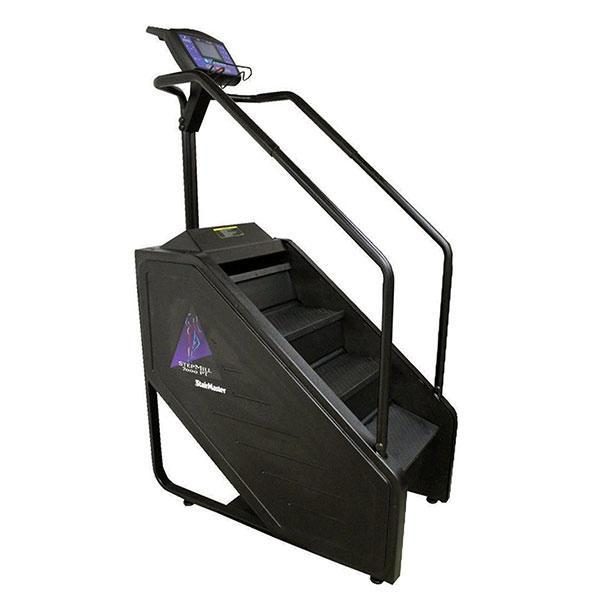
I was working out on a Stairmaster 7000 (so basically stationary) in the bottom corner of the building (where the arrow is) yet, according to my watch’s track, I started outside & finished in the next store. Yet, according to my Garmin track, I went thru the window to my left a couple of times on my way to aimlessly wander thru a small part of the parking lot, as well as bust thru two cinderblock walls behind me as the gym & the store next door are not connected.
Out of curiosity what is your “satellites” setting for that? (There are three options.)
Doubling back to the running mechanics metrics … I’m more sure you are right to be dismissive of them now. Looking over my metrics over several runs the watch is telling me that my VO2max is great and my mechanics wonderful with amazing cadence and better than average vertical ratio and ground contact time. So why then am I so damn slow? 