We arrived at the races today. The crash happened right in front of our seats, but we had decided to skip today’s trials and go tomorrow morning. The races are canceled for the year.
From the images I’ve seen of the plane just before impact, it appears that it lost the trim tab on the elevator, rendering the plane uncontrollable. It pitched up violently then rolled over and dove into the ground. The pilot never had a chance.
My educated guess is that the plane suffered a catastrophic failure due to control surface flutter at high speed. The plane had just come out of a long modification program to improve performance, and flutter is a serious risk at the speeds these airplanes are going.
it does look like the trim tab broke off the elevator which by itself wouldn’t negate total control of the plane but it probably jammed the elevator itself. Eye witnesses said the plane was going straight into the stands and veered at the last moment so he probably knife edged it with the rudder and ailerons and saved a lot of people.
I’m glad it missed you, Sam. Do you have links to the specific images?
Your link isn’t working for me. All I get is a Google search page.
I’ve said it’s too early to guess the cause of the crash, and we amateurs don’t have much evidence to look at. But I’m curious about the trim tab theory.
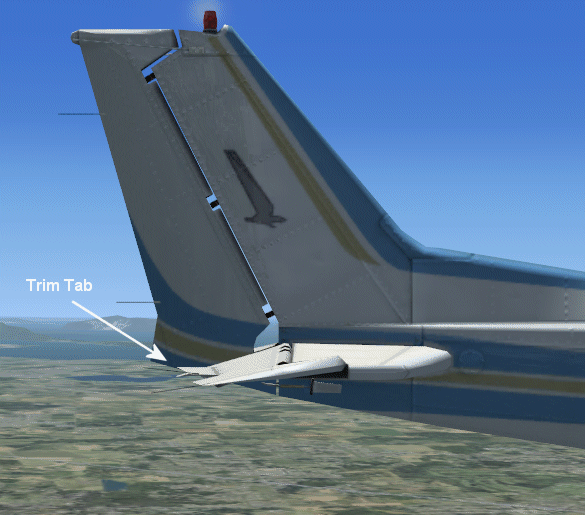
Here is a trim tab on a Skyhawk. (The little triangular bit at the bottom of the rudder is also a trim tab. It’s ‘ground adjustable’, meaning ones bend it by hand before flying. I’ve never seen anyone do that.) The purpose of a trim tab is to relieve aerodynamic forces on a control surface. In the linked image, the Cessna is trimmed nose down. The trim tab is up, which puts downward pressure on the elevator. The idea is that the pilot trims the aircraft so that pressure on the control yoke (or stick, in the case of a P-51) is neutral.
Since the trim tab is on the trailing edge of the elevator, I don’t see how losing it would jam the controls. Depending on the setting, control forces could be very heavy. This could be a serious issue at low altitude and high speed, but it shouldn’t cause a total loss of control.
Airplanes have a never-exceed speed (V[sub]NE[/sub]) beyond which flutter is a possibility. I wonder if losing the trim tab is not the cause of the crash, but rather a symptom? If the aircraft was operating beyond design limits, and especially if there had been modifications (I’ve heard some aircraft are susceptible to flutter even if the control surface is improperly painted), then what people might have seen was the break-up caused by flutter.
I’ve only seen a shaky video – once – taken from a distance, and I couldn’t see what happened. The flutter theory is a possibility though.
The link works for me. I’ll look for others. It clearly shows the trim tab ripped off. It’s consistent with eye witness accounts that the plane shuddered, pulled up and rolled over/down. Sounds like the plane went full-up elevator. This would have pulled a lot of G’s. But since it rolled over that was most likely pilot input. Turning the plane is the only way to stop it from flying into a stall. His only shot at survival was to get it stabilized in a hard turn and then to pull power until he could get it into a controlled descent. Since it was an air race the plane would have been running flat out and things would have happened fast.
OK, that’s definitely the trim tab. It shouldn’t cause a crash, though. I still wonder if it is a symptom. (Not ruling out a broken trim tab as a cause, of course.)
The trim tab would have linkage attached to it inside the elevator and horizontal stabilizer. If it breaks off then it could jam the elevator in any position. The plane was seen to shudder so either it went full elevator and forced the plane up or pilot naturally pulled up because of the shudder and it locked in that position. Either way, he would have had to roll it to keep from climbing into a stall. At 450 mph it would have happened very quickly.
It’s possible it could have caused a jam. It just doesn’t seem likely to me. How about this scenario? The pilot had full-down trim cranked in, either because of the requirements of the operation or because he preferred it that way for the kind of flying he was doing. When the trim tab failed there would be sudden, strong up-elevator resulting in a climb.
(NB: My explanation of what a trim tab does, and a picture of one, was not directed at you, Magiver. There are enough non-aviation Dopers though, that I thought it would be helpful.)
There is no practical way to fly full up or down trim. It would make the plane really hard to control. The point of a trim tab is to reduce the workload. Having the controls jam elevator up is an extremely difficult situation to deal with. It’s taken down commercial airplanes in that situation. You’d think a trim system that works the whole tail plane would be immune to this but I know of at least one DC-8 that went down because of it. The jack-screw assembly failed.
I agree that there is no practical way to fly with full trim (though I’ve learned that full-up trim in a Skyhawk is just about perfect for establishing glide speed in an engine failure). IANA race pilot. I’ve never flown a Mustang. The crash airplane was highly modified. I can imagine situations were a pilot might want to add control forces instead of negating them. For example, if I was crop dusting I might want up-trim so that all I’d have to do is reduce stick pressure to climb. That might get me out of a sudden situation, at the expense of a higher workload. (IANA cropduster, either.) I’m just thinking that in unusual flight regimes, some pilots might do things differently than when they are making a cross-country trip.
Question about the jack screws: Were those failures of trim, or failures of the elevator jack screws?
I’m guessing the ‘G’ loads pulled the pilot down out of sight from the angle ofthe picture.
Losing a trim tab in an airplane like this is a big deal. ‘Voodoo Chile’, another race plane, lost a trim tab a few years ago. The result was a 10-G pull-uo that caused the pilot to lose conciousness. He was lucky - the plane stabilized into a climb and he regained consciusness at 9,000 ft and managed to land safely.
In this case, if the piot was attempting to turn away from the crowd when he felt the onset of flutter, the result of a lost trim tab could easily be a violent spiral into the ground.
Being that it’s a fighter plane, I would have figured that the seat would have been placed in such away to allow for maximum visibility out of the cockpit. This is an earlier version of the Mustang, since later editions had a “bubble” canopy
I guess I’m wondering why the loss of a trim tab would have such a drastic effect.
I would bet that the accident aircraft was a D-model or an F-51H rather than an earlier model. Racing Mustangs tend to be highly modified to make them more slippery.
Agree. The turtle-decked Mustangs were sold to the English with less powerful Allison Engines, and they were not very numerous. These didn’t carry the P-51 designation at the time, though it often gets thrown on in the histories.