I see an accident like that and one of the things I think about is… how do you clean up a mess like that?
However gruesome some of these accidents may appear, at least some of them must be so fast that the victim may never know what’s happening to him, or only for a fleeting moment.
Getting pulled into a wood chipper, awful though it may look, seems very quick. Getting sucked into a jet engine, if one goes all the way through must be very quick. One moment you’re a healthy live being, an instant later you’re nothing but a puddle of blood, protoplasm, and bone meal.
Airplane crashes (the kind with hundreds of passengers) are spectacular. And so gruesome, because of the big fireball. But the victims probably die on impact faster than a nerve impulse can travel from one synapse to the next, so they probably never felt a thing.
Soviet cosmonaut-in-training Valentin Bondarenko got trapped in a capsule simulator fire that took 30 minutes to get him out of. He had 3rd degree burns over most of his body, but lived for another 8 hours before he died. The story is told here:
http://www.jamesoberg.com/usd10.html
but the page won’t open – the link may be defunct.
The Bhopal disaster released a cloud of methyl isocyanate gas in the middle of the night that killed 2200+ immediately and an estimated 8000 more within two weeks, and estimated 3900 others left permanently maimed.
A past coworker who happened to be an Air Force Crew Chief at his previous job told me a story of how he was working on a transport aircraft on the tarmac at an Air Force Base when an F-16 which had just taken off proceeded to lose all power and belly flop into the runway immediately bursting into flames. It was too low when it lost power for the ejector to work (apparently you have a minimum altitude to eject?) so he ran towards the plane to save the pilot but as he ran towards it the full load of fuel still in the aircraft went up and exploded. He shielded himself from the heat wave as he was still about 50 yards or so away from it but he said something round the size of a basketball flew away from the wreck and started bouncing towards him on the tarmac and the only thing he could think of was to kick it away from him as it reached him, only to realize as it rolled away from him that it was the pilots helmet with presumably the head still attached in there.
Story really kept me up at night for a few weeks after hearing it.
It’s wealth. Workplace safety’s expensive. Just as the USA didn’t have as much workplace safety 100 years ago, poor countries don’t have as much now, and rich people need to be forced to do the decent thing though the exhaustive process of social change and democratization.
Workers will always work on machines without guards if they’re told to. It can be hard to get them to wear basic PPE even if they ARE told to.
I know someone whose first husband died after getting caught in a veneering machine. He died in the hospital.
Oh, the ejector will work just fine even at ground level - you need the altitude for the parachute to open so the sudden stop at the end of the ride doesn’t kill you.
My morbid fascination veers to accidental falls from heights and wild animal encounters. But the wood chipper accidents are nightmarish and surreal. I have deep sympathy for the victims families of any horrible accidents. A few years ago a young woman was accidentally killed in a dumbwaoter accident in a Wisconsin banquet hall. The violent aftermath of the mishap was witnessed by her coworkers who will probably carry those visual scars for life. Such a preventable loss must be excruciating to comprehend for their loved ones.
As a college kid I attended the aftermath of a suicide by railroad train. Which body was located for us by a pack of semi-feral dogs. The memories … linger.
I’ve been in foundries and they’re terrifying. There are so many ways to get killed there. Sharp objects, high voltage, falling off of things, falling into things, things falling on you, molten metal dangers, cryogenic hazards, constant sparks.
I’ve seen other vids where a smelting furnace burps its load which leaves half a foot of solid steel on the floor.
Nothing beats Liquid Oxygen safety videos, I swear. There is one made by the military that just defies description: “The Man From LOX”
INFAMOUS LIQUID OXYGEN HANDLING SCARE FILM “THE MAN FROM LOX” 81844 - YouTube
Sorry if I missed it upthread and it’s not workplace but…guy and his truck fall 70 feet and survive.
My great grandfather died in a “mining accident.” He was killed by a pick ax in 1912 in southern Ohio. I never heard any details, but there seemed to be something fishy about it. I could never get anyone to admit to knowing anything. He was 61 which was probably an old 61.
Was he involved in any union activities? I think was around the time of coal miner strikes.
The ACES II ejection seat used on the F-16 and numerous other aircraft is a zero-zero ejection seat: you can eject from a parked aircraft and survive.
Wow. And now it could double as a sexual harassment training film.
Technology marches on…
Nope. He was a Hungarian immigrant and barely spoke English. I think he would have been in jeopardy of being deported, too. The usual immigrant complications.
All valid as far as it goes.
“Zero-zero” means zero airspeed and zero altitude. Which as you say is great for ejecting from a parked airplane.
During the early jet fighter days there were lots of engine failures at high speed during takeoff. The airplane would duly run off the side (or end) of the runway at speed, roll over, and explode. Being able to jump out while careening down the runway was a huge improvement in safety and a morale boost for the pilots. Landing accidents post-touchdown were also common; either brake failure, steering failure, tire failure, or whatever and now your 150mph tricycle is going off-roading with you in it. Being able to eject out of those scenarios is nice.
By my era the ACES-II had many successful zero-zero ejections; we had high confidence it’d deliver us safely to near the ground. The parachute landing might be pretty rough, but it’d be survivable.
But …
Once you get airborne, a third factor gets involved: rate of descent. It’s certainly possible to be descending (or falling) steeply & quickly and be unable to eject safely even from a few hundred feet. Your downward momentum won’t be fully arrested before the ground arrives.
Said another way, the zero-zero guarantee is predicated on zero rate of descent.
For something like @Asuka was talking about immediately post-takeoff, the issue is unlikely to be sink rate.
More likely it was a problem with decision making, reaction time, a preflight error that left the seat disarmed, or a seat malfunction. Once airborne, or almost airborne, procedure for an engine failure was pull up into a zoom climb, jettison all the external munitions & fuel tanks to improve the zoom (time & kinetic energy permitting), and eject at or just before the apogee. Which apogee may not be much, but every 50 feet improves your landing success rate and increases how far you’ll touch down versus the fireball that had been the jet.
A fine example of almost zero-zero ejection, when a crash-landed Harrier bursts into flame before coming to a full stop on the runway, finally convincing the pilot it’s time to go see the Egress:
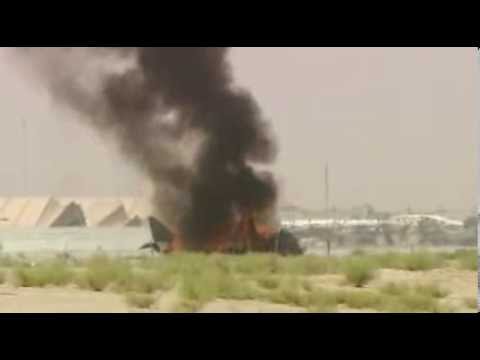
There’s also the 2003 Thunderbird pilot who really tested the limits, bailing out with a very high sink rate roughly one second before impact:

This spectacular view from a drone shows the fall of an old stadium being demolished in Russia. It shows what happens after many steel supports are cut and there are no other support beams to prevent a collapse.
The video does omit the part where a worker making the last cut did not manage to get into the gondola they where using.