You can just use the terms “egg” (or “ovum”) and sperm.
Maybe you could spend some time explaining why you are focusing on this single mechanism as it is a rather obscure mechanism with respect to what seems to be the topic of this thread.
Yes, mutations in genes can alter the proteins that affect the egg/sperm interaction, and the effect can either be positive or negative. Some mutations are also going to have no effect at all. But this isn’t usually the driving or main mechanism which makes two populations incapable of interbreeding.
I’m not going to get into the bigger questions here, but I agree with others that the way you’re thinking about this is flawed in certain respects. Let me see if this will get you thinking more along the right lines. Any mutation that prevents an organism from reproducing, for whatever reason, will be removed from the gene pool within a single generation. Thus, those mutations can be ignored if you’re interested in evolution. That’s 1 and 2.
#3 is poorly worded. I would rephrase it as “give the individual a reproductive advantage”. My mutant super-sperm is able to grab on to the egg and not let go until it drills in. I’m going to have a reproductive advantage. Thus, in x number of generations, my mutation will have spread through the population.
#4 is what we call a neutral mutation. It has no effect on an individual’s fitness.
Now, #5. If we’re talking about changes that ultimately lead to speciation (via the D-M model I discussed above), you need genetic drift. You need to change your proteins very gradually, so that in any generation, the changed version still works just fine, but over thousands of generations, the changes add up. So in #5, I’d put in a neutral mutation that changes the protein’s shape just a little. Over time, that mutation may be lost by random chance, or it may have some other benefit and spread, or whatever. But having some genetic diversity in the gene is a key first step toward ultimately evolving incompatibility.
I should note that the D-M model is far from the only model of speciation. It can happen in lots and lots of ways. The model is just a very simple one, and one that’s been observed in real life, so it’s easy to discuss.
I can see where #3 could spread through a population quickly if they breed through broadcasting sperm, such as sessile molluscs or plants, or for mass maters like chimpanzees, but for most animals there are so many other hurdles to get past before the sperm and egg meet that I think a super-sperm is not an clear evolutionary advantage.
Well, maybe not an obvious HUGE advantage, but if you consider fertilization as a multi-step process, with multiple hurdles to clear, anything that makes one step easier would provide some level of advantage. I guess you’d have to first show that some percentage of possible matings fail at the “sperm gets into the egg” step.
I guess it’s just my anthropocentricism, but my gut feeling is that there are very few times when nature sees competition among sperm from different males racing for one egg. It seems the winner is usually decided before intromission.
I’ve read that the number of sperm cells produced by males is an indicator of the sexual exclusivity of the females - a species whose females have sex with multiple partners will evolve to have males that produce more sperm. And humans are high on that list.
They may be few, but they are significant. Grey whales are an example of a species wherein sperm competition, rather than male posturing, determines who the victor is in mating.
Some lizards and fruit flies do it as well, to pick examples off the top of my head. A girl I know is doing a study to determine how female lizards select sperm to father their eggs. They can hold sperm from several different males at once, and data indicates that the choice of which one gets to actually fertilize the egg is nonrandom.
If that is true it is only very, very poorly correlated.
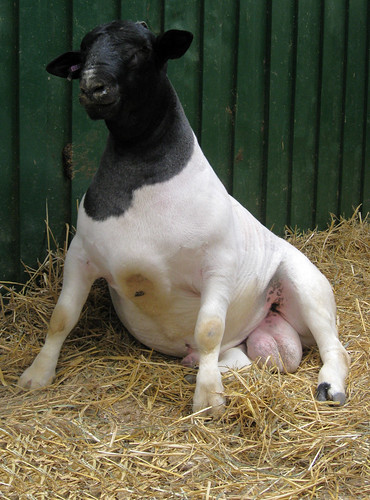
Large testicles are found amongst temporary harem species wherein the females are almost entirely exclusive. Sheep for example, are only about half the size of a human, or in the size range of a large dog, but theirtesticles are easily 4 times the size of either.
This large size has nothing to do with exclusivity. It has to do with the fact that all the females come into season in a very short span, and a ram can only maintain his harem for for a short period of time before becoming exhausted. So a ram has to mate with as many females as possible as fast as possible. That may be 10 or more a day for days on end. For that sort of performance, large testicles are needed.
In contrast, in species where the females have a staggered mating period, such as baboons or pigs, the testicles are usually much smaller, despite both baboon and pig females being highly promiscuous.
The picture is also complicated by simple aggression. In species where males fight over females, body size and weaponry is more important than testicle size, so dogs or pigs have small testicles despite female promiscuity because fighting to retain females at optimal fertility is much more important than any potential sperm competition after the peak fertility period. In contrast amongst the cetaceans there is no male aggression and testicle size is huge.
While there may be a correlation between female promiscuity and testicle size, it will be weak because there are so many other factors at play.