(my bolding in quote)
You mean, eating them ***for ***lunch.
(my bolding in quote)
You mean, eating them ***for ***lunch.
That would be Neil Shubin, actually (different University of Chicago guy  ).
).
Many of the problems we see with Windows come from its origin as an OS for computers who got networked through low speed modems or the exchange of floppy disks. Evolving software designs have some of the same issues as evolving organism designs.
Wings have evolved (or been designed) several times. Mostly they look very different from each other. Insects use modified cooling membranes as wings (we think). Pterosaurs and birds use modified arms, with differences in details. Bats use modified hands. There is a large overlap in the size of many bats and birds. There is also significant overlap in lifestyles- most American bats are insectivores as are many birds. Flying foxes eat fruit, as do many birds. The smallest hummingbirds may be close to the size of the largest insects.
I guess that what I’m getting at, is that while I can imagine an intelligent designer pulling out one set of wings to do one job and another for a different job, especially in a different size domain. I get troubles when all the ones with hair, ear ossicles, diaphragms, and mammary glands get stuck with modifies hands; while all the ones with feathers, beaks, and whatever else non-flight-related shared traits get arm-wings (just like those other pterosaur guys, who have a different set of non-flight-related shared traits). This goes beyond re-using successful designs or optimizing design to size/lifestyle domain.
Sure, but even if I can’t shouldn’t God be able to? On one hand it’s easy for you to believe that God created everything out of thin air, that He molded man out of mud and breathed life into him yet scaling up dragonflys is beyond his capabilities? Sorry, color me skeptical.
To be clear, I’m not arguing for a designer here, I am athier than most. But I’ve read semi-serious treatises on why dragons, as depicted and without significant boosts in muscle mass to power ratios over known animals, can’t fly, and I’d be interested in seeing something similar about alternate designs that could fly that weren’t just a cool drawing.
The reason dragons can’t fly isn’t because of their number of limbs; it’s just because of their size. But a bird-sized creature with a draconic body plan (four legs plus wings)? Sure, why not?
I have read something, ages ago, that suggests that the Chinese dragon is more possible - full of air chambers which it fills with hydrogen, which is also how it breathes fire. Silly, yes, but a flight mechanism you don’t see in life on Earth.
It isn’t just power-to-weight ratios that would keep larger animals from flying (though factoring in the amount of energy required to maintain level flight for a given mass and assumed average lift compared to maximal metabolic function would give a good sense of the absolute limits of the size of a flyable creature); there is also the strength requirements of both the cantilevered wing structure and especially the capability of an articulated joint to carry load. As anyone who has handled them can attest, birds have a very low mass for their size, and a considerable portion of the mass is in the wing and the musculature that drives the articulation of the wing to body joint. They also have high nutrition requirements to support a very active metabolism which supports flight.
An animal like a dragon or pegasus, as portrayed in Western art, is just inconceivably heavy to be flightworthy with anything like the strength of normal muscle and ligament tissue. A pegasus would require an enormous breastbone and muscles much larger than those in the haunch in order to support its own weight in flight. The other problem is one of propulsion; the only way to get something the size and mass of even a small aircraft to fly is by having a propeller or jet which forces high apparent airflow across the wings by pulling or pushing the craft through the air. The motion of the wings to generate upward thrust is only practical at very low mass compared to wing area, and even at that many birds are aided in sustained flight by using thermal updrafts (hence why you don’t see many birds thousands of feet up in the air).
If you wanted a truly large animal capable of sustained flight, it would essentially have to be a large articulated ribbon or some other lifting body form where the lift forces are well distributed, or else lighter than air.
Stranger
Actually, very little overlap in lifestyle since bats are mostly nocturnal.
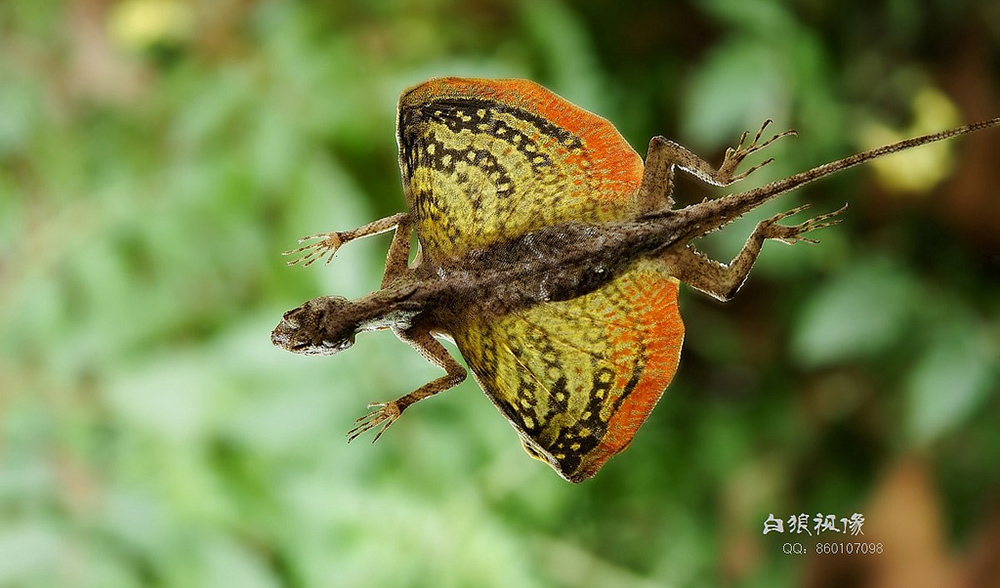
With a bit of redesign, the modern Flying Dragon lizard might be able to achieve true flight.
In most people’s books, Quetzalcoatlus northropi, with a wingspan of 10 m and a weight of 200 kg, would probably qualify as at least a small dragon. Slap on a couple of forelimbs in addition to the wings and lengthen the tail a bit and there you go.
Flying birds didn’t out-compete pterosaurs. The two groups co-existed for 50 million years. Pterosaurs became extinct at the end of the Cretaceous, but then again so did most groups of birds that were alive at that time.
As a means of breathing fire, this could work. As a means of reducing weight and making it easy to fly, forget it.
To illustrate this, consider an impossibly huge dragon, with the same volume as a large blue whale: 150 m[sup]3[/sup], of which a rather absurd 75% is devoted to chambers that can be filled with gas - only 25% is actual flesh and bones (yielding a mass around 35 tonnes).
Filling the chambers with hydrogen instead of air would reduce the effective weight of the dragon by the equivalent of 128 kg - or about 0.4%.
Where are my IR sensitive loreal pits, my electric organ and my luciferin/luciferase distraction system (1:08 in)?
The point isn’t that they occupy the same niches, the point is that they could occupy their niches with interchangeable wing structures. That is if creatures were designed like tinker toys (rather than evolved) you could have small bat-like critters with bird wings and you could have small bird-like critters with bat wings.
As noted multiple times up thread, anatomic and biochemical homologies provide some of the strongest evidence we have that evolution is a real natural process. Even if you destroy the fossil evidence, these pretty much seal the deal.
I agree that dragons could never fly because of science and physics but my point was that if you (the royal you, not you personally) are positing a Designer none of that matters. God could just will it. The fact that a dragon couldn’t fly is an argument against a designer.
Huh, what are those, modified ribs? Which presumably means that D. volans is losing out on some thorical rigidity in exchange for flight. Evolved creatures always have tradeoffs, that designed creatures wouldn’t need.
Yes, they are modified ribs. It would be tough to achieve powered flight with this design, since ribs don’t already have the joints and muscles needed for locomotion that legs do, but perhaps possible. It would be a lot easier if you could design from scratch and not have to repurpose ribs.
There were a number of flying lizards in the Mesozoic whose wings were not formed by the ribs themselves but by dermal rods extending from them. This design would seem to have more potential for evolving into powered flight (although it seems they never achieved it.)