Clovis hunters evidently used a detachable foreshaft on their spears.
I wouldn’t, however, refer to them as harpoons. Some harpoons also have detachable heads, but not all do.
Clovis hunters evidently used a detachable foreshaft on their spears.
I wouldn’t, however, refer to them as harpoons. Some harpoons also have detachable heads, but not all do.
In the tribal visitor’s center in Carmacks, Yukon, they had a diorama explaining the way their oral history said mammoths were hunted. There would be fences leading the mammoth to walk through a series of rope loops tied to trees that were partially cut down. The mammoth would break the tree all the way down and be left pulling several logs, slowing it down enough that people could then spear it.
As the oral history also reported that mammoths ate humans, I’ll let you decide how much to trust it.
Did the oral history include Ewoks, by any chance ? 
There’s actually no evidence of the Clovis people pushing the North American megafauna into extinction. There’s maybe a dozen mammoth kill sites in the USA (one has about a dozen very young mammoth, another has two, etc, compared with multiple sites each with hundreds if not thousands of kills in Europe, including those with the bones stacked like cordwood according to type. In some cases, they made homes from the bones
This was apparently done by traps and stampeding.
Climate change shrunk mammoth habitat extensively: (wiki)”A 2008 study estimated that changes in climate shrank suitable mammoth habitat from 7,700,000 km2 (3,000,000 sq mi) 42,000 years ago to 800,000 km2 (310,000 sq mi) 6,000 years ago.”
“The argument that human hunters were responsible for the extinction of a wide variety of large Pleistocene mammals emerged in western Europe during the 1860s, alongside the recognition that people had coexisted with those mammals. Today, the overkill position is rejected for western Europe but lives on in Australia and North America. The survival of this hypothesis is due almost entirely to Paul Martin, the architect of the first detailed version of it. In North America, archaeologists and paleontologists whose work focuses on the late Pleistocene routinely reject Martin’s position for two prime reasons: there is virtually no evidence that supports it, and there is a remarkably broad set of evidence that strongly suggests that it is wrong. In response, Martin asserts that the overkill model predicts a lack of supporting evidence, thus turning the absence of empirical support into support for his beliefs. We suggest that this feature of the overkill position removes the hypothesis from the realm of science and places it squarely in the realm of faith. One may or may not believe in the overkill position, but one should not confuse it with a scientific hypothesis about the nature of the North American past.”
However, some do think that the Mammoth was thus significantly declined in population, but Humans put the final nail in the coffin, so you may have a point:
http://www.plosbiology.org/article/info%3Adoi%2F10.1371%2Fjournal.pbio.0060079
Results show a dramatic decline in suitable climate conditions for the mammoth between the Late Pleistocene and the Holocene, with hospitable areas in the mid-Holocene being restricted mainly to Arctic Siberia, where the latest records of woolly mammoths in continental Asia have been found. The population model results also support the view that the collapse of the climatically suitable area caused a significant drop in mammoth population size, making the animals more vulnerable to increasing hunting pressure from expanding human populations. The coincidence of the collapse of climatically suitable areas and the increase in anthropogenic impacts in the Holocene are most likely to have been the “coup de grâce,” which set the place and time for the extinction of the woolly mammoth.
The Clan of the Cave Bear series has one or two descriptions of a mammoth hunt. Jean Auel reportedly tried to research that for accuracy.
The hit it in this spot.
it was difficult. they never did master doing calls and setting decoys.
Can you explain the difference, because I honestly don’t see it. What does “stocking up for winter” consist of if not storing food.
How is this not storing food?
Of course the plains Indians, by the time the Europeans encountered them, were virtually all herders, ie agriculturalists. And they were the descendants of people who had been agriculturalists for millennia.
The plains Indians who were actual HGS, as in no horses and who were probably the descendants of the original HGs, pushed out by the agriculturalists once they got horses, didn’t store food to the best of my knowledge.
What is that based on? Do we have any evidence of them doing so? Do we have any evidence of observed HG groups storing food in this manner?
It’s always very hard to know people did in the past. The only recent HG group hat stored food in any quantity that I am aware of were the village dwellers of the Pacific NW. Of course this was an anomalous group in an anomalous environment, descendant of agriculturalists and still practicing agriculture on a small scale. And we can assume that the incipient agriculturalists probably stored food while still HGs.
But do we have any evidence of full-time HGs storing food in the manner that you describe? As in preserving meat from individual kills to carry with them?
But they weren’t any more, were they ? They still did *some *agriculture on the side, but thanks to horses (which IIRC got to them before the Europeans, via trade with the more settled Indian nations of the east) they had found better living following the bison herds all around the place throughout the year, which mitigated the traditional issues of their previously more settled agricultural lifestyles, i.e. some years are bad, and those’re very bad.
But they didn’t really store or stockpile surplus food from one year to the next as purely agricultural+herding groups tend to do (precisely because some years are leaner than others) ; just enough to make it comfortably through the coming winter when it’d be too cold to be out hunting - because that’s all they needed. Soon as spring was back they’d be following bison again which would allow them to eat like kings once more, 100% of the years. And you can’t really take a grain/bean/squash storehouse with you when you’re being all horses and tents anyway, can you ? 
That’s how I read the distinction Colibri’s pointing out, at least.
I think that Blake somehow is trying to say that the Plains Indians were herders because they had herds of horses - and then further calling them agriculturalists because they were herders. Of course this not is the usual use of the word agriculturalist. The Plains Indians primarily hunted for their main source of the food, the buffalo, and so were hunter gatherers. They did not herd buffalo, even if they kept herds of horses for the purpose of hunting.
Of course if Blake is alleging that “stocking up for the winter” is the same as storing food then he’s wrong that hunter gatherers didn’t store food, because the Plains Indians certainly did so.
Regarding evidence that Clovis peoples stored and cached meat for use during the winter, see Paleo-Indian Winter Subsistence Strategies on the High Plains by George C. Frison, pp. 193-201 in this volume
Frison suggests that unlike the recent Plains Indians, who preserved meat for the winter by drying, Paleo-Indians cached frozen meat.
This is apparently how they did it.
http://66.147.244.222/~coachtw4/ridgehead/wp-content/uploads/2010/06/image.png
IIRC the plains Indians got horses from the south, via the Spanish. That was a lot easier than getting them over the Appalachians, and 100 year head start.
The plains Indians were nomads, following the buffalo herds. Agriculture was a waste of time if a herd 30 miles long was liable to wander across the fields, and the plains were subject to cyclical droughts that made crops unreliable. Raising domestic work animals (horses) does not make a people agriculturalists, and I don’t recall that eating horse was a common trait. Eating your workhorse (literally) would be as unthinkably desperate as eating your seed grain.
Explorers to untouched lands (i.e. Darwin at the Galapagos is a good example) describe animals unfamiliar with humans who do not recognize them as a threat. While birds or rodents might be numerous enough to survive long enough to acquire skittishness as a trait, the megafauna of the new world likely did not have the breeding cycles to select for caution before they were all slaughtered.
The fact that the animals were there when humans arrived and gone not long after - suggests there was at least a contribution to the result. The massive bone finds in Europe just mean that the animals over there were more cautions - like the other megafauna of Africa and Eurasia, the elephants and wildebeests that survive to today, they were cautions enough that they would survive until much larger human populations, and disappearing habitat did them in.
There were a lot of settled, agricultural people in the US Great Plains before the arrival of the horse. Mainly in the river valley areas. They outnumbered the nomadic tribes since farming could sustain a larger population. The introduction of the horse gave the nomadic people a huge advantage in terms of raiding ability and turned things around.
And HG doesn’t necessarily mean nomadic. The coastal tribes of the PNW lived a very fairly settled life and didn’t practice much agriculture. (They’d burn off areas where camas tubers would grow to keep the area forest-free and things like that.)
But even the Intermountain tribes would travel hundreds of miles to the Columbia to catch and smoke salmon which would be their principal food during the winter.
In addition to smoking food, Native Americans were also big on dried meats. It was a major ingredient in pemmican.
There are a lot of places in the western US where food of some type (fish, buffalo, nuts, shellfish, etc.) in a given area at a given time. People would show up, collect it and take it with them. No big deal.
Tribes in Idaho would send hunting parties east of the Rockies to hunt and bring back buffalo. While recorded in post-horse years, the traditional lore indicated it went on before the horse. So hauling large volumes of preserved mammoth around for months at a time is no biggie.
Palatable, good source of fat to avoid ‘rabbit sickness’ and vitamins - and a reasonably complete meal in a single greasy meaty fruity lump. We cheat and run unflavored ground beef jerky, tallow and fruit leather made of cranberries and strawberries through a meat grinder and form it into 2 oz pemmican pucks. They are great as a meal replacement though I do admit I really would not prefer to live on them entirely over the winter however they are more palatable than they sound. It really is a pity that Americans have gotten out of the whole fruit is never meant to go with meat mindset.
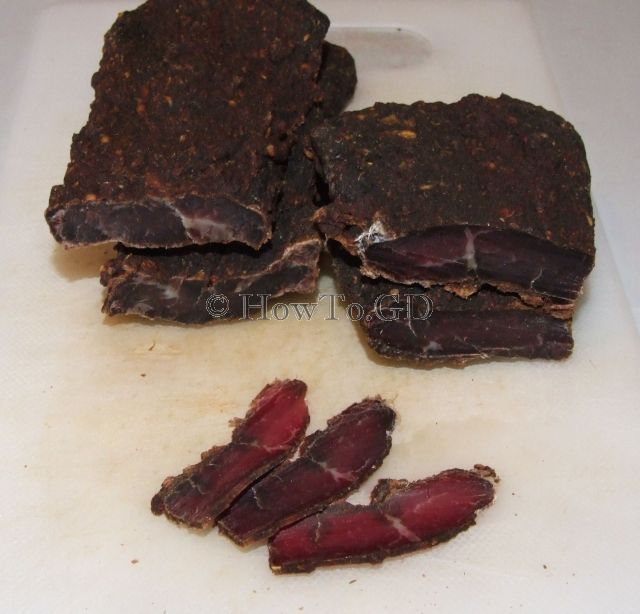
Nomads have a long tradition for preserving meat - bstirma is originally mongolian - a heavily spiced dried hunk of meat [beef, cow, yak, whatever] that could be turned into a rough stew by hacking off chunks and boiling them up in water. [I baffled a visitor because a bstirma looks like a slab of wood, they were wondering why I had a plank in my meat drawer:smack::p] Even a good meaty fish makes a nice plank of meat to store in a saddlebag. Air and sun drying, as well as smoking are a very natural first preservation technique - you dress out something and ride off with a slab of it hanging off your saddle, you end up with a nice sun and wind dried hunk of critter.
That is incorrect. The plains indians were mostly farmers who also hunted. The nomadic lifestyle of Indians such as the Lakota came later.
Just to be clear and to sum up what has been been said before, prior to direct European contact most Indian groups that lived on the Great Plains were agriculturalists who farmed in river valleys. After they acquired the horse, which happened before direct contact with Europeans, some became nomadic hunters following the buffalo herds (although some might have continued to farm on occasion). Others continued to farm in the more productive lands while also doing some hunting.
According to Wiki, the first group included the Blackfoot, Arapaho, Assiniboine, Cheyenne, Comanche, Crow, Gros Ventre, Kiowa, Lakota, Lipan, Plains Apache (or Kiowa Apache), Plains Cree, Plains Ojibwe, Sarsi, Nakoda (Stoney), and Tonkawa, and the second included the Arikara, Hidatsa, Iowa, Kaw (or Kansa), Kitsai, Mandan, Missouria, Omaha, Osage, Otoe, Pawnee, Ponca, Quapaw, Wichita, and the Santee Dakota, Yanktonai and Yankton Dakota.
Of course the popular image of Plains Indians is of the nomadic hunters, but they actually included a range of subsistence strategies.
However, Clovis peoples may have hunted mammoths more intensively over a shorter period of time. Saying there’s “no evidence” is misleading and not accurate.
[QUOTE=DrDeth]
Today, the overkill position is rejected for western Europe but lives on in Australia and North America. The survival of this hypothesis is due almost entirely to Paul Martin, the architect of the first detailed version of it. In North America, archaeologists and paleontologists whose work focuses on the late Pleistocene routinely reject Martin’s position for two prime reasons: there is virtually no evidence that supports it, and there is a remarkably broad set of evidence that strongly suggests that it is wrong. In response, Martin asserts that the overkill model predicts a lack of supporting evidence, thus turning the absence of empirical support into support for his beliefs. We suggest that this feature of the overkill position removes the hypothesis from the realm of science and places it squarely in the realm of faith. One may or may not believe in the overkill position, but one should not confuse it with a scientific hypothesis about the nature of the North American past.”
[/QUOTE]
This quote is misleading. As has been repeatedly pointed out to you, Paul Martin’s overkill (or “blitzkrieg”) hypothesis is only one model for the extinction of the megafauna by overhunting. While Martin’s specific hypothesis, which involves extremely intensive hunting over a relatively short period of time, has been largely discounted, that does not mean that persistent hunting by humans wasn’t the root cause of megafaunal extinction.
The extinction of the megafauna of the Americas took place over a comparatively short period of time, affected a wide variety of animals of different ecologies from mammoths to horse to giant ground sloths to glyptodonts, and took place in every climatic zone, from the Arctic to the temperate zones to the subtropics to tropical rainforests. It’s very unlikely that climate change would have had the same effect on all these species in all these different areas almost simultaneously, especially since climate had changed many times before during the Pleistocene without causing any such equivalent extinction. The one new factor the fauna had to deal with was hunting by humans.
The Plains Indians who transitioned into a nomadic type of HG lifestyle are probably not good guides as to how stone age HGs behaved. As they transitioned from agriculturalists to roaming nomads with horses, I doubt they forgot everything they and their people had learned from millenia of practicing agriculture. Stone Age humans who predate settled agricultural communities wouldn’t have the same cultural memory or learned skills as the Plains Indians.
I don’t know how much food storage Cro-Magnon era man engaged in or what techniques they used if any, but I don’t see any reason to assume the Plains Indians behaved exactly the same as humans that pre-dated settled agricultural society as a concept.
Or *under *your saddle. This may well be apocryphal of course, or the victors poo-pooing the enemy, but I clearly recall my childhood’s history classes teaching us how our Hunnic invaders would keep dried meat there between leather and horse, so that the friction and constant slapping would tenderize it over time without the need for human effort. Any truth to this ?
It makes sense to me, in any event - I never had *bstirma *but Bündnerfleisch really does have the consistency of a meat brick. It’s also really, really tasty. For optimum decadence (and teeth breakage) cut it into thin slices, possibly using a jackhammer, then wrap them around a cube or stick of old, bone-hard Parmeggiano. You now have the food of the Gods in your hand AND you’re all set to reach Mongolia on foot, dig until you reach Balrog or code through the whole week without leaving your desk :p.
True. I brought the Plains Indians into the discussion mainly to counter the assertion that hunter gatherers don’t store food. Because of the horse, the Plains Indians were far more mobile, could carry more supplies, and could use hunting techniques that were not available to Paleo-Indians. And of course, with regard to the OP, they rarely if ever hunted mammoths.
As I mentioned in post #50, evidence suggests that Paleo-Indians and Clovis peoples cached food for the winter by freezing it, rather than by drying it as Plains Indians did:
The well-knownMezhirich site in Ukraine, with its famous huts made out of mammoth bones, was inhabited by Cro-Magnons who may have stored meat supplies for the winter in pits at the site.