Usually I do not have to take a dump in an outhouse. Modern conveniences FTW
That is in the low range for room temperature, but I suppose it still counts as room temperature?
Usually I do not have to take a dump in an outhouse. Modern conveniences FTW
That is in the low range for room temperature, but I suppose it still counts as room temperature?
The whole point of hot food is it’s supposed to warm you up. That restaurant was negligent.
My perception is that, after women go through menopause, they very often become far more sensitive to the cold, even if it isn’t really COLD. If my SiL is over after I’ve gotten ready for bed, I’ll be on the couch in my nightshirt with no socks/slippers, and she’ll be fully clothed with my Afghan over her legs. This kind of discrepancy is the norm and, from what I’ve observed over time, she is norm.
I’m sort of the reverse. I find that I can get by outdoors wearing a sweatshirt in chilly weather that previously would have demanded at least a warm jacket.
I thought this thread was going to be about immediate reactions to intense heat and cold, where (in my case anyway) it’s far more likely that a very hot stimulus will cause immediate withdrawal.
That reminds of the time I was preparing my ritual Thursday night spaghetti dinner after work, and had heated a plastic container of homemade tomato sauce with meatballs in the microwave. When I removed the sauce, somehow an invisible mini-jet of superheated steam began escaping around the lid, causing me to believe that my hand was on fire, and to immediately fling the container away, accompanied by loud expostulations. While I was shaking my first-degree burned extremity and cursing, and Mrs. J. was investigating if I had been mortally wounded, I saw out of the corner of my eye that Bessie the Labrador was calmly lapping up sauce and meatballs from the floor and walls.
A fond memory.
We’ll, maybe you can’t. I can easily dress warmly enough to sit and enjoy a meal at 70°F. That’s often the temp in my kitchen in the winter. I wear jeans and a long sleeved cotton shirt, usually.
The coldest I had ever experienced was 48 degrees in San Antonio Texas. I could not get warm. I have been out at close to zero in Wisconsin and was fairly comfortable. I guess it was the humidity.
I’m in Ohio, and I don’t mind cold weather and winters. But about ten years ago I developed Raynaud’s syndrome for some reason. It sucks. Some of my fingers will turn white at even 50 °F, and I lose all feeling in them. Wish there was a cure for it.
Traditionally, Japanese houses were built to handle the heat and humidity, and people put up with the cold. Honshu doesn’t get as cold as Hokkaido.
When I was first here, we only used kerosene heaters in old homes without insulation. We also had kotasu, low tables with blankets and a heating element.
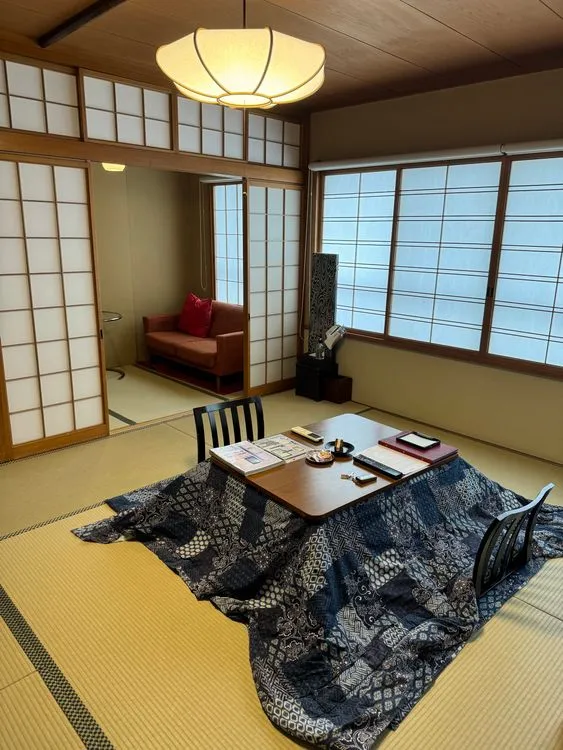
We would also wear hanten, Japanese winter coat featuring quilted cotton batting, three-quarter sleeves, a black sateen collar, and front ties. Wearing a hanten and sitting in a kotatsu keeps you pretty warm.

Kind of like this, but the ones I had were thicker and shorter.
Japanese homes generally don’t have central heating, even here in Hokkaido. We have a small space heater in the bathroom (the half bathroom with just the toilet).
Oh, and I hate the heat and the heat and humidity even worse. Which makes me wonder how I managed to live in Taiwan for 10 years.
In the summer i sometimes turn off the hearing element in my toilet seat, but i really like it in the winter.
It seems to me that it is in cities where it never gets that cold that you find homes without insulation, compared to cities where you know it is going to be below freezing in the winter.
My first winter was in Nagasaki, where the average low temperature in the winter is just above freezing, so it does get below that at times.
The first time Japanese building codes started requiring insulation was in the early 80s. The house I lived in at the time was already quite old and no insulation and the windows didn’t fit particularly well. Lots of drafts.