I will also go with not. I have been in ships engineering spaces when crossing a bar where the water is mixed with river water and sea water, running a low pressure evaporator can be difficult going out. With the water boiling and a good water level as leave the fresh water and start taking in sea water the boiling will increase because the water has more minerals and there can be carry over where the output from the evap is not useable. The procedure is lower the levels to the minimum safe levels and ass the bubbling increases decrease the feed water until everything settles out.
Coming in is easier just watch the levels and increase the feed water rate as the levels drop.
Another point is you never make drinking water while on a river only boiler water.
I think desalinization plants would be more economical than the arduous and inefficient process of capturing, purifying and shipping water.
You’d be surprised. Desalinization plants are incredibly expensive to build and maintain and have massive energy requirements.
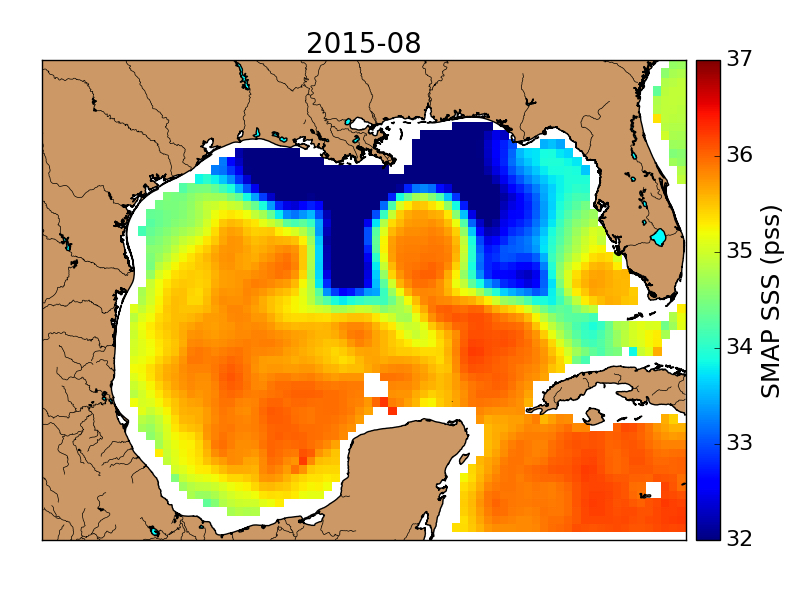
Here’s a NASA SMAP Sea Surface Salinity (SSS) map of the Gulf of Mexico:
This. Neal DeGrasse Tyson and many others have pointed out that it’s still far far more economical to ship bottled water halfway around the world than it is to desalinate it.
Desalinization consumes HUGE amounts of energy and produces TONS of waste salt that must be put somewhere. But putting it back into the ocean creates hypersaline areas that devastate the local environment. And big salt piles on land aren’t too conducive to a pleasant local environment either.
Probably new tech will bring down the price but it’s still going to be expensive as hell. But eventually fresh water may be in high enough demand to justify the process in many more locations.
I’m involved in the Mississippi River/Gulf of Mexico Hypoxia Task Force. Freshwater from the Mississippi stays on top of the salt water. The nutrients from the Miss. cause algal blooms in the summer which then die off and sink to the bottom. Bacteria proliferate and use up the oxygen. Due to the density gradient there’s no mixing between the two layers and the bottom goes hypoxic. The zone fluctuates but this year was a little below average at 4,200 square miles. It stretches well into Texas waters.
So I guess all that is to say that the effects of the freshwater go a long way but how far the water actually stays “fresh” is very dependent on weather and flow.
Yes, we do up here in Minnesota.
But we also dump our (treated) sewage into the river and send it down south.
I think your figures are off there.
1,000,000 gallons will weigh more like 8 million pounds. Even more expensive than you said.
“A pint’s a pound the world 'round.”
Wowsers … still under intense scrutiny after 11 years!
The error is explained by the context. I keyed one too many zeros in the second line. The missing comma sorta hints but yes it is a typo and an error of an order of magnitude.
And yes 1,000,000 US gallons will weigh more like 8 million pounds.
But on this side of the puddle back when we were using imperial units 1,000,000 (imp) gallons weighs 10 million pounds.
I’ve always heard the opposite, that salt water from the Gulf, travels up the Mississippi to make the mouth of the river undrinkable (a saltwater intrusion).
Depends on the volume of water that is coming out of the Mississippi River.
Here’s a link to a graph of the flow over the last year in Baton Rouge, LA,
(It might default to gage height, but it can be changed to discharge)
Over the last year it ranged from 965,000 cfs to 130,000 cfs. So at times it will push the saltwater out and other times the saltwater can intrude along the bottom due to the density gradient.