(LSLGuy types such long posts it’s a dead giveaway he’s steering the yoke between his knees. Just sayin’.)
Late edit: Here’s one major supplier of such training: http://www.cae.com/civil-aviation/commercial-aviation/
On another tab you can see their bizjet training offerings.
Actually trying to cook dinner without burning it. Wife says to knock this off and get it plated. Adios. 
There are some airlines that only hire type rated pilots. They don’t do this because they want pilots experienced on type, they do it so they can avoid the cost of training their pilots. You go to the interview and they say, “yep you’ll do, but you don’t have a type rating.” So you get a letter of offer conditional on you getting your own rating and you go and pay for their recommended provider to train you then you have a job. They’ve saved around 20-30K (AUD, US is cheaper as per LSLGuy) in training costs and the pilot has invested in furthering their career.
Many in the industry think this practice sucks but there will always be pilots who are desperate enough for the job that they’ll cough up the money. I received a phone call from an Airbus A320 operator several years ago suggesting that I update my online application with them. In this industry to actually have them call you out of the blue like that is basically guaranteeing at least an interview. I declined, primarily due to their pay to play employment scheme. If I had been out of work my attitude would likely have been different.
My point being that some things in the industry suck and you can go and get a type rating easily enough if you have the cash.
It’s a big balance between lifestyle, job security, and pay, with the relative importance of each changing throughout your life. When you are young you probably won’t meet any of those objectives, as you move up through the industry you’re probably primarily motivated by pay with job security playing a part as well. As you get older and build a family, life style becomes increasingly more important but you can’t really afford to trade off pay and job security, you just have to find the life-style improvements while maintaining the status quo in the other areas.
It is very rare to get all three. I work for the Australian division of a large international aviation company. In Australia we rely almost entirely on contract work. We have contracts to provide oceanic airborne surveillance for the government and to provide air search and rescue to another branch of the government. We also contract to a major airline to provide some of their regional passenger jet and freight services and have a number of mining charter contracts that involve flying mine workers from the capital cities to their operating mines.
On the whole I think the company has a broad enough contract base that it won’t get in any major trouble, but it is not easy to move between each contract. I fly mining charters and freight, if I wanted to move to the regional passenger jet contract I would have to apply externally and take my chances with everyone else from the street.
I have a good life style here, which is important to me, pay is adequate for the work I do, but job security is an issue as many of our contracts are only for a few years at a time so we are are always in the process of losing a contract here and gaining one there. It is not unusual to go from rumours of redundancies one week to a mad recruiting drive the next.
I don’t see myself moving to another company unless I’m forced to. I would only move to another aircraft within the company if it meant staying in the left seat or a major upgrade in type, e.g., I would consider the right seat if we added a B757 to our freight operation (which is a remote possibility). All going well the next 20 years of my career will involve one or two changes of aircraft type and perhaps a base change, all going well.
Check out the urban dictionary definition, at your own risk.
I’m assuming the aviation context comes from the act of moving the joystick (pole) around.
“poling” – I was picturing lazily maneuvering a plane around the airspace, like a Venetian gondolier.
I found this in anold (fun) thread, and I thought of what happens even if you have cash to burn for instruction.
“A fool and his money are soon …
flying more airplane than he can handle”
LSLGuy quoted it, with a near ninja by Broomstick.
Revived thread for a “and how about this” example which just hit me: so you’re an F-blank hot shot, maybe flown a ton of other planes, but none of them is one big giant flying wing.
If a modern F-nn pilot were handed the wheel of the B2, how would he react? I’m wondering what, if anything, would be immediately felt as … different…ie not in accord with his fixed wing reflexes…in handling and control because of the design.
How about a civilian airliner pilot?
Or any of the other pilots around the world, many of whom lurk in GQ?
My guess – real easy. It’s fly by wire. Assuming the pilot would recognize flaps throttles and landing gear controls, flying and landing should be a relative piece of cake.
Well, I’m following through with my new awareness of “where the wing is” as was re-(and re and re) expounded on why tipping a B52 over 90 degrees is a prop bet (heh, pun just came out).
I mean, even visually, looking to see your wing tilt must be a kick in the head for new B2 pilot.
Boyo nailed it in one. Modern aircraft fly pretty similarly. By design. You wouldn’t want to try doing something difficult the first time, like crappy weather, extreme crosswinds, etc.
But if the guy can figure out how to start it he can probably survive flying a traffic pattern on a nice day.
Some airplanes you can see your wings. Others you can’t. But you’re not flying by looking at them or thinking about where they are, at least not directly.
Right at touchdown and liftoff you have to be mindful that relatively small bank angles will drag a wingtip (or an underslung engine) in a long-winged airplane. And that relatively small pitch angles will drag the tail in a long-fuselaged airplane. Even in the relatively short-coupled F-16 it was possible to drag the lower speed brakes on the runway with too much nose-high during landing.
Emphasis mine
What about Mirage series of fighters? Are they similar to other Western fighters or more Soviet style?
Yes, it was exactly these kinds of things I was wondering about. And wondering where the hell a flying wing stood in the instinctive knowledge which most every pilot–being that most every pilot has never flown the B2 frame–associated with long wing/long fuselage/general-feel coupling reactions.
I’ve never sat in one but the pix available online make them look pretty familiar to anyone who’s flown similar western aircraft of the era. Recognizing that Mirage series extends from initial prototype first flight in 1955 to final production in the late 1970s and updates continuing into at least the 1990s. So spanning several generations of fighter cockpit tech.
The obvious challenge would be all the dial & switch labels in French. Although I suspect various export models came with English labels.
The point is that with fly-by-wire none of that matters. The computer can make an F-35 feel like (and fly like) a 787 or vice versa. Up to the point where structural strength or engine power become a limiting factor.
I’d bet a B-2 handles a lot like an Airbus. The differences will be in where the bank angle limit or G limit is set. Not in how they feel. I’ve not read anything which indicates the B-2 has any particular noxious habits or weak maneuverability in any axis. Unlike the WW-II era flying wings which had scary-bad handling characteristics or the B-52 which has weak maneuvering (low control power vs. high inertia).
We’re past the point where the gross shape implies much about the handling.
More on Mirages:
Here’s a Mirage IIIC in close to original 1960s fit. An F-100 pilot would be right at home & I and my contemporaries could recognize it’s similarity to trainers we’d flown: Dassault Mirage IIICJ - Argentina - Air Force | Aviation Photo #2026637 | Airliners.net
A new kid used to F-22s might be pretty lost in all that archaic arcana though.
OTOH, this upgraded Mirage 5 Dassault (SABCA) Mirage 5MA Elkan - Chile - Air Force | Aviation Photo #1886523 | Airliners.net looks about like an F-16C; slightly newer than my era, but I’d feel pretty at home here at least back when I was current.
I’d also expect an F-22 driver could make it work just fine. Though he’d be chuckling at the sheer primitivity of the thing.
Cool, thanks.
Here is ROSE Mirage cockpit. for comparison.

Here is a JF17 cockpit
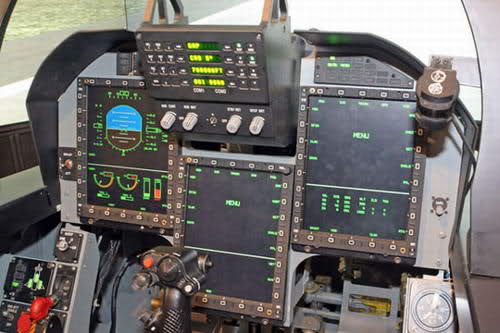
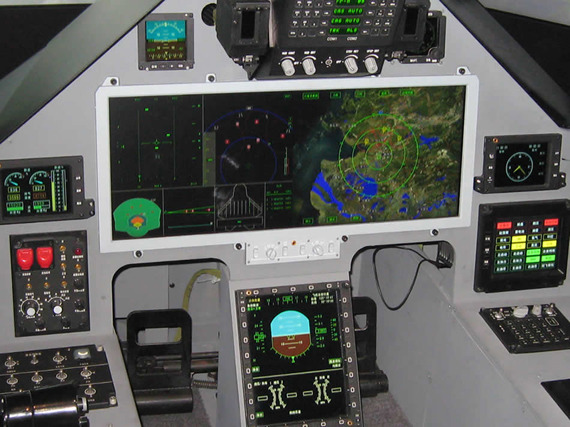

Would you be able to fly any/all of them? What about the F22 kid?
[Quick side question]
This is the cockpit/airplane of the air assault by the IDF in 1967, yes?
@AK84: All of those get pretty scary-looking to me. The F-22 driver would recognize at least the idea instantly.
The hard part is in the details. Maybe those computer screens just wake up in a fully useable form. If so all I need to do is start the damn thing.
Maybe there’s 10 minutes of key-stroking needed just to fly around the traffic pattern. If so that’s not very discoverable.
If you’ve ever rented a car you’ve no doubt noticed that operating the car is easy and standardized. Operating the radio or the climate control system is not so simple & standard though. And god forbid the damn thing have a GPS navigator. I swear no two of those have any UI logic in common.
Anyone who thinks computer UIs are necessarily “intuitive” never gave one to somebody with little background in computers. “Discoverablity” is the current ideal in UI design; it means you can explore in a semi-directed fashion and pretty soon find what you need. For flying the problem is we don’t have time to “discover”. Once we’re in motion we need to know. Easier to do when there’s 10 labeled toggle switches rather than when it’s 175 options under 5 different multi-layer menus on different screens.
Which comes back to the rental car analogy. If any jet driver can get it started and get the usual minimum instruments on some screen or another he could take it around the pattern and work the landing gear and flaps. Or just leave them hanging down.
After that it gets problematic; the more different aircraft and generations of aircraft the pilot has flown the more he can generalize. The more sophisticated / complex the aircraft, the less those generalizations are likely to take him very far into the rest of the machine’s capability space. At the same time the more sophisticated / complex the aircraft, the larger the capability space.
You’re wading ever less far into an ever deeper pool. Until you hit the limit case when you can’t even get in far enough to get wet.
The picture is of an Argentine air force aircraft. But yes, IDF flew similar aircraft in the 1967 war. I don’t know anything more specific than that. The earliest even semi-computerized airplanes were well after then, so the IDF aircraft would have differed at most in some details, not in the overall “flavor”.
That photo is of a very tired aircraft. It may be an unflyable derelict or a static display / museum bird. Or it may just be really tired and not getting any TLC as the Argentines slowly run it out of useful life.
Neat metaphor on a metaphor Mr. Don’t Post Metaphorically.
As yet another input to this discussion, a discussion from a few years ago on a USAF-specific forum I frequent revealed that USAF Thunderbirds pilots who were not originally F-16 pilots have a specific transition training syllabus to get qualified to fly the F-16. A week or so of classroom academics, a few simulator sessions, and about 30 hours in the jet to be qualified to fly the F-16. Note my use of the word “fly”; there’s a difference between “flying” and “operating” an advanced tactical jet. *Flying *implies that you can safely takeoff, land, and yank & bank the aircraft safely, whereas *operating *implies that you can fly the jet AND utilize the various systems to put steel on target in all conditions.
On a personal note, in the KC-10 sim I was able to takeoff, fly a visual pattern to a touch & go, then hand-fly vectors to a hand-flown ILS approach to a full-stop landing. It was ugly, I busted pattern altitude a few times (both high and low), and I definitely would have caused some maintenance inspections on the real thing… but I managed to do it. But, I also had around 2000hrs of watching the pilots do it, so I was a few steps ahead of a “What do you mean the steering wheel doesn’t turn the airplane on the ground?!?” non-pilot.