I’m having trouble picturing this. Lets say it is not a symmetrical wing and you are just supplying sufficient power to stay in the air. The air over the top* is still faster than the air under the bottom?
A stalled wing still produces lift, and the flow on the top is not necessarily moving more quickly–it may even be moving opposite to the flow on the bottom! Massively overpowered RC planes don’t care, as the Newtonian action on the bottom surface is enough to keep them flying.
Angle of attack is more powerful, generally, than wing shape.
Take a flat plate and hold it at a positive angle to the airflow and it will turn the flow downwards and create some lift. It will work the same upside down or right way up as it is symmetrical.
Shape the plate so it is curved over the top and flat or has a lesser curve at the bottom and it will create more lift for the same positive angle the original flat plate had. It is working more efficiently and you could get the same lift as before with less angle and therefore less drag.
Turn this new curved plate upside down and hold it at the same positive angle and you will get less lift or possibly none or zero lift. Increase the angle though and you can get the lift back. In this case the angle of attack is working against the wing shape, but angle of attack is king and for a normal wing shape you can get enough angle of attack to still make the wing work.
In the above example the air over the top (what used to be the bottom) is moving faster than the air over the bottom. You are having to use a large angle of attack to achieve this but it is still happening.
Make the wing curved but symmetrical and it will work the same upside down as it does right way up but will not be as efficient as the asymmetrical wing in either case.
Yes fair point. I’d have thought that the small amount of Newtonian action was not enough and that the additional lift was actually coming from the engine thrust though?
What about for wings in their normal angle of attack range?
A reasonable quesetion. Some RC planes can definitely just hover on pure engine thrust. But a plane flying with, say, a 45 degree AoA must have a reasonable contribution from the wing. The upforce from engine thrust is at the front of the plane; for the body to be at an angle requires a force further back, both from the wing and tail. This demands some vector diagrams :).
I’d posit that what you said is accurate for pure laminar flow. Also, I’d agree with the overall message that there’s no way to cleanly separate the different effects–Bernoulli is just a special case of Newton.
What’s certainly true is that if you covered the entire wing with pressure sensors, you could compute the exact amount of lift by integrating the vector contribution of each one. The question then is the best explanation for the varying pressure. I suspect that for laminar flow, the Bernoulli equation is exact and hence an adequate explanation. Newton of course always works but isn’t necessarily as intuitive.
Some very small creatures climb through the air exploiting its viscosity. Still an action/reaction thing, so technically similar to both jets and wings.
The Bernoulli effect is real, but it doesn’t mean what most people think it means. Bernoulli’s equation is just a way of re-writing Newton’s Second Law that’s easier to use with fluids (note that this is a definition of “easier” which includes calculus). The lift of an airplane is 100% due to air being accelerated downwards (call it “pushed” or “deflected” or whatever), as described by Newton’s laws and the Bernoulli equation.
What most people mean when they refer to the Bernoulli effect is actually called the Coanda Effect. Which is also real, and which is often relevant to some degree for wings, but is not usually a big deal.
As for wings where the air is not moving faster over the top surface, I can do one better than that: You can make a wing that doesn’t even have a top surface at all. Picture a wind tunnel with a hole cut in its top. Fit a large-cross-section piston into that hole. Cut the end of the piston at a bevel, such that the downwind side extends further into the wind tunnel than the upwind side. Blow air through the tunnel, and there will be a lift force on that piston pushing it out of the tunnel. It’ll probably be horribly inefficient, at least until you get up to supersonic speeds, but it’ll work, and produce nonzero lift at any speed.
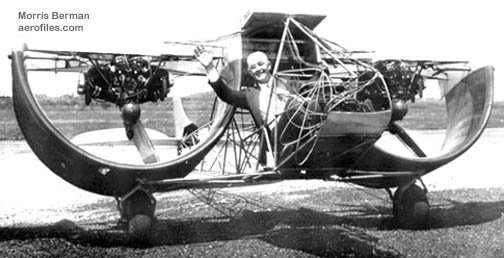
A plane like that was actually built. The engine nacelles and propellers sat in U shaped channels in the middle of each wing. It was able to lift vertically off the ground with some forward motion. It was much more of the traditional concept of Bernoulli’s principle creating low pressure above the wing.
Ok, I see what you mean. There are bottom surface optimized airfoils but what you describe sounds like the high angle of attack flight of supersonic planes at high altitude where the wing is just deflecting air downwards.
In that situation the propeller blades themselves serve as the wings, in that they are airfoil shapes deflecting air to produce a reaction force. No different than a helicopter or RC drone.
Differences in fluid densities … density is proportional to pressure … thus all the OP’s examples (except #6) can be explained by fluid motion to equalize it’s density. The airfoil “cutting” through the air creates higher density below (higher pressure) than above so the air pushes up on the airfoil. The hot air inside a balloon is less dense than outside (equal pressure) creating buoyancy.
As far as solar sails, I was not aware this has been demonstrated to actually work.
I have wondered if it were possible to create some kind of very light weight solar wings that simply absorbed heat on the top side that would concentrate with in the hollow wing itself and somehow use that heated air for thrust. I doubt you get get much perofrmance out of it and it might be more of a solar assisted glider. Watching the turbines of roof vents spin makes me think there might be some recoverable energy there.
Water is compressible, it just takes one hell of a force to do so. That same force is returned when we decompress. Certainly water obeys Bernoulli’s principle, so that can be used to describe 'foils behavior. I’m using density as the causative agent because hot air balloons have equal pressure inside and out, it’s only density that is different.