How much could a single person with an average salary save up per month in your city/state?

I make almost exactly the median income for my area at present. I manage to save about $200-400 a month. Some of that will be used over the course of a year for periodic expenses, like paying all my vehicle insurance in one payment instead of monthly (which gets me a discount) and vehicle maintenance, unexpected expenses, and so forth. I pay about $130 less than the median rent in this county (at least for now - we’ll see what happens when I renew my lease shortly).

Mostly, I just carefully consider any purchases I make. I don’t buy much, although when I do something like buy work shoes I spend about $140 on a pair, but that pair lasts me years instead of falling apart in a couple months (I took Vimes’ Boots to heart). My vehicles are fully paid for, a 2002 sedan and a 1999 pickup. I don’t much, but when I do buy I try to go for lasting quality rather than the absolute cheapest.

To be honest, though, quite a bit of my nest egg has been windfalls - like when the government sent us covid money that, still working full time, I didn’t really need, I parked it in a mutual fund that will be part of my hoped-for retirement. There have been a couple small inheritances.

But getting back to Sam Vimes and his boots - by valuing quality over cheapness there are many things I buy less often than many of my peers and over time that adds up. Most people don’t think that way, especially not in a culture than screams BUY! BUY! BUY! As part of that, I make very limited use of credit. I do have a credit card I use during the course of a month but it’s paid off at the end of the month because I hate paying interest. It’s a convenience, not an ATM. But that level of discipline is something I developed over time, it wasn’t something I had when I was 20.

Another thing is that I don’t desire some things my peers spend lots of money on - I don’t wear make up, I don’t purchase expense bath products, I don’t buy artificial nails, I don’t spend much on haircuts or styling. I don’t miss any of that, not really ever having desired it. Other women are quite different. Didn’t ever spend hundreds or thousands on extensive tattooing. I don’t buy an entire new wardrobe every season. Even when I had more money I never did any of that (no, I spent it on airplanes - so I am certainly capable of throwing money into the wind. Literally.)

And, like others have mentioned, I use my library a lot instead of buying books all the time (even if they are a favorite addiction) which is also useful for videos, too these days. I’ll go to the matinee/cheap show at the movies when I go to the movies, which is less than I used to. I’ve found a lot of ways in my life to be frugal without feeling deprieved.

TL/DR where I live it is possible for a single person with an average salary to save hundreds of dollars a month but very few do so.
Using numbers from the state comptroller and SOFI to get averages in Texas, a single person should be able to save $1445/month.

Average pay in Texas: $4781.00 per month
Average COL in Texas: $3305.00 per month

For the city (DFW) the numbers are different, on average residents should be able to save $1344.00 per month.
Average pay in DFW: $3557/month
Average COL in DFW: $2213/month

Still a respectable savings rate, but probably unrealistic given the personal realities that affect people. Nobody’s really average. Running those numbers in an FV calculation for 40 years will predict a fantastic retirement. But life doesn’t work that way, and most (I’d assume) don’t get to average until some midway point in their earnings life, so must save like crazy to achieve any sort of financial independence. And the FV calcs don’t take factor in black swan events (global or personal). It’s not uncommon for savings to be eviscerated due to an uncontrollable event.

To expand on “no one is average”:

The Census bureau says 15% of adults live alone–the vast majority live with a spouse or partners and/or children and/or parents. Both the average wages and average CoL you cite seems to be per capita across all sorts of households, even though I would expect CoL per capita to be much different for a household of 4 than a household of 1–and it would also make a difference if the other 3 were adults or children. Average CoL isn’t constructed to be “what it costs an adult to live”.

And of course there is some selection bias: higher earners may be more likely to not live with their parents, and people living with a partner will have lower housing costs.

Finally, your wage figures appear to be gross, not take-home, and average, not median. So the “average” wage earner in Dallas has a lower gross, and a much lower take-home than that.

I continue to hold that the way the OP framed the question is just not really a useful way to look at it.

I wonder if the best way to suggest savings goals shouldn’t be based on effective tax rate. Like, you should be putting your effective tax rate into long term savings, and then put that same number into short-term savings, or something like that? It’s at least a number that bakes in the idea that the % you can save rises with income and looks at households instead of individuals. On the other hand, it doesn’t take into account regional cost of living.

Nearly every older person I’ve known has benefitted from having some personal money to spend over and above medicaid. That would especially be true of people w/ a million bucks in the bank. I have a hard time imagining that someone with such savings would content themselves with zero care over and above what medicare provides. Not even medical supplement insurance?

But perhaps the many aged folk I have known are the exception rather than the rule.

They sure don’t.

I had retirement savings, a very expensive hobby (aviation), and was still saving several hundred a month when I was laid off in 2007, the start of the Great Recession. By the time I got back on my feet my savings AND retirement were both gutted to keep us from being homeless (except the pension, which I wasn’t old enough to collect, and social security, ditto). What I have now is what I’ve rebuilt since 2014.

If something like that hit me now I’m not sure I could recover in time to actually retire at some point, even though I’ve done everything “right” TWICE now.

I don’t think you appreciate the difference between what even a little private money can get you over what Medicaid would provide for long term care.

When I put my late spouse into such a facility I discovered that there were people in that place who never left their rooms because they didn’t have trousers or underwear. And guess what, Medicaid doesn’t pay for such things. No money? You live wrapped in a bedsheet unless some kind person or charity gives you clothes to wear. Or in one of those washed-a-thousand-times gowns you find in medical facilities. Yes, they have to provide what is necessary - key word necessary. You will have something to cover your nakedness, but it will be the bare minimum. You are guaranteed cover, but you are not guaranteed clothes as we normally think of them.

So, sure, don’t save anything and get your free end-of-life care. It’s better than sleeping in a cardboard box over a sewer grate, I guess. But you’re still better off if you’re not completely indigent. The penniless in long-term care are treated like prisoners at best.

Yeah I could be wrong. I don’t know if the medicaid limit is still $2000 in assets, but isn’t there a middle ground between being so destitute you can’t afford clothes, vs having to spend $10,000 a month on long term care?

Most people don’t spend very long in long term care. Median stay is only about 5-6 months, which is 50-60k.

But if you’re one of the outliers who spends years and years in a long term care facility, you don’t really have any options but to destroy your retirement nest egg, unless you’re willing to move to another country where LTC is more affordable. And moving a person in that condition isn’t easy.

Boy, I bought LTC insurance 7 years ago. We’re privileged to be able to afford the one-time $100,000 payment. It’s also a life insurance policy. Pay-out started at $12,000 a month 7 years ago (when needed) and goes up 6-7% a year until I die. It’s a hedge since I’m much more likely to die of a heart attack, but my wife has MS and definitely could not get insurance.

Sure, but it doesn’t last long.

I was “fortunate” (for some definitions of that term) that my spouse only required about a month in such a place and I was able to keep and eye on him and provide stuff he needed. People who don’t have such help are screwed.

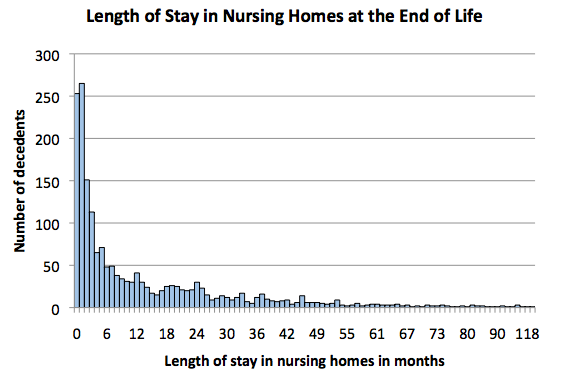
I’m not great at charts, and I’m not sure what the Y axis on yours really shows. But it looks to me like there is a BIG %/# of folk who spend less than 1/2 year in NHs, and anther pretty big %/# who spend 6-24 months there.

A million in the bank will buy you 8.3 years in. your $10k a month NH. (Actually more, w/ accrued interest.)

Well, how about we replace that with "Here in America, we always have hope, but we also suffer from recessions, depressions, big layoffs, companies changing hands, lack of raises that match inflation, and we still must make our mortgage/rent/electric/phone/medical bill payments regardless of our income status.

It hurts to be laid off at the same time that either inflation hits or the stock market takes a dive, slicing the amount of your retirement savings in half, but you still have to pay your bills as you search for jobs. Some people thrive and some people don’t. Some people have expensive medical issues and others don’t. It’s not all a matter of saving skills. Reality can bite hard sometimes.

It does seem very frustrating that you can’t hold anything back. Part of the reason people work hard and save is to leave their kids and grandkids something: the fact is, generational wealth DOES make a huge difference in people’s prospects, and if you benefited from it yourself, you tend to want to pass that on. And it doesn’t have to be a million for it to make a huge difference: $25k from my husband’s mother when we were in our mid-20s put us in a house a few years ahead of schedule, which has made a huge difference in our lives: it was that much cheaper to buy, and will be paid off that much sooner. I’d very much like to leave my son something, someday, and it does sorta sting that the randomness of needing long term care can destroy the savings of a lifetime for some.

Its like kids saving for college: financial aid calculations generally expect a kid to contribute 20% of personal assets to their education. If a kid has $100k they inherited, that seems fair. But it sorta burns that the poor kid who worked all through high hschool and saved up $10k will have their grants reduced by that much as a consequence.

I assumed the Y axis shows the number who spend X months in a long term care facility before death. Assuming the first line is <1 month, that would mean people who stay 0-6 months make up about 1000 currently dead people on that chart.

If you assume the average of the 7-24 months is 30 people per, thats about 540 for that crowd who die after 7-24 months. I could see months 25-118 adding up to barely 500, which again would fit the data. Months 54-118 for example are minimal.

Social Support is Key to Nursing Home Length of Stay Before Death | UC San Francisco.

The average age of participants when they moved to a nursing home was about 83. The average length of stay before death was 13.7 months, while the median was five months. Fifty-three percent of nursing home residents in the study died within six months.

Men died after a median stay of three months, while women died after a median stay of eight months. Married participants died a median four months sooner than those who were unmarried. Participants in the highest quartile of net worth died a median six months sooner than those in the lowest quartile.

You can simply buy your house (assuming you have the money), can’t you? Even if you buy it with a loan, you still pay it off eventually and then fully own it and not pay anything other than regular property/council tax. People in east Europe have 4-8 times smaller salaries than Americans, the price of property per square meter isn’t that different, but over 2/3 of people have their own homes, so if we can afford houses, anyone can.

Plus as you said, inheritance, when someone’s parents die, I doubt they leave the house to no one, in most of Europe it’s perfectly normal to leave your house to your kids, and if it’s a decent/renovated house, you can even leave it for a few generations, especially in city centers where it’s value is far above an apartment. The only thing you pay for it is the property tax.

For that reason it’s perfectly normal to have 30 olds and (rarely) even older adults live with their parents in the same house, especially if it’s a very large house in which families can live separately, in such a case it’s pointless to chase away a young 18 year old to their apartment two blocks away and waste money renting it, when he/she can still live in the house and spend the money on traveling or whatever nice things they can afford.

I’d bet the COL calculations are both conservative and limited, as in that COL is probably the absolute bare minimum to keep yourself fed, clothed, housed, and able to go back and forth to work.

But anything outside of that is going to cut into that $1344/month- any sort of non-essential groceries, things like phone plans, streaming services/cable TV, nicer clothes than that “average”, any eating out, any hobby type expenditures, and so forth.

My suspicion is that a single person making that $57k salary ends up using a fair bit more than that average COL in living like a “normal” person.

I’d bet the difference is in the down payment, not the monthly payment. The “classic” down payment is 20% of the value. So if the house you’re looking to buy is $200k, you’re looking at having to pay $40k in cash as a down payment, and you’re financing the other $160k. 40k is a tough nut to crack for many people, regardless of age. So there are other ways to do it that almost always involve smaller down payments, additional loans and higher interest rates on those. So you may do 5% down, finance $160k on one loan at a relatively low interest rate, and the remaining 15%(30k) on a shorter term, higher interest loan.

All these financial shenanigans mean that buying a house is something best done when you’ve been financially stable for a while and have saved up a substantial down payment. Which is almost certainly by design; loan companies want people who are stable and can pay regularly, etc…

But it does make it difficult if you’re not particuarly well paid- saving up a down payment for a home is typically a fairly long term thing- if you have $200 spare a month, you’re still looking at something like $16 years to accumulate a $40k down payment, assuming you don’t have to dip into that fund for other more immediate cash needs.

Yeah, I see that. But 1000 people out of what total? Usually I expect charts like that to show a percentage, or “per 1000”, etc.

Your numbers sound/look good. But I think some more complex calculations are needed. For the 30 per month living 7-24 months, don’t you need to multiply by the months in the facility? Are 2 people in the facility for 1 year the equal of one person in there for 6 months?

We have no idea where the prior poster’s parents were WRT assisted living. If they lived independently up to their last 2-6 months of their life, then their $1 mill would have been plenty. Or, did they live there for some time - perhaps one declined earlier than the other… And I really don’t know how to compare the quality of care during even a rapid/brief decline for someone solely dependent on Medicaid/are as opposed to supplemented by private resources. (Fodder of other threads but IMO, the care given at the VERY end of life, and people w/o DNRs is inexcusable.)

But there are many people who are in assisted living much longer than 6 months. Some common examples are “memory care.” They are just being warehoused. Or even young people w/ profound impairments. Some move in as part of their retirement, starting off pretty independent, and progressing thru until the hears hauls them away from the end of life unit. These folk can be there for years.

My impression is that there is a WORLD of difference between what sort of facility Medicaid covers, as opposed to Medicare - or LT insurance/private savings.

Sure. But in the US, someone earning $500/month is not going t be able to afford to buy anything more than a cardboard box under the viaduct. And discussing saving $50/month seems quite at odds w/ someone who owns their house free and clear.

Sure, if you are a single child, and your parents leave you your home, I get it. Or if you are living with your parents. I guess I didn’t get either of those images from your OP. I was assuming someone living independently. My mistake.

But in the US, making Federal minimum wage you’d be making at least $1160/mo for a full time job. You’re not making $500/mo unless you’re working 20 hrs/wk. Still not a lot of money, especially with taxes, social security and healthcare taken out. And around here (Middle TN), even fast food starts at about $12/hr. That’s about $2K gross.

StG

That’s assuming you actually have a full time job. Or that you full time job gives you 40 hours a week instead of 36 (very common) or even as low as 32.

I got confused - using the OP’s $500 figure but forgetting they were from E Eur. Whether it is $500 in E Eur or min wage in the US, I don’t think a huge percentage of such folk own their homes free and clear. Or are saving much on a regular basis.

Someone living with (and off of) their parents is a different situation.