I will bet the cheap printer paper will not last for hundreds of years.
It’s not supposed to, any more than newsprint paper.
** NO idea why my direct and full quote from Lumpy was deleted by the software in use here. I’m quoting their post just above mine.
With all due respect I must disagree.
My father was the Science Editor of a newspaper here in the United States. I have his entire clippings box. Filled with every single article printed by that paper. Starting in 1962. Common newsprint stock was used.
It’s 2026. That newspaper material is past the half-way point. It’s never been stored in extreme humidity, then again it’s never been stored in a controlled environment. It just sits there. First in my parents’ house in a closet. Now in my storage locker.
I could open up the box, lift out a bunch of newspapers and open the pages and read his articles. They are not browned, they are not crumbling, they are not brittle.
No reason to think that in another 36 years my son or daughter couldn’t open that box and lift out newspaper that can be handled and read.
Sorry. In this case my first-hand experience tells me you’re wrong.
If I were you, I’d still insure against anything happening to those clippings, like a burst pipe or some other disaster. At the very least, take good photos of them, or hire someone to do so, so you can store digital images.
Because the Discourse forum software removes full quotations of the immediate prior post. Because the designers of the software consider it redundant. And they’re adamant, and have been as long as Discourse has existed, and it can’t be diabled.
The paper in your link is 280 gsm (which, to me is a weird measurement - grams per square metre). The fountain pen paper that I like, Tomoe River, is made from eucalyptus wood pulp and is coated to give it its desired quality is either 52 gsm or 68 gsm.
Yes, it is a very thick, heavy paper. It needs to be to work with etching/intaglio, which involves pushing the paper into inked pits/grooves made in a zinc or copper plate. I’d be pretty surprised to receive a letter written on that weight of paper, unless my print making wife sent it to me.
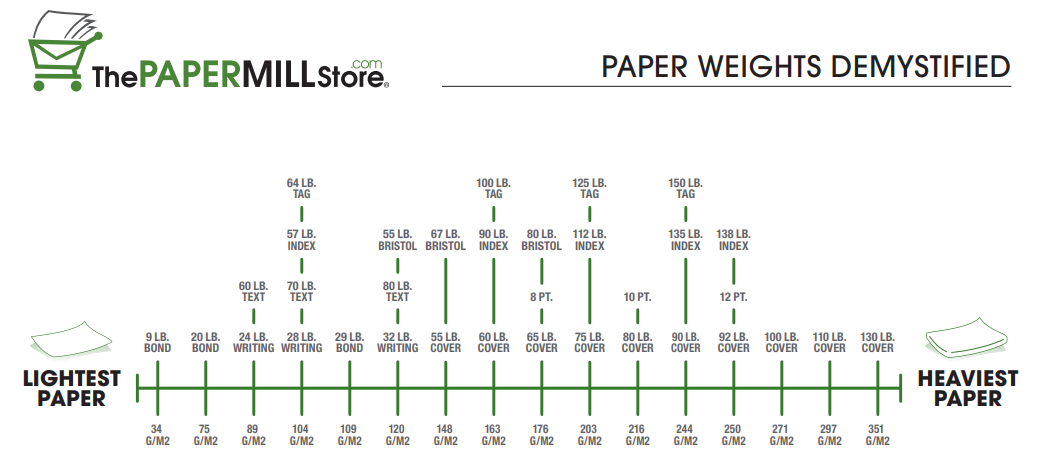
It has the advantage of being both metric and objective. When I was researching what weight cardstock to get for personalized greeting cards I discovered a bewildering array of different standards: “index”, “cover”, “text”, “bristol”, “bond” etc. Which all use the word “pound” in their description even though they’re completely different. The chart below gives you an idea.
THAT’D be sad. They’re sitting in a climate-controlled huge storage building. On the 2nd floor. This matters because before I claimed them from Mom’s house after Dad died, we rented a storage unit in the basement of this enormous former factory.
Superstorm Sandy’s violent surge pushed a delighful mélange of sea water, sewage, oil and refused violently up the East River and then up the Newtown Creek. That creek exists on the other side of a small berm from our storage place.
We lost everything but a few articles of clothing. It was pretty brutal. But, as we were slowly going through stuff once we were all allowed back in, plenty of other “tenants” were getting a first shot at their stuff.
Around the corner from us were a bunch of young men (20s). They were simply overwrought. All of their band instruments were completely destroyed. One guy stood there holding his guitar and case, crying.
So, yeah. The clippings are safe. I’ve considered trying to digitize them but to be honest, it’s thousands of items that are mostly on full-sized newspaper pages. I’m not sure how I’d go about it.
It is supposed to enable you to instantly calculate the weight of a sheet of paper: e.g. one 80 gsm A4 sheet is 80 × 2−4 = 5 grammes. There is no way to know how much a sheet of, say, 20# foolscap weighs without memorizing a bunch of stuff, and it may or may not be the same thickness as 20# of something else.
TIL there is a paper size A0 with dimensions of 84.1 cm × 118.9 cm (1 square metre).
Now it all makes sense.
Straight Dope column on paper sizes, including how the A0, A1, etc. sizes work.
The “A” paper standard is almost Vulcan in its mathematical logic.
As Cecil Adams said, “It’s a bit compulsive and you won’t be surprised to learn it was thought up by the Germans.”